Laboratory Workflow Determinants Affecting Glucose Integrity: A Secondary Analysis of Pre-Analytical Errors
DOI:
https://doi.org/10.68041/jbpt.v1i1/07Keywords:
Pre-analytical Errors, Glucose Estimation, Laboratory Diagnosis, In-Vitro Glycolysis, Quality Control, Diagnostic PathogenesisAbstract
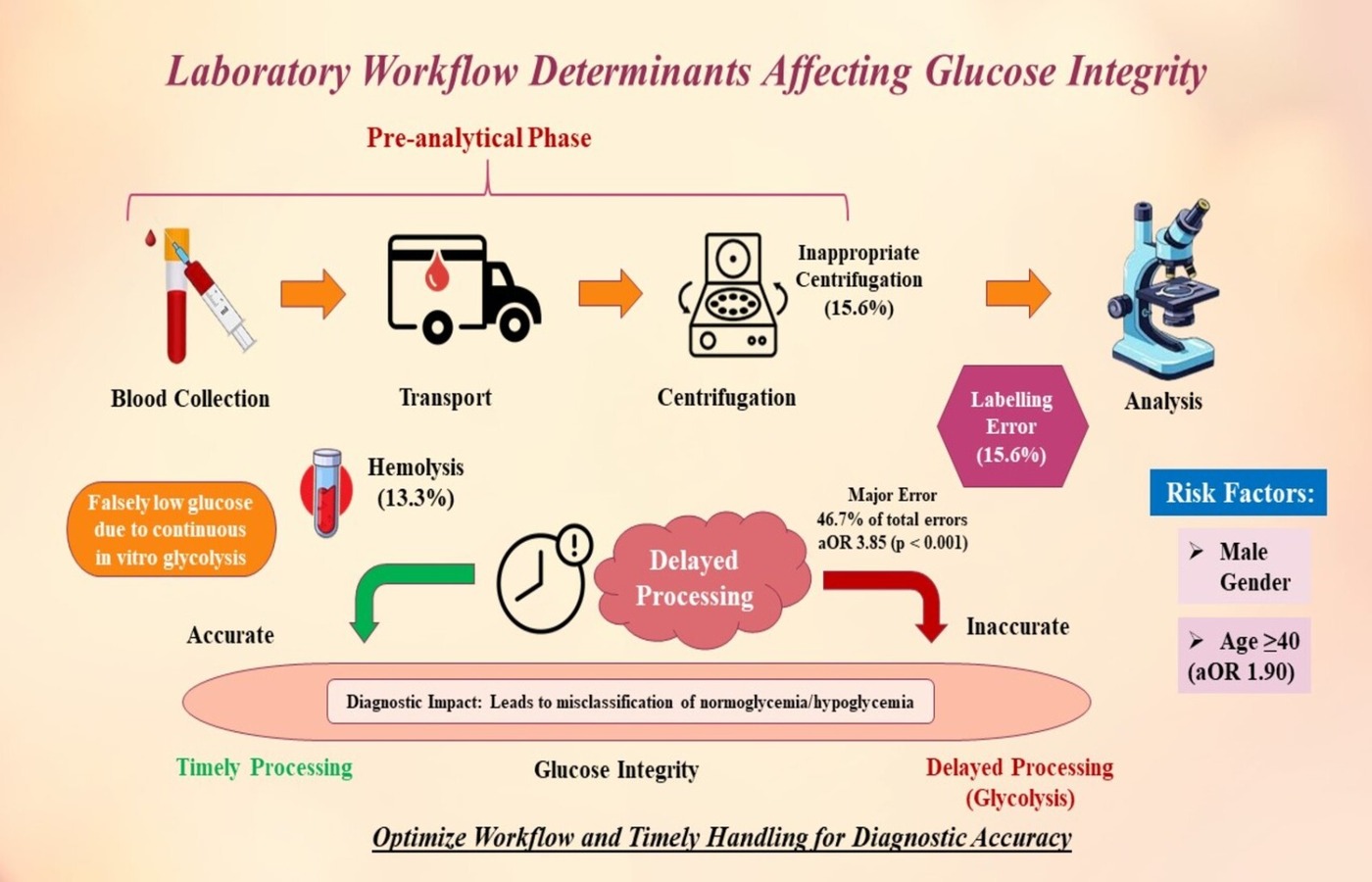
Background: Laboratory inaccuracies are mainly caused by pre-analytical errors, which have a major influence on the estimation of glucose. Continuous in vitro glycolysis contributes to glucose testing being very sensitive to specimen handling and processing delay particularly in a resource constrained environment. The purpose of this research was to establish the rate and predictors of pre-analytical errors in glucose tests, especially delayed specimen handling. Methods: The study (n=225) included venous blood samples obtained as routine glucose estimation and pre-analytical errors were evaluated including delayed handling, hemolysis, inadequate sample volume, improper centrifugation and labeling errors. Demographic variables were summarized in descriptive form. Chi-square tests were used to assess associations between age, gender and error occurrence, and binary logistic regression was used to determine independent predictors. The p-value below 0.05 was taken as statistically significant. Results: The average age of the participants was 40.72 years and females constituted 135 (60 %) of the group. In 45 (20%) of the samples, pre-analytical errors were found. The most common mistake was delayed specimen processing, which occurred in 9.3 % of the total number of samples and 46.7 % of the cases with an error. Higher error rates were significantly related to increasing age (≥40 years) and male gender. The independent predictors (aOR = 1.9; 95% CI: 1.1-3.3; p = 0.026) and delayed processing (p = 0.001) were confirmed using logistic regression. Conclusion: The major cause of pre-analytical errors in glucose testing was delay in processing of specimens and the age of patients also contributed to the presence of errors.
References
1. Tasneem A, Zubair M, Rasool Z, Tareen FZ. Frequency and types of pre-analytical errors in a clinical laboratory of a specialized healthcare hospital. Pak J Med Sci. 2024 Jan;40(2 ICON Suppl):S70–S74. https://doi.org/10.12669/pjms.40.2(ICON).8963 DOI: https://doi.org/10.12669/pjms.40.2(ICON).8963
2. Nordin N, Ab Rahim SN, Wan Omar WFA, Zulkarnain S, Sinha S, Kumar S, et al. Preanalytical errors in clinical laboratory testing at a glance: source and control measures. Cureus. 2024 Mar 30;16(3):e57243. https://doi.org/10.7759/cureus.57243 DOI: https://doi.org/10.7759/cureus.57243
3. John GK, Favaloro EJ, Austin S, Islam MZ, Santhakumar AB. From errors to excellence: the pre-analytical journey to improved quality in diagnostics. A scoping review. Clin Chem Lab Med. 2025 Jan 28;63(7):1243–1259. https://doi.org/10.1515/cclm-2024-1277 DOI: https://doi.org/10.1515/cclm-2024-1277
4. Al Sula KM, Almalki AM, Alzaidi HM, Alshanbar TA, Althobiti BH, Alharb YA, et al. A comprehensive review of errors in medical laboratories and strategies for improvement. J Int Crisis Risk Commun Res. 2024;7(Suppl 9):1902. https://doi.org/10.63278/jicrcr.vi.917
5. Lin Y, Spies NC, Zohner K, McCoy D, Zaydman MA, Farnsworth CW. Pre-analytical phase errors constitute the vast majority of errors in clinical laboratory testing. Clin Chem Lab Med. 2025 May 5;63(9):1709–1715. https://doi.org/10.1515/cclm-2025-0190 DOI: https://doi.org/10.1515/cclm-2025-0190
6. Alcantara JC, Alharbi B, Almotairi Y, Alam MJ, Muddathir ARM, Alshaghdali K. Analysis of preanalytical errors in a clinical chemistry laboratory: a 2-year study. Medicine (Baltimore). 2022 Jul 8;101(27):e29853. https://doi.org/10.1097/MD.0000000000029853 DOI: https://doi.org/10.1097/MD.0000000000029853
7. Li B, Cai X, Zhan L, Zhang X, Lin Y, Zeng J. Quality control circle practices to reduce specimen rejection rates. J Multidiscip Healthc. 2024 Oct 26;17:4925–4935. https://doi.org/10.2147/JMDH.S486276 DOI: https://doi.org/10.2147/JMDH.S486276
8. Sacks DB, Arnold M, Bakris GL, Bruns DE, Horvath AR, Lernmark Å, et al. Guidelines and recommendations for laboratory analysis in the diagnosis and management of diabetes mellitus. Diabetes Care. 2023 Oct 1;46(10):e151–e199. https://doi.org/10.2337/dci23-0036 DOI: https://doi.org/10.2337/dci23-0036
9. Coelho H, Silva F, Correia M, Rodrigues PM. Artificial intelligence in patient blood management: a systematic review of predictive, diagnostic, and decision support applications. J Clin Med. 2025 Nov 29;14(23):8479. https://doi.org/10.3390/jcm14238479 DOI: https://doi.org/10.3390/jcm14238479
10. Güner Y, Güner EK, Üçüncüoğlu M, Yüksel H. Evaluation of specimen rejection rates in the preanalytical phase and nurses’ experiences: a mixed design study. BMC Nurs. 2025 Jul 1;24(1):705. https://doi.org/10.1186/s12912-025-03426-w DOI: https://doi.org/10.1186/s12912-025-03426-w
11. Bhardwaj R, Agrawal U, Vashist P, Manna S. Determination of sample size for various study designs in medical research: a practical primer. J Fam Med Prim Care. 2024 Jul;13(7):2555–2561. https://doi.org/10.4103/jfmpc.jfmpc_1675_23 DOI: https://doi.org/10.4103/jfmpc.jfmpc_1675_23
12. Azocar González I, González-González ML, Sepúlveda Maturana F, Azocar González C, Ramírez-Pereira M. Pre-analytical errors in clinical laboratories: an integrative review. Enfermería Cuidados Humanizados. 2024 Dec;13(2):e21214. https://doi.org/10.22235/ech.v13i2.4223 DOI: https://doi.org/10.22235/ech.v13i2.4223
13. Dundar C, Bahadir O. Preanalytical errors in clinical biochemistry laboratory and relationship with hospital departments and staff: a record-based study. J Patient Saf. 2023 Jun 1;19(4):239–242. https://doi.org/10.1097/PTS.0000000000001115 DOI: https://doi.org/10.1097/PTS.0000000000001115
14. Piskunov DP, Danilova LA, Pushkin AS, Rukavishnikova SA. Influence of exogenous and endogenous factors on the quality of the preanalytical stage of laboratory tests (review of literature). Klin Lab Diagn. 2020 Dec 29;65(12):778–784. https://doi.org/10.18821/0869-2084-2020-65-12-778-784 DOI: https://doi.org/10.18821/0869-2084-2020-65-12-778-784
15. Ialongo C. Blood alcohol concentration in the clinical laboratory: a narrative review of the preanalytical phase in diagnostic and forensic testing. Biochem Med (Zagreb). 2024 Feb 15;34(1):010501. https://doi.org/10.11613/BM.2024.010501 DOI: https://doi.org/10.11613/BM.2024.010501
16. Zorbozan N, Zorbozan O. Evaluation of preanalytical and postanalytical phases in clinical biochemistry laboratory according to IFCC laboratory errors and patient safety specifications. Biochem Med (Zagreb). 2022 Oct 1;32(3):030701. https://doi.org/10.11613/BM.2022.030701 DOI: https://doi.org/10.11613/BM.2022.030701
17. Orhan B, Sonmez D, Cubukcu HC, Zengi O, Ozturk Emre H, Cinaroglu I, et al. The use of preanalytical quality indicators: a Turkish preliminary survey study. Clin Chem Lab Med. 2020 Oct 20;59(5):837–843. https://doi.org/10.1515/cclm-2020-1426 DOI: https://doi.org/10.1515/cclm-2020-1426
18. Giavarina D. The pre-analytical phase. In: Clinical and Laboratory Medicine. Cham: Springer International Publishing; 2024 Feb 22. p. 47–56. https://doi.org/10.1007/978-3-031-24958-7_6 DOI: https://doi.org/10.1007/978-3-031-24958-7_6
19. Gaikwad K, Selkar S. Evaluation of pre-analytical errors in clinical biochemistry laboratory of a tertiary care center in India. J Clin Basic Res. 2021 Dec 10;5(4):1–8. https://doi.org/10.61186/jcbr.5.4.1 DOI: https://doi.org/10.61186/jcbr.5.4.1
20. Alenezy NT, Arain SA, Omair A, Afnan R, Nadheef A, Ahmed AF, et al. Frequencies and causes of pre-analytical errors in a tertiary care hospital laboratory in Saudi Arabia. Ann Saudi Med. 2025 Nov–Dec;45(6):381–387. https://doi.org/10.5144/0256-4947.2025.381 DOI: https://doi.org/10.5144/0256-4947.2025.381
21. Thachil A, Wang L, Mandal R, Wishart D, Blydt-Hansen T. An overview of pre-analytical factors impacting metabolomics analyses of blood samples. Metabolites. 2024 Aug 28;14(9):474. https://doi.org/10.3390/metabo14090474 DOI: https://doi.org/10.3390/metabo14090474
22. Guo Y, Dai W, Jiang Y, Liu X. Analysis and actions after laboratory errors in a Chinese university hospital. BMC Health Serv Res. 2025 Oct 3;25(1):1296. https://doi.org/10.1186/s12913-025-13320-5 DOI: https://doi.org/10.1186/s12913-025-13320-5
23. Kazmierczak SC, Morosyuk S, Rajkumar R. Evaluation of preanalytical point-of-care testing errors and their impact on productivity in the emergency department in the United States. J Appl Lab Med. 2022 May 4;7(3):650–660. https://doi.org/10.1093/jalm/jfab158 DOI: https://doi.org/10.1093/jalm/jfab158
24. Lee L, Rankin W. Preparation for blood tests: what can go wrong before the sample reaches the lab. Aust Prescr. 2025 Aug;48(4):122–127. https://doi.org/10.18773/austprescr.2025.034 DOI: https://doi.org/10.18773/austprescr.2025.034
25. Hedayati M, Razavi SA, Boroomand S, Kheradmand Kia S. The impact of pre-analytical variations on biochemical analytes stability: a systematic review. J Clin Lab Anal. 2020 Dec;34(12):e23551. https://doi.org/10.1002/jcla.23551 DOI: https://doi.org/10.1002/jcla.23551
Downloads
Published
Issue
Section
License
Copyright (c) 2025 Asma Hafiz, Misbah Hafeez (Author)

This work is licensed under a Creative Commons Attribution-NonCommercial 4.0 International License.
Journal of Biomolecules, Pathogenesis and Therapeutics (JBPT) follows the Attribution Creative Commons-Non commercial (CC BY-NC 4.0) license which allows the users to copy and redistribute the material in any medium or format, remix, transform and build upon the material. The users must give credit to the source and indicate, provide a link to the license, and indicate if changes were made. However, the CC BY-NC 4.0 license restricts the use of material for commercial purposes (Further details are available at website. The Editorial Board of the JBPT endeavors to ensure the accuracy, integrity, and quality of all published content. However, the responsibility of opinions, interpretations, and conclusions expressed in the published articles rests entirely with the authors and do not necessarily reflect the views of the Editorial Board, publisher, or affiliated institutions.