Cognitive Behavioral Therapy Versus Antidepressant Medication in Generalized Anxiety Disorder: A Prospective & Novel Approach
DOI:
https://doi.org/10.68041/jbpt.v2i1/05Keywords:
Generalized Anxiety Disorder, Cognitive Behavioral Therapy, Antidepressants, SSRIs, GAD-7, Selective Serotonin Reuptake InhibitorsAbstract
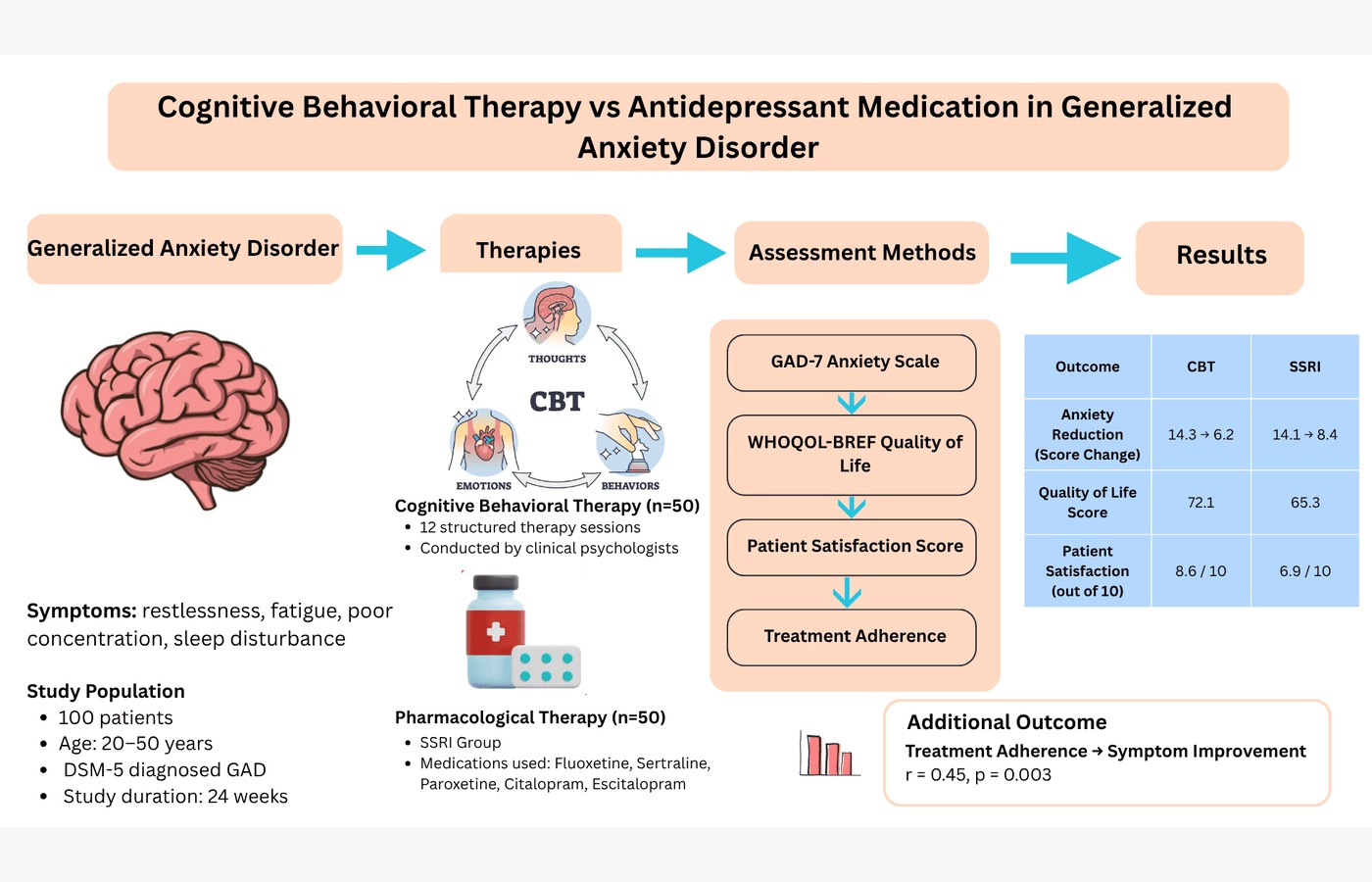
Background: Generalized Anxiety Disorder (GAD) is a condition which causes impairment in affected individuals. The conventional treatment includes the application of Cognitive Behavioral Therapy (CBT) or antidepressants. The prospective study compares the CBT and pharmacological therapy in terms of their effects on the reduction of symptoms and functional improvements. Methods: This prospective study (January to July 2024) included 100 individuals with GAD diagnosis, aged 20-50 years according to DSM-5 criteria. Respondents were put in two groups where a structured CBT therapy was administered during 12 weeks in one group and the other group received a standard dose of Selective Serotonin Reuptake Inhibitors. The symptoms, quality of life, and patient self-evaluation were measured using the GAD-7 scale before and after the intervention for comparative analysis. Paired t-tests, independent t-tests, correlation analysis, and estimation of effects size were used for statistical analysis. Results: The GAD-7 scores were significantly reduced in CBT group, and participants showed better performance in terms of functional activities and quality of life measurements (p = 0.02), with high levels of patient satisfaction. The data indicated that there was a moderate positive correlation between symptom reduction and treatment adherence (r = 0.45, p = 0.003). Conclusion: The CBT therapy showed better treatment results as compared to antidepressants in terms of patient satisfaction and functional outcome of the GAD treatment. The results indicated that CBT therapy should be applied as a primary treatment with integration of research into personal treatment plans covering symptoms of anxiety.
References
1. Ibrahim D, Ahmed RM, Mohammad AZ, Ibrahim B, Mohammed T, Mohamed ME, et al. Prevalence and correlates of generalized anxiety disorder and perceived stress among Sudanese medical students. BMC Psychiatry. 2024;24(1):68. https://doi.org/10.1186/s12888-024-05510-y
2. Sun J, Sarfraz M, Ivascu L, Iqbal K, Mansoor A. How did work-related depression, anxiety, and stress hamper healthcare employee performance during COVID-19? The mediating role of job burnout and mental health. Int J Environ Res Public Health. 2022;19(16):10359. https://doi.org/10.3390/ijerph191610359
3. Newman MG, Basterfield C, Erickson TM, Caulley E, Przeworski A, Llera SJ. Psychotherapeutic treatments for generalized anxiety disorder: cognitive and behavioral therapies, enhancement strategies, and emerging efforts. Expert Rev Neurother. 2022;22(9):751–770. https://doi.org/10.1080/14737175.2022.2125800
4. Murphy SE, Capitão LP, Giles SLC, Cowen PJ, Stringaris A, Harmer CJ. The knowns and unknowns of SSRI treatment in young people with depression and anxiety: efficacy, predictors, and mechanisms of action. Lancet Psychiatry. 2021;8(9):824–835. https://doi.org/10.1016/S2215-0366(21)00154-1
5. Fagan HA, Baldwin DS. Pharmacological treatment of generalised anxiety disorder: current practice and future directions. Expert Rev Neurother. 2023;23(6):535–548. https://doi.org/10.1080/14737175.2023.2211767
6. Boschloo L, Hieronymus F, Cuijpers P. Clinical response to SSRIs relative to cognitive behavioral therapy in depression: a symptom-specific approach. World Psychiatry. 2022;21(1):152–153. https://doi.org/10.1002/wps.20944
7. Pinho LGd, Lopes MJ, Correia T, Sampaio F, Arco HRd, Mendes A. Patient-centered care for patients with depression or anxiety disorder: an integrative review. J Pers Med. 2021;11(8):776. https://doi.org/10.3390/jpm11080776
8. Bernstein EE, Phillips KA, Greenberg JL, Curtiss J, Hoeppner SS, Wilhelm S. Mechanisms of cognitive-behavioral therapy effects on symptoms of body dysmorphic disorder: a network intervention analysis. Psychol Med. 2023;53(6):2531–2539. https://doi.org/10.1017/S0033291721004451
9. Chernoff RA, Messineo G, Kim S, Pizano D, Korouri S, Danovitch I. Psychosocial interventions for patients with heart failure and their impact on depression, anxiety, quality of life, morbidity, and mortality: a systematic review and meta-analysis. Psychosom Med. 2022;84(5):560–580. https://doi.org/10.1097/PSY.0000000000001073
10. Stein DJ, Craske MG, Rothbaum BO, Kessler RC, Ruscio AM, Chiu WT. The clinical characterization of the adult patient with an anxiety or related disorder aimed at personalization of management. World Psychiatry. 2021;20(3):336–356. https://doi.org/10.1002/wps.20919
11. Singha SP, Memon S, Kazi SAF, Nizamani GS. Gamma aminobutyric acid signaling disturbances and altered astrocytic morphology associated with Bisphenol A induced cognitive impairments in rat offspring. Birth Defects Res. 2021;113(12):911–24. https://doi.org/10.1002/bdr2.1886
12. Singha SP, Memon S, Bano U, Isaac AD, Shahani MY. Evaluation of p21 expression and related autism-like behavior in Bisphenol-A exposed offspring of Wistar albino rats. Birth Defects Res. 2022;114(11):536–50. https://doi.org/10.1002/bdr2.2022
13. Mujahadah H, Ambarini TK, Juwita A. Cognitive-behavioral therapy for reducing anxiety symptoms and improving life satisfaction in young adults with generalized anxiety disorder: a case report. Procedia: Studi Kasus dan Intervensi Psikologi. 2025;13(1):20–32. https://doi.org/10.22219/procedia.v13i1.35913
14. Minjie Z, Zhijuan X, Xinxin S, Xinzhu B, Shan Q. The effects of cognitive behavioral therapy on health-related quality of life, anxiety, depression, illness perception in patients with atrial fibrillation: a six-month longitudinal study. BMC Psychol. 2023;11(1):431. https://doi.org/10.1186/s40359-023-01457-z
15. Southam-Gerow MA, Chapman JE, Martinez RG, McLeod BD, Hogue A, Weisz JR, et al. Are therapist adherence and competence related to clinical outcomes in cognitive-behavioral treatment for youth anxiety? J Consult Clin Psychol. 2021;89(3):188–199. https://doi.org/10.1037/ccp0000538
16. Peng Y. Impact factors and treatments for generalized anxiety disorder. InSHS Web Conf. 2024;193:03011. https://doi.org/10.1051/shsconf/202419303011
17. Naveen V, Felic SV, Aswin A, Arul PK. A review on current understanding, clinical manifestations, and therapeutic approaches of anxiety disorders. J Pharma Insights Res. 2024;2(5):173–181. https://doi.org/10.69613/xy1yek24
18. Strawn JR, Mills JA, Suresh V, Peris TS, Walkup JT, Croarkin PE, et al. Combining selective serotonin reuptake inhibitors and cognitive behavioral therapy in youth with depression and anxiety. J Affect Disord. 2022;298:292–300. https://doi.org/10.1016/j.jad.2021.10.047
19. Jia Y, Xu Z, Yang J, Chai J, Li W, Xu H, et al. Comprehensive evaluation of the efficacy and patient acceptance of combined antidepressant and cognitive behavioral therapy in the treatment of post-traumatic stress disorder. Front Psychiatry. 2025;16:1737322. https://doi.org/10.3389/fpsyt.2025.1737322
20. Boschloo L, Hieronymus F, Lisinski A, Cuijpers P, Eriksson E. The complex clinical response to selective serotonin reuptake inhibitors in depression: a network perspective. Transl Psychiatry. 2023;13(1):19. https://doi.org/10.1038/s41398-022-02285-2
21. Wen A, Wei Z, Zhang S, Ma J, Zhang Y, Li Y, et al. Cognitive behavioral therapy combined with escitalopram in the treatment of senile depression. Asian J Psychiatr. 2025;107:104384. https://doi.org/10.1016/j.ajp.2025.104384
22. Stiede JT, Trent ES, Viana AG, Pina AA, Cervantes P, Martinez R. Cognitive behavioral therapy for children and adolescents with anxiety disorders. Child Adolesc Psychiatr Clin N Am. 2023;32(3):543–558. https://doi.org/10.1016/j.chc.2022.12.001
23. Mazziotti R, Rutigliano G. Tele-mental health for reaching out to patients in a time of pandemic: provider survey and meta-analysis of patient satisfaction. JMIR Ment Health. 2021;8(7):e26187. https://doi.org/10.2196/26187
24. Bovendeerd B, de Jong K, de Groot E, Moerbeek M, de Keijser J. Enhancing the effect of psychotherapy through systematic client feedback in outpatient mental healthcare: a cluster randomized trial. Psychother Res. 2022;32(6):710–722. https://doi.org/10.1080/10503307.2021.2015637
25. López-Pinar C, Rosen H, Selaskowski B, Staerk C, Jans T, Retz W, et al. Exploring the relationship between adherence to therapy, treatment acceptability, and clinical outcomes in adults with attention-deficit/hyperactivity disorder: results from the COMPAS multicenter randomized controlled trial. Psychother Psychosom. 2024;93(1):46–64. https://doi.org/10.1159/000532043
26. Alexandersson K, Wågberg M, Ekeblad A, Holmqvist R, Falkenström F. Session-to-session effects of therapist adherence and facilitative conditions on symptom change in CBT and IPT for depression. Psychother Res. 2023;33(1):57–69. https://doi.org/10.1080/10503307.2022.2025626
27. Seittu HA, Falk T, Bhatnagar K, Saarni SE. Therapists’ role in patient adherence to internet-based cognitive behavioral therapy: qualitative study. J Med Internet Res. 2025;27:e71852. https://doi.org/10.2196/71852
28. Ghafoor A, Kashif S, Ali SMS, Memon S, Memon SS, Mehmood A, et al. Evaluating neurotherapeutic potential of naringenin by true experiments: insights into in-vivo psychiatry care models. Pak J Med Dent. 2025;14(3). https://doi.org/10.36283/ziun-pjmd14-3/043
Downloads
Published
Issue
Section
License
Copyright (c) 2026 Faiza Ehsan, Zafar Junaid (Author)

This work is licensed under a Creative Commons Attribution-NonCommercial 4.0 International License.
Journal of Biomolecules, Pathogenesis and Therapeutics (JBPT) follows the Attribution Creative Commons-Non commercial (CC BY-NC 4.0) license which allows the users to copy and redistribute the material in any medium or format, remix, transform and build upon the material. The users must give credit to the source and indicate, provide a link to the license, and indicate if changes were made. However, the CC BY-NC 4.0 license restricts the use of material for commercial purposes (Further details are available at website. The Editorial Board of the JBPT endeavors to ensure the accuracy, integrity, and quality of all published content. However, the responsibility of opinions, interpretations, and conclusions expressed in the published articles rests entirely with the authors and do not necessarily reflect the views of the Editorial Board, publisher, or affiliated institutions.