Normalizing the Abnormal: Is Remodeling the TME the Next Frontier in Cancer Care Therapy?
DOI:
https://doi.org/10.68041/jbpt.v2i2/02Keywords:
Tumor Microenvironment, Angiogenesis, Immunotherapy, Tumor Hypoxia, Extracellular MatrixAbstract
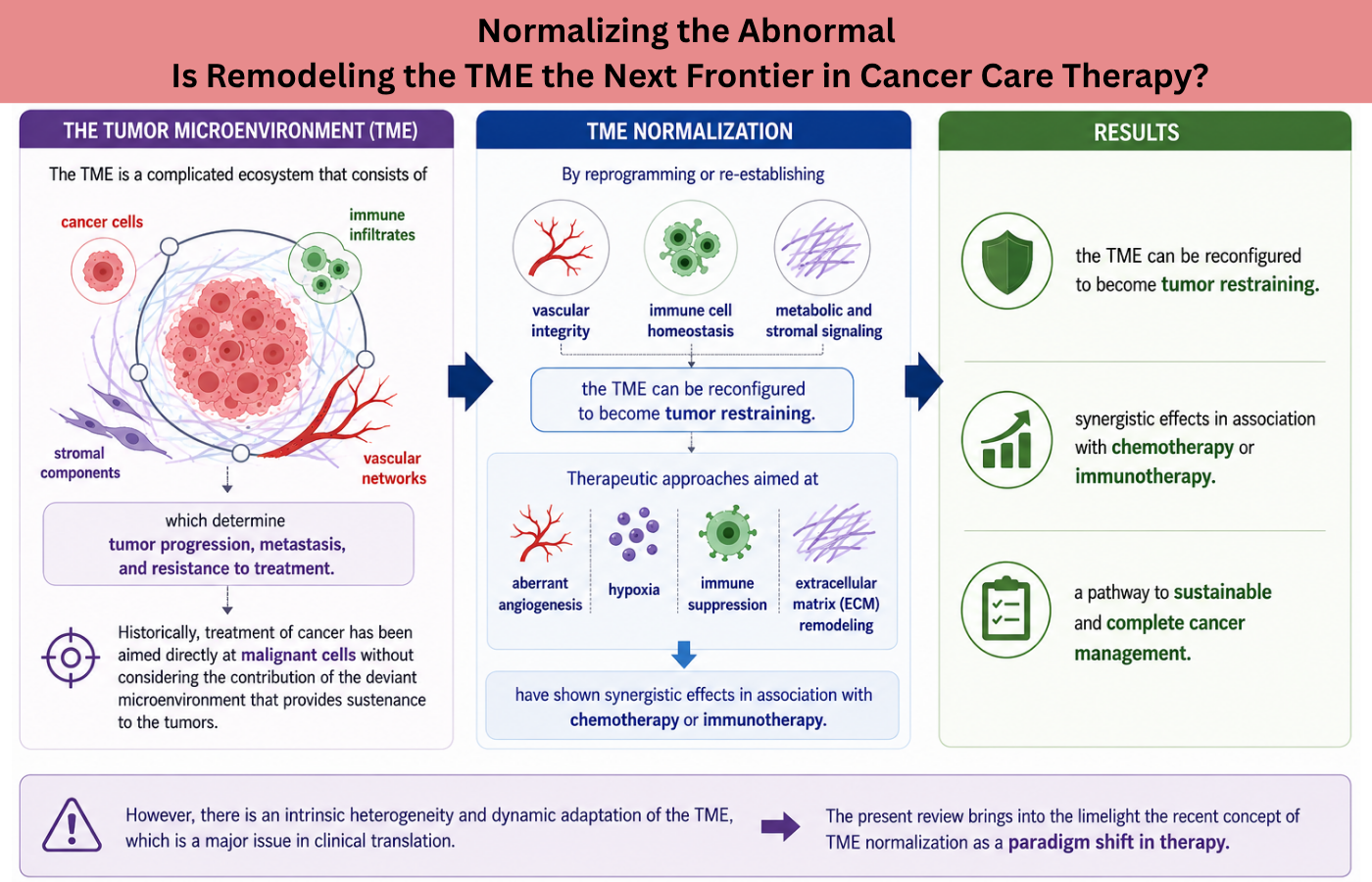
The Tumor Microenvironment (TME) is a complicated ecosystem that consists of cancer cells, stromal components, immune infiltrates, and vascular networks, which determine tumor progression, metastasis, and resistance to treatment. Historically, the treatment of cancer has been aimed directly at malignant cells without considering the contribution of the deviant microenvironment that provides sustenance to the tumors. Recent observations have highlighted that by reprogramming or re-establishing vascular integrity, immune cell homeostasis, and metabolic and stromal signaling, the TME can be reconfigured to become tumor restraining. Different therapeutic approaches that are aimed at aberrant angiogenesis, hypoxia, immune suppression, and extracellular matrix (ECM) remodeling have shown synergistic effects in association with chemotherapy or immunotherapy. There is, however, an intrinsic heterogeneity and dynamic adaptation of the TME, which is a major issue in clinical translation. The present review brings into the limelight the recent concept of TME normalization as a paradigm shift in therapy, which offers a pathway to sustainable and complete cancer management.
References
1. Piwocka O, Piotrowski I, Suchorska WM, Kulcenty K. Dynamic interactions in the tumor niche: how the cross-talk between CAFs and the tumor microenvironment impacts resistance to therapy. Front Mol Biosci. 2024;11:1343523. https://doi.org/10.3389/fmolb.2024.1343523
2. Xiao Y, Yu D. Tumor microenvironment as a therapeutic target in cancer. Pharmacol Ther. 2021;221:107753. https://doi.org/10.1016/j.pharmthera.2020.107753
3. Glaviano A, Lau HS-H, Carter LM, Lee EHC, Lam HY, Okina E, et al. Harnessing the tumor microenvironment: targeted cancer therapies through modulation of epithelial-mesenchymal transition. J Hematol Oncol. 2025;18:6. https://doi.org/10.1186/s13045-024-016
4. Ciepła J, Smolarczyk R. Tumor hypoxia unveiled: insights into microenvironment, detection tools and emerging therapies. Clin Exp Med. 2024;24:235. https://doi.org/10.1007/s10238-024-01501-1
5. Prakash J, Shaked Y. The interplay between extracellular matrix remodeling and cancer therapeutics. Cancer Discov. 2024;14:1375–88. https://doi.org/10.1158/2159-8290.CD-24-0002
6. Haist M, Stege H, Grabbe S, Bros M. The functional crosstalk between myeloid-derived suppressor cells and regulatory T cells within the immunosuppressive tumor microenvironment. Cancers. 2021;13:210. https://doi.org/10.3390/cancers13020210
7. Zheng R, Li F, Li F, Gong A. Targeting tumor vascularization: promising strategies for vascular normalization. J Cancer Res Clin Oncol. 2021;147:2489–505. https://doi.org/10.1007/s00432-021-03701-8
8. Horkova V, Everts B, Brenner D. Blocking lactate: kick T cells when they are down. Immunometabolism. 2025;7:e00059. https://doi.org/10.1097/IN9.0000000000000059
9. Qian C, Liu C, Liu W, Zhou R, Zhao L. Targeting vascular normalization: a promising strategy to improve immune–vascular crosstalk in cancer immunotherapy. Front Immunol. 2023;14:1291530. https://doi.org/10.3389/fimmu.2023.1291530
10. Qian C, Liu C, Liu W, Zhou R, Zhao L. Targeting vascular normalization: a promising strategy to improve immune–vascular crosstalk in cancer immunotherapy. Front Immunol. 2023;14:1291530. https://doi.org/10.3389/fimmu.2023.1291530
11. Xu M, Zhang T, Xia R, Wei Y, Wei X. Targeting the tumor stroma for cancer therapy. Mol Cancer. 2022;21:208. https://doi.org/10.1186/s12943-022-01670-1
12. Xu M, Zhang T, Xia R, Wei Y, Wei X. Targeting the tumor stroma for cancer therapy. Mol Cancer. 2022;21:208. https://doi.org/10.1186/s12943-022-01670-1
13. Zheng J, Gao P. Toward normalization of the tumor microenvironment for cancer therapy. Integr Cancer Ther. 2019;18:1534735419862352. https://doi.org/10.1177/1534735419862352
14. Gao Q, Wu H, Duan L, Lv G, Quan D. Multi-omics analysis of the tumor microenvironment after metastasis: advancing toward personalized immunotherapy and molecular targeted strategies. Front Immunol. 2025;16:1648987. https://doi.org/10.3389/fimmu.2025.1648987
15. OpenAI. ChatGPT (GPT-4o) [Computer Software]. 2026 [cited 2026 Jun 1]. Available from: https://chatgpt.com
Published
Issue
Section
License
Copyright (c) 2026 Asma Ali (Author)

This work is licensed under a Creative Commons Attribution-NonCommercial 4.0 International License.
Journal of Biomolecules, Pathogenesis and Therapeutics (JBPT) follows the Attribution Creative Commons-Non commercial (CC BY-NC 4.0) license which allows the users to copy and redistribute the material in any medium or format, remix, transform and build upon the material. The users must give credit to the source and indicate, provide a link to the license, and indicate if changes were made. However, the CC BY-NC 4.0 license restricts the use of material for commercial purposes (Further details are available at website. The Editorial Board of the JBPT endeavors to ensure the accuracy, integrity, and quality of all published content. However, the responsibility of opinions, interpretations, and conclusions expressed in the published articles rests entirely with the authors and do not necessarily reflect the views of the Editorial Board, publisher, or affiliated institutions.