Artificial Intelligence in Tumor Microenvironment Research: Hype, Hope, or Both?
DOI:
https://doi.org/10.68041/jbpt.v1i1/01Keywords:
Artificial Intelligence, Tumor Microenvironment, Deep LearningAbstract
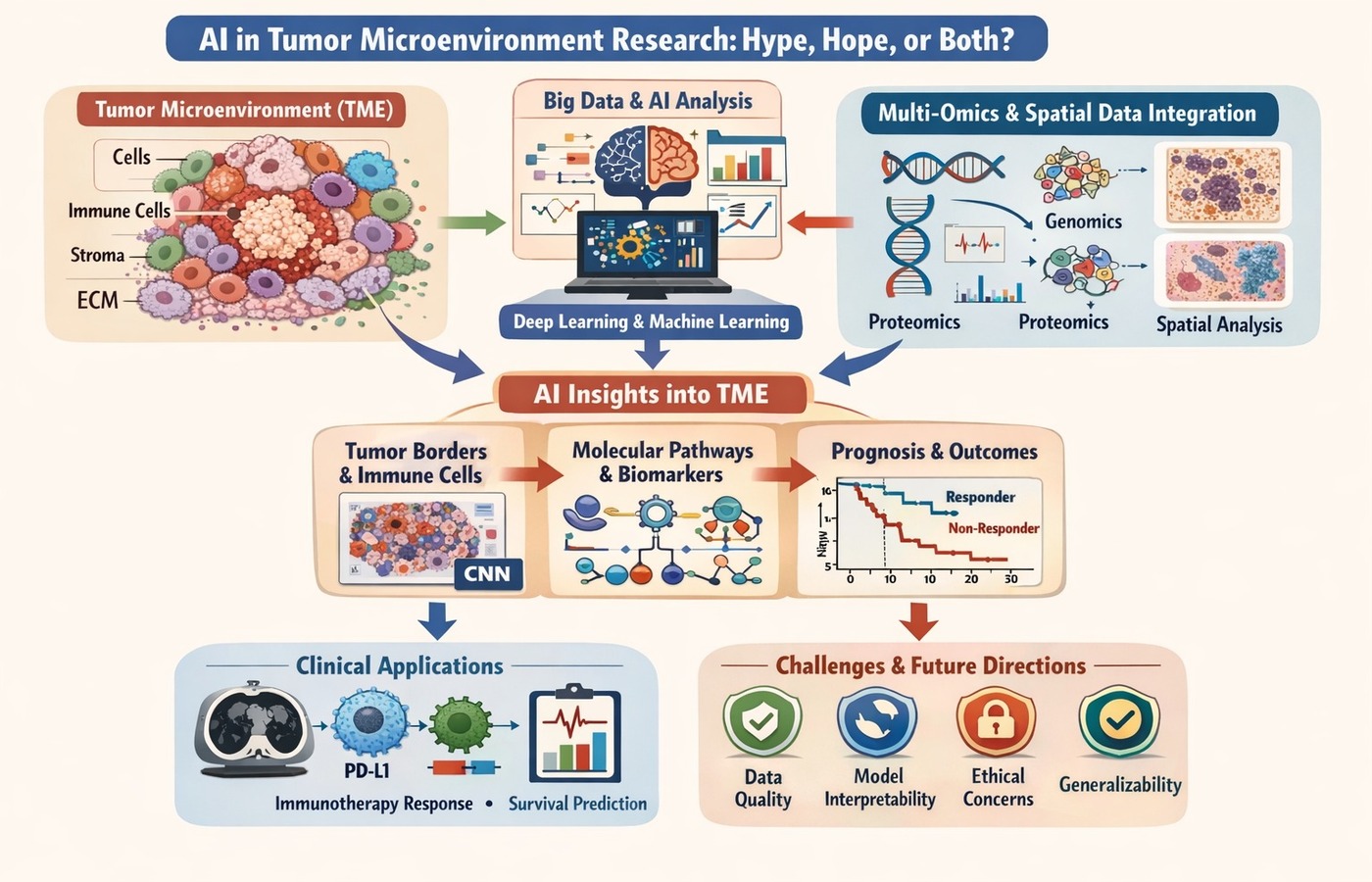
Tumor microenvironment (TME) is a dynamic and heterogeneous niche, which comprises of tumor cells, immune influx, stromal components and extracellular matrix fragments. Its space and molecular complexity pose a significant challenge to the conventional methods of analysis. The artificial intelligence (AI) can learn trends in big amounts of data which is the solution to this complexity. AI models can identify hidden morphological data, multi-omics, and clinical outcomes and thus provide a systems-level understanding of the TME. The integration of digital pathology results and AI is promising in predicting the presence of immune cells and patient prognosis, suggesting an indispensable role of AI in the future of cancer biology.
References
1. Goenka A, Khan F, Verma B, Sinha P, Dmello CC, Jogalekar MP, et al. Tumor microenvironment signaling and therapeutics in cancer progression. Cancer Commun. 2023;43:525–61. https://doi.org/10.1002/cac2.12416 DOI: https://doi.org/10.1002/cac2.12416
2. Madanchian M, Taherdoost H. The impact of artificial intelligence on research efficiency. Results Eng. 2025;26:104743. https://doi.org/10.1016/j.rineng.2025.104743 DOI: https://doi.org/10.1016/j.rineng.2025.104743
3. Xie T, Huang A, Yan H, Ju X, Xiang L, Yuan J. Artificial intelligence: illuminating the depths of the tumor microenvironment. J Transl Med. 2024;22:799. https://doi.org/10.1186/s12967-024-05609-6 DOI: https://doi.org/10.1186/s12967-024-05609-6
4. Yao IZ, Dong M, Hwang WYK. Deep learning applications in clinical cancer detection: a review of implementation challenges and solutions. Mayo Clin Proc Digit Health. 2025;3:100253. https://doi.org/10.1016/j.mcpdig.2025.100253 DOI: https://doi.org/10.1016/j.mcpdig.2025.100253
5. Lobato-Delgado B, Priego-Torres B, Sanchez-Morillo D. Combining molecular, imaging, and clinical data analysis for predicting cancer prognosis. Cancers. 2022;14:3215. https://doi.org/10.3390/cancers14133215 DOI: https://doi.org/10.3390/cancers14133215
6. Zhao S, Su C, Lu Z, Wang F. Recent advances in biomedical literature mining. Brief Bioinform. 2020;22:bbaa057. https://doi.org/10.1093/bib/bbaa057 DOI: https://doi.org/10.1093/bib/bbaa057
7. Kuswanto W, Nolan G, Lu G. Highly multiplexed spatial profiling with CODEX: bioinformatic analysis and application in human disease. Semin Immunopathol. 2023;45:145–57. https://doi.org/10.1007/s00281-022-00974-0 DOI: https://doi.org/10.1007/s00281-022-00974-0
8. He W, Huang W, Zhang L, Wu X, Zhang S, Zhang B. Radiogenomics: bridging the gap between imaging and genomics for precision oncology. MedComm. 2024;5:e722. https://doi.org/10.1002/mco2.722 DOI: https://doi.org/10.1002/mco2.722
9. Collin CB, Gebhardt T, Golebiewski M, Karaderi T, Hillemanns M, Khan FM, et al. Computational models for clinical applications in personalized medicine—guidelines and recommendations for data integration and model validation. J Pers Med. 2022;12:166. https://doi.org/10.3390/jpm12020166 DOI: https://doi.org/10.3390/jpm12020166
10. Xie J, Luo X, Deng X, Tang Y, Tian W, Cheng H, et al. Advances in artificial intelligence to predict cancer immunotherapy efficacy. Front Immunol. 2023;13:1076883. https://doi.org/10.3389/fimmu.2022.1076883 DOI: https://doi.org/10.3389/fimmu.2022.1076883
11. Lin G, Wang X, Ye H, Cao W. Radiomic models predict tumor microenvironment using artificial intelligence—the novel biomarkers in breast cancer immune microenvironment. Technol Cancer Res Treat. 2023;22:15330338231218227. https://doi.org/10.1177/15330338231218227 DOI: https://doi.org/10.1177/15330338231218227
12. Weiner EB, Dankwa-Mullan I, Nelson WA, Hassanpour S. Ethical challenges and evolving strategies in the integration of artificial intelligence into clinical practice. PLOS Digit Health. 2025;4:e0000810. https://doi.org/10.1371/journal.pdig.0000810 DOI: https://doi.org/10.1371/journal.pdig.0000810
13. Hassija V, Chamola V, Mahapatra A, Singal A, Goel D, Huang K, et al. Interpreting black-box models: a review on explainable artificial intelligence. Cogn Comput. 2024;16:45–74. https://doi.org/10.1007/s12559-023-10179-8 DOI: https://doi.org/10.1007/s12559-023-10179-8
14. Cirillo D, Núñez-Carpintero I, Valencia A. Artificial intelligence in cancer research: learning at different levels of data granularity. Mol Oncol. 2021;15:817–29. https://doi.org/10.1002/1878-0261.12920 DOI: https://doi.org/10.1002/1878-0261.12920
15. Open AI. ChatGPT (GPT-4o) [Computer Software]. 2026 [cited 2026 Dec 17]. Available from: https://chatgpt.com
Downloads
Published
Issue
Section
License
Copyright (c) 2025 Ayesha Yousuf, Fatima Ali (Author)

This work is licensed under a Creative Commons Attribution-NonCommercial 4.0 International License.
Journal of Biomolecules, Pathogenesis and Therapeutics (JBPT) follows the Attribution Creative Commons-Non commercial (CC BY-NC 4.0) license which allows the users to copy and redistribute the material in any medium or format, remix, transform and build upon the material. The users must give credit to the source and indicate, provide a link to the license, and indicate if changes were made. However, the CC BY-NC 4.0 license restricts the use of material for commercial purposes (Further details are available at website. The Editorial Board of the JBPT endeavors to ensure the accuracy, integrity, and quality of all published content. However, the responsibility of opinions, interpretations, and conclusions expressed in the published articles rests entirely with the authors and do not necessarily reflect the views of the Editorial Board, publisher, or affiliated institutions.