Infection prevention insights into knowledge scores, improved hand hygiene and personal protective equipment compliance among nurses at tertiary healthcare
Keywords:
Infection prevention and control, nursing staff, compliance, healthcare-associated infections, patient safetyAbstract
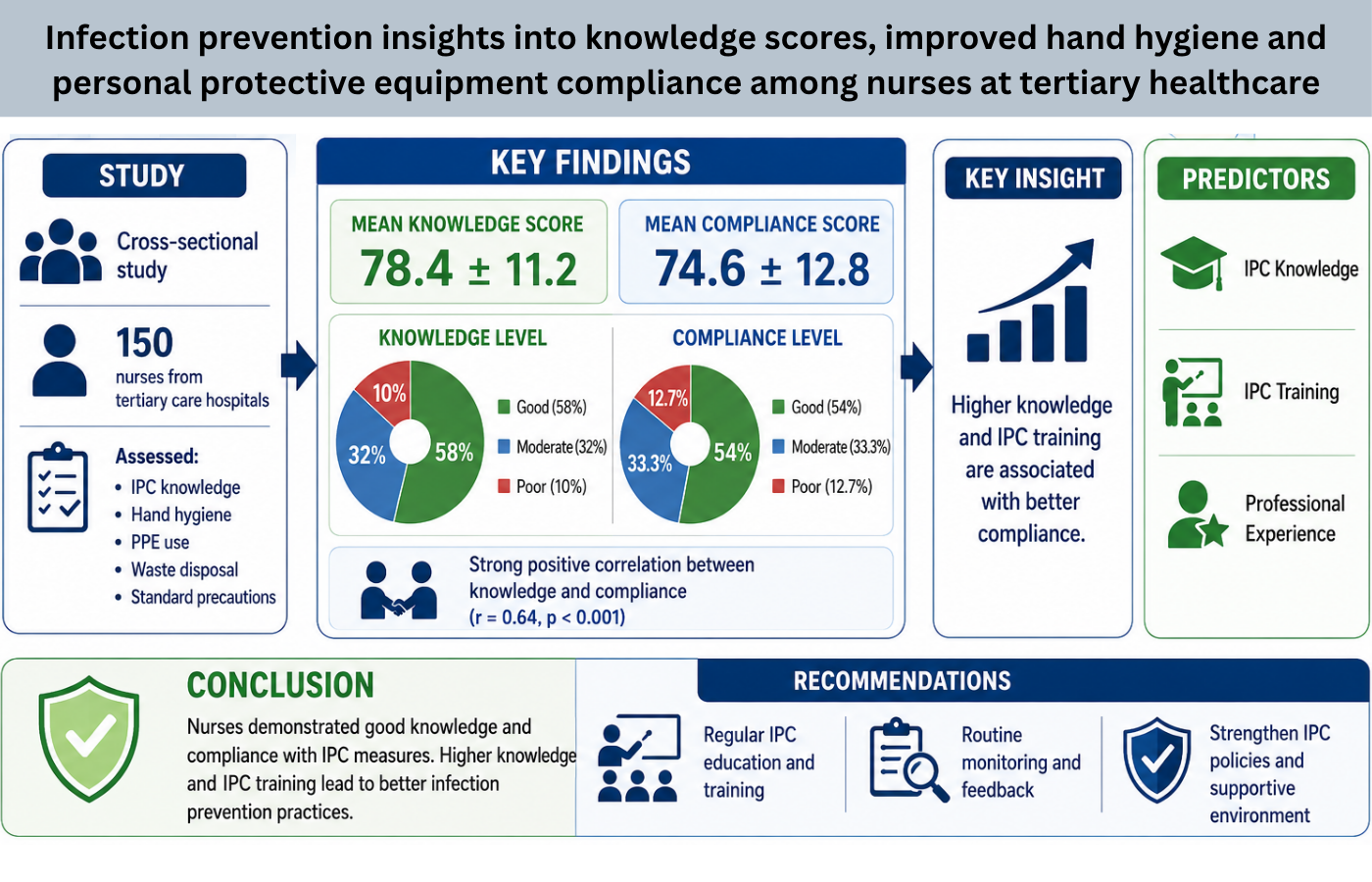
Background: Infection prevention and control (IPC) is a vital program to minimize the risk of health care-associated infections (HAIs) and keep healthcare workers safe and healthy for patients. Nursing staff are in close and continuous contact with patients so present study was set to evaluate the knowledge and compliance of the nursing staff with IPC measures and to find the associated factors. Methods: A cross sectional study was conducted in 150 nursing staff of various clinical departments of tertiary care hospitals. Structured self-administered questionnaire data collected on socio-demographic characteristics, IPC knowledge, hand hygiene, PPE use, waste disposal and standard precautions. The total knowledge and compliance score were obtained and then divided into poor, moderate and good. Data was analyzed in SPSS version 26.0. Result: The mean knowledge score was 78.4 ± 11.2 and the mean compliance score was 74.6 ± 12.8. The participants' knowledge about the topic was good in 58.0%, moderate in 32.0% and poor in 10.0%. The percentage of nurses that reported good compliance was 54.0% and 33.3% reported moderate compliance. There was significant association between knowledge level and compliance (p < 0.001); and there was positive correlation between compliance score and knowledge score (r = 0.64, p < 0.001). Knowledge and IPC training as well as professional experience, were significant predictors of compliance. Conclusion: Nursing staff had good knowledge and compliance with IPC. There was positive correlations between higher knowledge and IPC training and compliance. Recommendations include regular education and monitoring for strengthening IPC practices.
References
1. McCloy O, McGuinness A, Craig S. Infection prevention and control: understanding the fundamentals. Nurs Stand. 2024;39(10):39-44.https://doi.org/10.7748/ns.2024.e12286
2. Sartelli M, Marini CP, McNelis J, Coccolini F, Rizzo C, Labricciosa FM, et al. Preventing and controlling healthcare-associatedinfections: the first principle of every antimicrobial stewardship program in hospital settings. Antibiotics (Basel). 2024;13(9):896.https://doi.org/10.3390/antibiotics13090896
3. Senbato FR, Wolde D, Belina M, Kotiso KS, Medhin G, Amogne W, et al. Compliance with infection prevention and control standardprecautions and factors associated with noncompliance among healthcare workers working in public hospitals in Addis Ababa,Ethiopia. Antimicrob Resist Infect Control. 2024;13(1):32. https://doi.org/10.1186/s13756-024-01381-w
4. Cruz JP, Almazan JU, Kuntuganova A, Syzdykova A, Danebek K, Agazhayeva G. Standard precautions compliance and its associatedfactors among nurses in Kazakhstan: a cross-sectional study. Am J Infect Control. 2024;52(8):941-946.https://doi.org/10.1016/j.ajic.2024.03.007
5. Dobrina R, Donati D, Giangreco M, De Benedictis A, Schreiber S, Bicego L, et al. Nurses’ compliance to standard precautions priortoand during COVID-19. Int Nurs Rev. 2024;71(1):20-27. https://doi.org/10.1111/inr.12830
6. Ghorbanmovahhed S, Shahbazi S, Gilani N, Ostadi A, Shabanloei R, Gholizadeh L. Effectiveness of implementing of aninfectioncontrol link nurse program to improve compliance with standard precautions and hand hygiene among nurses: a quasi-experimentalstudy. BMC Med Educ. 2023;23(1):265. https://doi.org/10.1186/s12909-023-04208-1
7. Donati D, Miccoli GA, Cianfrocca C, Di Stasio E, De Marinis MG, Tartaglini D. Effectiveness of implementing link nurses andauditsand feedback to improve nurses’ compliance with standard precautions: a cluster randomized controlled trial. AmJ Infect Control.2020;48(10):1204-1210. https://doi.org/10.1016/j.ajic.2020.01.017
8. Sayrafi NA, Salami A, Ghssein G. Impact of effort-reward imbalance and burnout on the compliance with standard precautionsamongnurses and midwives in Lebanese hospitals. Nurs Rep. 2024;14(2):1477-1493. https://doi.org/10.3390/nursrep14020111
9. Harb S, Abu Shosha G, Oweidat IA, Al-Mugheed K, Alzoubi MM, Abdelaliem SMF. Compliance of infection control practicesamong registered nurses: a cross-sectional study. Medicine (Baltimore). 2025;104(14).https://doi.org/10.1097/MD.0000000000042062
10. Gozdzielewska L, KC D, Butcher J, Molesworth M, Davis K, Barr L, et al. Interventions for preventing or controllinghealthcare-associated infection amongst healthcare workers or patients within primary care facilities: a scoping review. AmJ Infect Control.2024;52(4):479-487. https://doi.org/10.1016/j.ajic.2023.10.011
11. Batran R, Ayed A, Batran A, Ejheisheh MA, Alassoud B, Hayek MF, et al. Determinants of Nurses' Compliance withInfectionPrevention and Control Practices in Critical Care Units. SAGE Open Nurs. 2025 Apr 30;11:23779608251339193.https://doi.org/10.1177/23779608251339193
12. Mutaru AM, Balegha AN, Kunsu R, Gbeti C. Knowledge and determinants of infection prevention and control complianceamongnurses in Yendi municipality, Ghana. PLoS One. 2022 Jul 20;17(7):e0270508. https://doi.org/10.1371/journal.pone.0270508
13. Madran B, Demir ZI, Yalcin B, Ayaz OT, Iyikosker K, Keskin A, et al. Reasons for insufficient compliance with infectionpreventionand control measures in the intensive care unit: a qualitative study conducted in Türkiye in 2024. Antimicrob Resist Infect Control.2025 Jun 23;14(1):71. https://doi.org/10.1186/s13756-025-01544-3
14. Cen Y, Lao C, Li Z, Zhao H, Wang T, Fan C, et al. Association between infection prevention and control safety culture andhealthcareworkers' compliance with infection control measures: a cross-sectional study. Front Public Health. 2025 Oct 17;13:1668493.https://doi.org/10.3389/fpubh.2025.1668493
15. Durrani N, Raziq A, Mahmood T, Khan MR. Barriers to adaptation of environmental sustainability in SMEs: Aqualitativestudy.PLoS One. 2024 May 16;19(5):e0298580. https://doi.org/10.1371/journal.pone.0298580
16. Zhang M, Wu S, Ibrahim MI, Noor SSM, Mohammad WMZW. Significance of Ongoing Training and Professional Development inOptimizing Healthcare-associated Infection Prevention and Control. J Med Signals Sens. 2024 Jul 2;14:13.https://doi.org/10.4103/jmss.jmss_37_23
17. Gilbert GL, Kerridge I. The politics and ethics of hospital infection prevention and control: a qualitative case study of senior clinicians' perceptions of professional and cultural factors that influence doctors' attitudes and practices in a large Australian hospital. BMCHealth Serv Res. 2019 Apr 2;19(1):212. https://doi.org/10.1186/s12913-019-4044-y
18. Lacotte Y, Årdal C, Ploy MC; European Union Joint Action on Antimicrobial Resistance and Healthcare-Associated Infections(EU-JAMRAI). Infection prevention and control research priorities: what do we need to combat healthcare-associated infections and antimicrobial resistance? Results of a narrative literature review and survey analysis. Antimicrob Resist Infect Control. 2020Aug24;9(1):142. https://doi.org/10.1186/s13756-020-00801-x
19. Abalkhail A, Alslamah T. Institutional Factors Associated with Infection Prevention and Control Practices GloballyduringtheInfectious Pandemics in Resource-Limited Settings. Vaccines (Basel). 2022 Oct 27;10(11):1811.https://doi.org/10.3390/vaccines10111811
20. Kim SJ, Lee EJ. Factors Influencing Emergency Department Nurses' Compliance with Standard Precautions Using Multilevel Analysis.Int J Environ Res Public Health. 2021 Jun 7;18(11):6149. https://doi.org/10.3390/ijerph18116149
21. Ghabayen F, ALBashtawy M, Abdelkader RH, Jarrah S, Eshah N, Abdalrahim A, et al. Knowledge and Compliance WithStandardPrecautions Among Nurses. SAGE Open Nurs. 2023 Jul 28;9:23779608231189966. https://doi.org/10.1177/23779608231189966
22. Al-Faouri I, Okour SH, Alakour NA, Alrabadi N. Knowledge and compliance with standard precautions among registerednurses: Across-sectional study. Ann Med Surg (Lond). 2021 Jan 29;62:419-424. https://doi.org/10.1016/j.amsu.2021.01.058
23. Kubde D, Badge AK, Ugemuge S, Shahu S. Importance of Hospital Infection Control. Cureus. 2023 Dec 22;15(12):e50931.https://doi.org/10.7759/cureus.50931
24. Suliman M, Aloush S, Aljezawi M, AlBashtawy M. Knowledge and practices of isolation precautions among nurses in Jordan. AmJInfect Control. 2018 Jun;46(6):680-684. https://doi.org/10.1016/j.ajic.2017.09.023
25. Kindu M, Yenesew MA, Kassie GG. Infection prevention practices and associated factors among healthcare professionals inWestGojjam Zone public Hospitals Northwest Ethiopia, 2023. PLoS One. 2026 Jan 30;21(1):e0338621.https://doi.org/10.1371/journal.pone.0338621
Downloads
Published
Issue
Section
License
Copyright (c) 2026 Fatima Javed, Rimsha Awan, Zehra Qasim (Author)

This work is licensed under a Creative Commons Attribution-NonCommercial 4.0 International License.
Journal of Biomolecules, Pathogenesis and Therapeutics (JBPT) follows the Attribution Creative Commons-Non commercial (CC BY-NC) license which allows the users to copy and redistribute the material in any medium or format, remix, transform and build upon the material. The users must give credit to the source and indicate, provide a link to the license, and indicate if changes were made. However, the CC BY-NC license restricts the use of material for commercial purposes (Further details are available at website. The Editorial Board of the JBPT endeavors to ensure the accuracy, integrity, and quality of all published content. However, the responsibility of opinions, interpretations, and conclusions expressed in the published articles rests entirely with the authors and do not necessarily reflect the views of the Editorial Board, publisher, or affiliated institutions.