Treatment adherence and clinical outcomes among patients with Chronic Kidney Disease
DOI:
https://doi.org/10.68041/jbpt.v2i2/08Keywords:
Chronic kidney disease, treatment adherence, clinical outcomes, eGFR, quality of life, renal function, medication complianceAbstract
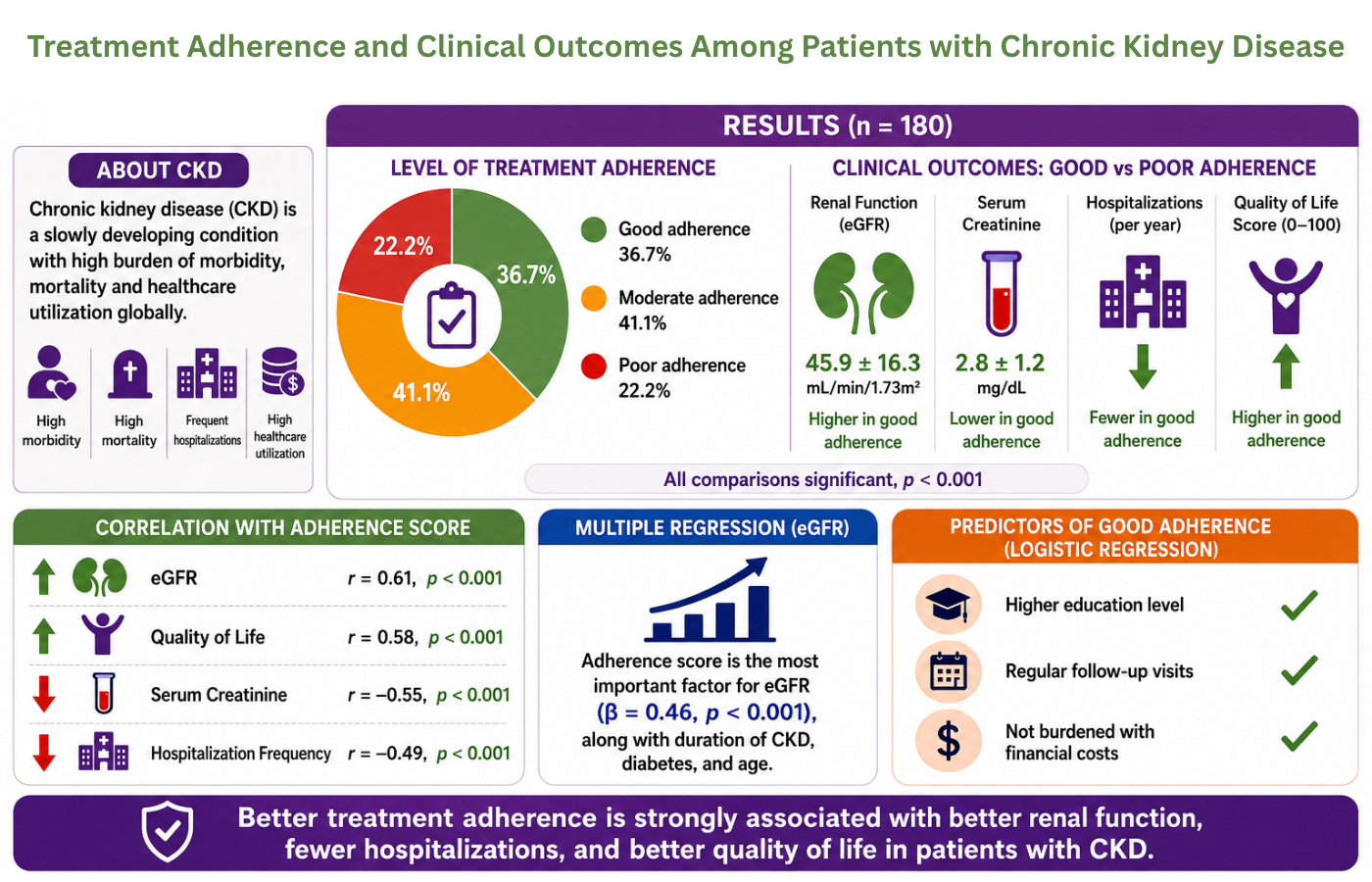
Background: Chronic kidney disease (CKD) is a slowly developing condition with high burden of morbidity, mortality and healthcare utilization globally. The purpose of this study was to determine the level of CKD treatment adherence and its relationship with clinical outcomes. Methods: This was a cross sectional analysis study which included 180 patients with CKD who were seen in nephrology outpatient clinics. The non-probability technique of convenience sampling was applied in selecting the participants. A structured questionnaire was used to gather information on socio-demographic data, treatment adherence behaviors, barriers to treatment adherence, and patterns of healthcare utilization (SPSS version 24.0, p < 0.05). Results: In total, 180 patients participated, 36.7% of which were good adherence, 41.1% were moderate adherence and 22.2% were poor adherence. The patients with good adherence had significantly higher renal function (eGFR: 45.9 ± 16.3 mL/min/1.73m²) and lower serum creatinine level (2.8 ± 1.2 mg/dL) than those with poor adherence, as well as fewer hospitalizations and higher quality of life scores (p < 0.001). Adherence was significantly positively correlated with eGFR (r = 0.61, p < 0.001) and quality of life (r = 0.58, p < 0.001), and negatively correlated with serum creatinine (r = −0.55, p < 0.001) and hospitalization frequency (r = −0.49, p < 0.001). Multiple regression analysis revealed adherence score as the most important factor for eGFR (β = 0.46, p < 0.001). Conclusions: Adherence to treatment is an important factor to consider when evaluating clinical outcomes of CKD patients.
References
1. Altamura S, Pietropaoli D, Lombardi F, Del Pinto R, Ferri C. An Overview of Chronic Kidney Disease Pathophysiology: The Impact of Gut Dysbiosis and Oral Disease. Biomedicines. 2023 Nov 12;11(11):3033. https://doi.org/10.3390/biomedicines11113033
2. Rukavina Mikusic NL, Kouyoumdzian NM, Choi MR. Gut microbiota and chronic kidney disease: evidences and mechanisms that mediate a new communication in the gastrointestinal-renal axis. Pflugers Arch. 2020 Mar;472(3):303-320. https://doi.org/10.1007/s00424-020-02352-x
3. Huang HW, Chen MJ. Exploring the Preventive and Therapeutic Mechanisms of Probiotics in Chronic Kidney Disease through the Gut-Kidney Axis. J Agric Food Chem. 2024 Apr 17;72(15):8347-8364. https://doi.org/10.1021/acs.jafc.4c00263
4. Li C, Chen X, Zha W, Fang S, Shen J, Li L, et al. Impact of gut microbiota in chronic kidney disease: natural polyphenols as beneficial regulators. Ren Fail. 2025 Dec;47(1):2506810. https://doi.org/10.1080/0886022X.2025.2506810
5. Dobrek Ł. POTENTIAL THERAPEUTIC OPTIONS TARGETING THE GUT DYSBIOSIS IN CHRONIC KIDNEY DISEASE. Wiad Lek. 2022;75(7):1757-1764. https://doi.org/10.36740/WLek202207127
6. Rivera E, Clark-Cutaia MN, Schrauben SJ, Townsend RR, Lash JP, Hannan M, et al. Treatment Adherence in CKD and Support From Health care Providers: A Qualitative Study. Kidney Med. 2022 Sep 20;4(11):100545. https://doi.org/10.1016/j.xkme.2022.100545
7. House TR, Wightman A, Rosenberg AR, Sayre G, Abdel-Kader K, Wong SPY. Challenges to Shared Decision Making About Treatment of Advanced CKD: A Qualitative Study of Patients and Clinicians. Am J Kidney Dis. 2022 May;79(5):657-666.e1. https://doi.org/10.1053/j.ajkd.2021.08.021
8. Ng SY, Islahudin F, Redzuan AM, Capule FR. Medication Adherence and Clinical Outcomes among Patients with Chronic Kidney Disease: A 6-month Prospective Evaluation using Individual Adherence Assessment. J Res Pharm Pract. 2026 Mar 31;15(1):18. https://doi.org/10.4103/jrpp.jrpp_96_25
9. Pourhabibi N, Sadeghi R, Mohebbi B, Shakibazadeh E, Sanjari M, Tol A, et al. Factors affecting nonadherence to treatment among type 2 diabetic patients with limited health literacy: Perspectives of patients, their families, and healthcare providers. J Educ Health Promot. 2022 Nov 26;11:388. https://doi.org/10.4103/jehp.jehp_804_22
10. Mechta Nielsen T, Frøjk Juhl M, Feldt-Rasmussen B, Thomsen T. Adherence to medication in patients with chronic kidney disease: a systematic review of qualitative research. Clin Kidney J. 2018 Aug;11(4):513-527. https://doi.org/10.1093/ckj/sfx140
11. Matsui M, Kokubu M, Nishimoto M, Kosugi T, Eriguchi M, Samejima KI, et al. Association of Estimated Glomerular Filtration Rate Slopes with Cardiorenal Outcomes in Patients with Chronic Kidney Disease before and after Multidisciplinary Education. Kidney Blood Press Res. 2026;51(1):141-150. https://doi.org/10.1159/000550676
12. Hamza MA, Ullah S, Ahsan H, Ali W, Masud M, Ahmed A. Health literacy, illness perception, and their association with medication adherence in end-stage renal disease. Int Urol Nephrol. 2025 Sep;57(9):2979-2994. https://doi.org/10.1007/s11255-025-04472-8
13. Cedillo-Couvert EA, Ricardo AC, Chen J, Cohan J, Fischer MJ, Krousel-Wood M, et al. CRIC Study Investigators. Self-reported Medication Adherence and CKD Progression. Kidney Int Rep. 2018 Feb 2;3(3):645-651. https://doi.org/10.1016/j.ekir.2018.01.007
14. Tangkiatkumjai M, Walker DM, Praditpornsilpa K, Boardman H. Association between medication adherence and clinical outcomes in patients with chronic kidney disease: a prospective cohort study. Clin Exp Nephrol. 2017 Jun;21(3):504-512. https://doi.org/10.1007/s10157-016-1312-6
15. Sirimalla S, Mateti UV, Shenoy P, Shastry CS, Shetty S. Impact of medication therapy management on medication adherence and health-related quality of life among non-dialysis chronic kidney disease patients. Res Social Adm Pharm. 2025 Dec;21(12):1090-1095. https://doi.org/10.1016/j.sapharm.2025.08.002
16. Wickramasinghe D, Lynch C, Coombes J, Jayamanne S, Silva S. Impact of clinical pharmacy services on medication adherence and quality of life in pre-dialysis patients with CKDu: a randomized controlled trial from Sri Lanka. BMC Nephrol. 2025 Jul 4;26(1):351. https://doi.org/10.1186/s12882-025-04301-1
17. Hussien H, Apetrii M, Covic A. Health-related quality of life in patients with chronic kidney disease. Expert Rev Pharmacoecon Outcomes Res. 2021 Feb;21(1):43-54. https://doi.org/10.1080/14737167.2021.1854091
18. Latif AA, Lee KW, Phang K, Rashid AA, Chan NN, Peh SC, et al. Patient-related factors associated with medication adherence behavior in patients with end-stage renal disease: A systematic review. Tzu Chi Med J. 2022 Jun 27;34(4):473-484. https://doi.org/10.4103/tcmj.tcmj_212_21
19. Patel S, Huang M, Miliara S. Understanding Treatment Adherence in Chronic Diseases: Challenges, Consequences, and Strategies for Improvement. J Clin Med. 2025 Aug 26;14(17):6034. https://doi.org/10.3390/jcm14176034
20. Kengne AP, Brière JB, Zhu L, Li J, Bhatia MK, Atanasov P, et al. Impact of poor medication adherence on clinical outcomes and health resource utilization in patients with hypertension and/or dyslipidemia: systematic review. Expert Rev Pharmacoecon Outcomes Res. 2024 Jan;24(1):143-154. https://doi.org/10.1080/14737167.2023.2266135
21. Religioni U, Barrios-Rodríguez R, Requena P, Borowska M, Ostrowski J. Enhancing Therapy Adherence: Impact on Clinical Outcomes, Healthcare Costs, and Patient Quality of Life. Medicina (Kaunas). 2025 Jan 17;61(1):153. https://doi.org/10.3390/medicina61010153
22. Muxunov A, Almazan J, Kalinina D, Kuanshaliyeva Z, Gaipov A, Makhadiyeva D, et al. Health-related quality of life in chronic kidney disease patients in low- and lower-middle income countries: a systematic review and meta-analysis. Qual Life Res. 2026 Jan 9;35(2):28. https://doi.org/10.1007/s11136-025-04154-z
23. Russell J, Austin K, Charlton KE, Igwe EO, Kent K, Lambert K, et al. Exploring Financial Challenges and University Support Systems for Student Financial Well-Being: A Scoping Review. Int J Environ Res Public Health. 2025 Feb 27;22(3):356. https://doi.org/10.3390/ijerph22030356
24. Wilder ME, Kulie P, Jensen C, Levett P, Blanchard J, Dominguez LW, et al. The Impact of Social Determinants of Health on Medication Adherence: a Systematic Review and Meta-analysis. J Gen Intern Med. 2021 May;36(5):1359-1370. https://doi.org/10.1007/s11606-020-06447-0
25. Biddell CB, Waters AR, Angove RSM, Gallagher KD, Rosenstein DL, Spees LP, et al. Facing financial barriers to healthcare: patient-informed adaptation of a conceptual framework for adults with a history of cancer. Front Psychol. 2023 May 15;14:1178517. https://doi.org/10.3389/fpsyg.2023.1178517
26. Poudel S, Yadav DK, Khanal VK, Nepal Gurung G, Pokhrel S, Pudasaini A, et al. Financial catastrophe and its associated factors among chronic kidney disease patients undergoing haemodialysis in Kathmandu, Nepal: a mixed-method study. BMJ Open. 2025 Dec 12;15(12):e109097. https://doi.org/10.1136/bmjopen-2025-109097
27. Kisomi ZS, Taherkhani O, Mollaei M, Esmaeily H, Shirkhanloo G, Hosseinkhani Z, et al. The moderating role of social support in the relationship between death anxiety and resilience among dialysis patients. BMC Nephrol. 2024 Mar 16;25(1):100. https://doi.org/10.1186/s12882-024-03533-x
Published
Issue
Section
License
Copyright (c) 2026 Mehmona Inam, Habib Ullah (Author)

This work is licensed under a Creative Commons Attribution-NonCommercial 4.0 International License.
Journal of Biomolecules, Pathogenesis and Therapeutics (JBPT) follows the Attribution Creative Commons-Non commercial (CC BY-NC 4.0) license which allows the users to copy and redistribute the material in any medium or format, remix, transform and build upon the material. The users must give credit to the source and indicate, provide a link to the license, and indicate if changes were made. However, the CC BY-NC 4.0 license restricts the use of material for commercial purposes (Further details are available at website. The Editorial Board of the JBPT endeavors to ensure the accuracy, integrity, and quality of all published content. However, the responsibility of opinions, interpretations, and conclusions expressed in the published articles rests entirely with the authors and do not necessarily reflect the views of the Editorial Board, publisher, or affiliated institutions.