From Silent Tumors to Molecular Signals: The Future of Pre-Symptomatic Cancer Detection
Keywords:
Cancer Screening, DNA Methylation, High-Throughput Nucleotide Sequencing, Molecular Markers, Risk Assessment, Personalized MedicinesAbstract
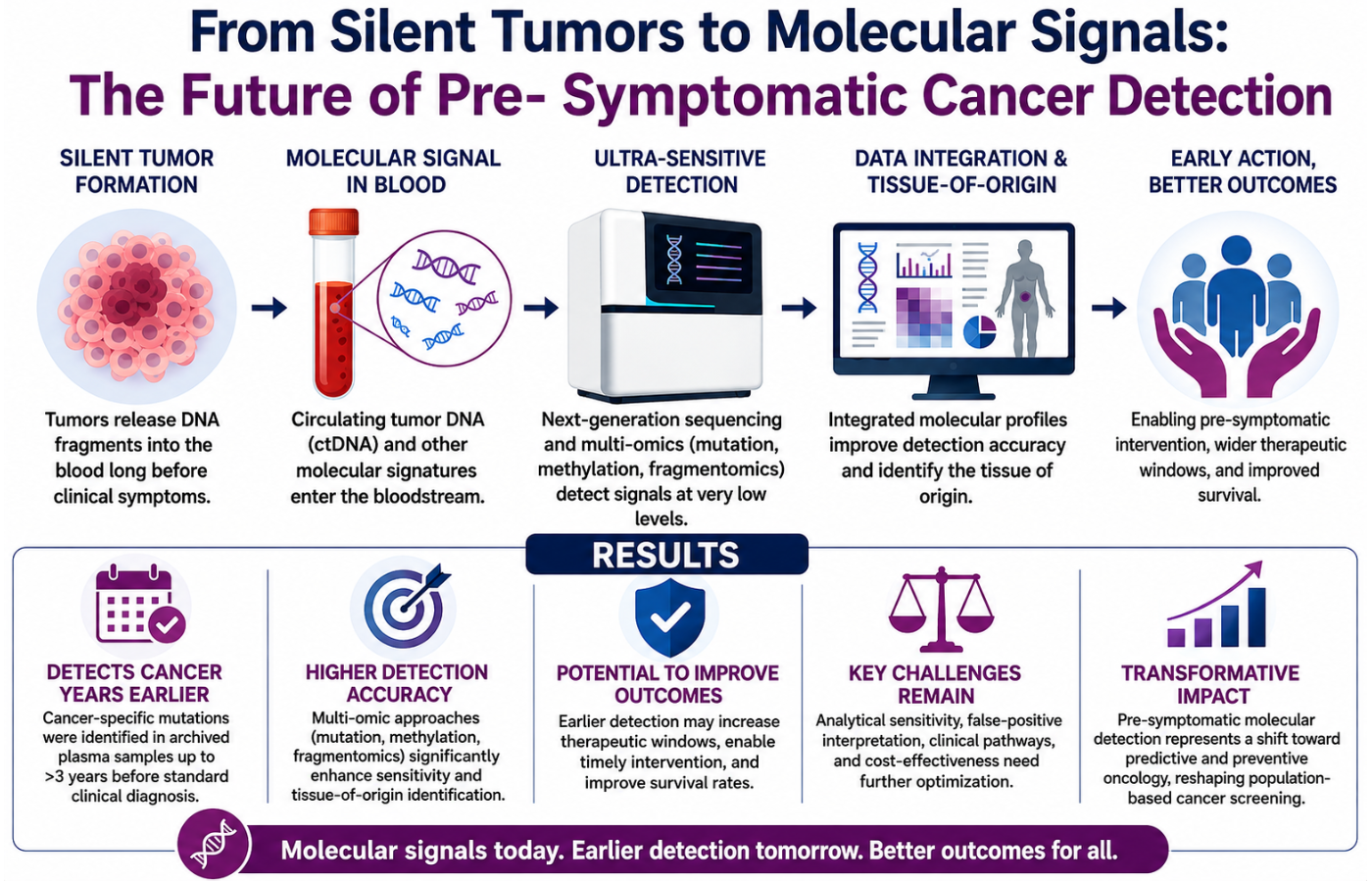
The latest developments in molecular oncology are revolutionizing the world of cancer diagnosis as they create an opportunity to detect tumor-related signals way before they have clinical effects. The circulating tumor DNA (ctDNA), which is released into the blood by cancer cells, can now be detected at very low levels by ultra-sensitive technologies based on next-generation sequencing. Recent retrospective studies on archived plasma samples have also shown the existence of cancer-specific mutations over three years before standard diagnosis, and this highlights the high sensitivity of current genomic technologies. Multi-cancer early detection schemes incorporating mutation profiling, epigenetic methylation signature, and fragmentomic studies also improve the detection accuracy and tissue-of-origin identification. Despite of their great potential, there are still issues of analytical sensitivity, false-positive interpretation, clinical management pathways, and cost-effectiveness. The research highlights that pre-symptomatic molecular detection represents a transformative shift towards predictive and preventive oncology with the potential to increase therapeutic windows, enhance survival rates, and alter the conceptualization of population-based cancer screening.
References
1. Li C, Liu Y, Xue D, Chan CWH. Effects of nurse-led interventions on early detection of cancer: A systematic review and meta-analysis.Int J Nurs Stud. 2020 Oct;110:103684. https://doi.org/10.1016/j.ijnurstu.2020.103684
2. Cirillo N. Deceptive Measures of "Success" in Early Cancer Detection. Curr Oncol. 2024 Aug 30;31(9):5140-5150.https://doi.org/10.3390/curroncol31090380
3. Bittla P, Kaur S, Sojitra V, Zahra A, Hutchinson J, Folawemi O, Khan S. Exploring Circulating Tumor DNA (CtDNA) andIts RoleinEarly Detection of Cancer: A Systematic Review. Cureus. 2023 Sep 22;15(9):e45784. https://doi.org/10.7759/cureus.45784
4. Wade R, Nevitt S, Liu Y, Harden M, Khouja C, Raine G, et al. Multi-cancer early detection tests for general population screening: a systematic literature review. Health Technol Assess. 2025 Jan;29(2):1-105. https://doi.org/10.3310/DLMT1294
5. Bao H, Yang S, Chen X, Dong G, Mao Y, Wu S, et al. Early detection of multiple cancer types using multidimensional cell-free DNA fragmentomics. Nat Med. 2025 Aug;31(8):2737-2745. https://doi.org/10.1038/s41591-025-03735-2
6. Duffy MJ, Crown J. Circulating tumor DNA (ctDNA): can it be used as a pan-cancer early detection test? Crit Rev Clin LabSci. 2024Jun;61(4):241-253. https://doi.org/10.1080/10408363.2023.2275150
7. Ma L, Guo H, Zhao Y, Liu Z, Wang C, Bu J, Sun T, Wei J. Liquid biopsy in cancer current: status, challenges and future prospects. SignalTransduct Target Ther. 2024 Dec 2;9(1):336. https://doi.org/10.1038/s41392-024-02021-w
8. Wang Y, Joshu CE, Curtis SD, Douville C, Burk VA, Ru M, et al. Detection of Cancers Three Years prior to Diagnosis UsingPlasmaCell-Free DNA. Cancer Discov. 2025 Sep 4;15(9):1794-1802. https://doi.org/10.1158/2159-8290
9. Wade R, Nevitt S, Liu Y, Harden M, Khouja C, Raine G, et al. Multi-cancer early detection tests for general population screening:asystematic literature review. Health Technol Assess. 2025 Jan;29(2):1-105. https://doi.org/10.3310/DLMT1294
10. Bao H, Yang S, Chen X, Dong G, Mao Y, Wu S, et al. Early detection of multiple cancer types using multidimensional cell-free DNA fragmentomics. Nat Med. 2025 Aug;31(8):2737-2745. https://doi.org/10.1038/s41591-025-03735-2
11. Allegretti M, Cottone G, Carboni F, Cotroneo E, Casini B, Giordani E, et al. Cross-sectional analysis of circulating tumor DNA in primary colorectal cancer at surgery and during post-surgery follow-up by liquid biopsy. J Exp Clin Cancer Res. 2020 Apr 20;39(1):69.https://doi.org/10.1186/s13046-020-01569-z
12. Bao H, Yang S, Chen X, Dong G, Mao Y, Wu S, et al. Early detection of multiple cancer types using multidimensional cell-free DNA fragmentomics. Nat Med. 2025 Aug;31(8):2737-2745. https://doi.org/10.1038/s41591-025-03735-2
13. Imai M, Nakamura Y, Yoshino T. Transforming cancer screening: the potential of multi-cancer early detection (MCED) technologies. Int J Clin Oncol. 2025 Feb;30(2):180-193. https://doi.org/10.1007/s10147-025-02694-5
14. Simancas-Racines D, Román-Galeano NM, Vásquez JP, Jima Gavilanes D, Vijayan R, Reytor-González C. Liquid Biopsy andMulti-OmicBiomarkers in Breast Cancer: Innovations in Early Detection, Therapy Guidance, and Disease Monitoring. Biomedicines. 2025Dec12;13(12):3073. https://doi.org/10.3390/biomedicines13123073
15. Bittla P, Kaur S, Sojitra V, Zahra A, Hutchinson J, Folawemi O, et al. Exploring Circulating Tumor DNA (CtDNA) and Its Role in Early Detection of Cancer: A Systematic Review. Cureus. 2023 Sep 22;15(9):e45784. doi: 10.7759/cureus.45784.
Published
Issue
Section
License
Copyright (c) 2026 kainat Zafar, Irshad Sana Ullah (Author)

This work is licensed under a Creative Commons Attribution-NonCommercial 4.0 International License.
Journal of Biomolecules, Pathogenesis and Therapeutics (JBPT) follows the Attribution Creative Commons-Non commercial (CC BY-NC) license which allows the users to copy and redistribute the material in any medium or format, remix, transform and build upon the material. The users must give credit to the source and indicate, provide a link to the license, and indicate if changes were made. However, the CC BY-NC license restricts the use of material for commercial purposes (Further details are available at website. The Editorial Board of the JBPT endeavors to ensure the accuracy, integrity, and quality of all published content. However, the responsibility of opinions, interpretations, and conclusions expressed in the published articles rests entirely with the authors and do not necessarily reflect the views of the Editorial Board, publisher, or affiliated institutions.