Biosafety Cabinet handling practices and PCR laboratory SOPs compliance among undergraduate Medical students: Implications for Laboratory safety and biomolecular training
DOI:
https://doi.org/10.68041/jbpt.v2i2/04Keywords:
Laboratory Competency, Molecular Diagnostics, Medical Students, Biosafety, Biosafety Cabinet, PCR Laboratory, Standard Operating ProceduresAbstract
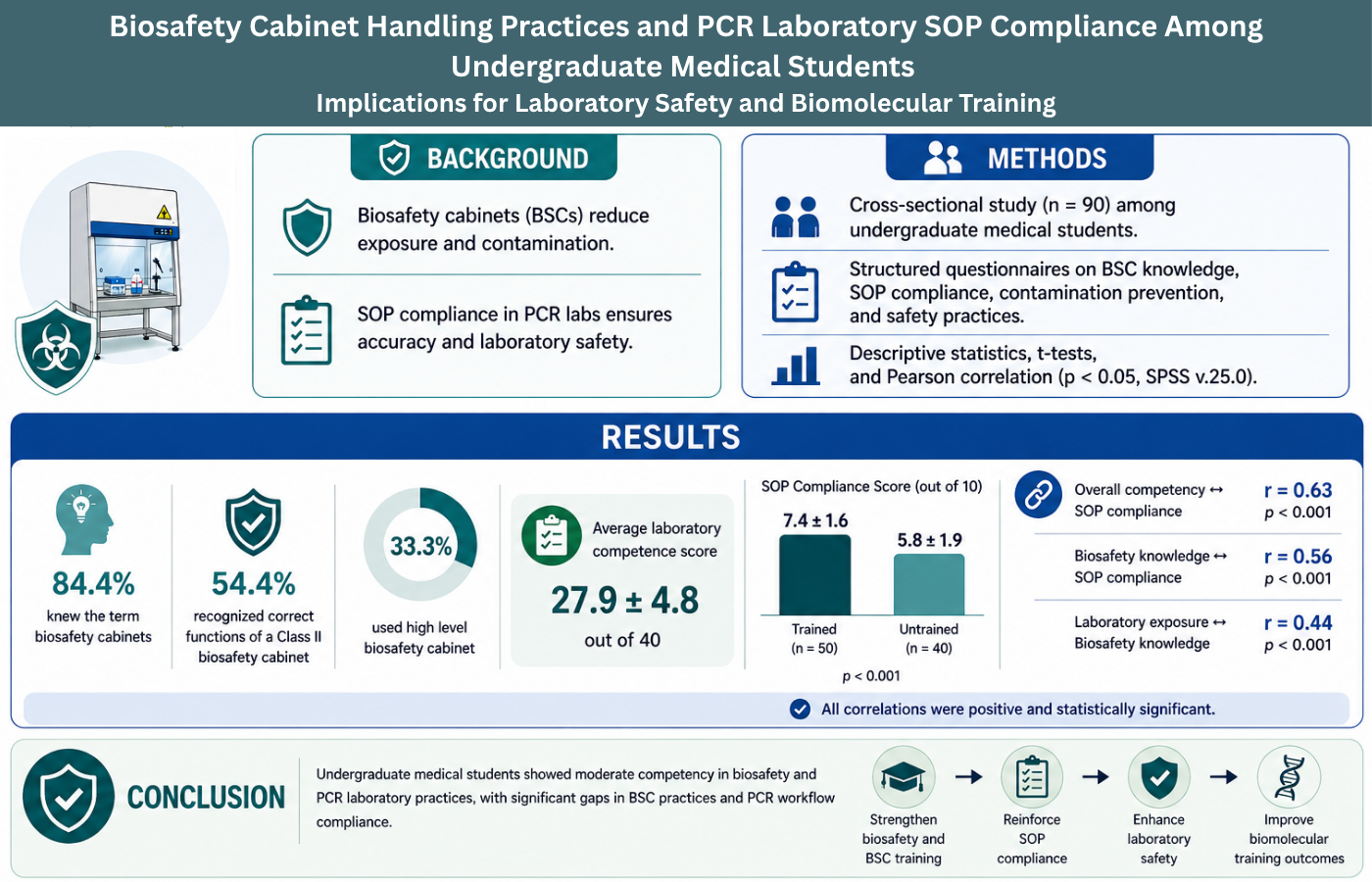
Background: Biosafety practices and following standard operating procedures (SOPs) are integral parts of molecular diagnostic laboratories. This study assessed the knowledge of biosafety cabinets, compliance to PCR laboratory SOPs, laboratory safety competency among undergraduate medical students and factors associated with better laboratory competency. Methods: A cross sectional analytical study (n=90) used structured questionnaires designed to gather data on biosafety cabinet knowledge, compliance with PCR laboratory SOP, awareness of contamination prevention, and laboratory safety practices. Participant characteristics and competency scores were described in terms of descriptive statistics. Independent-samples t-tests and Pearson correlation analysis were used (p value < 0.05, SPSS v.25.0). Results: 84.4% of the participants knew the term biosafety cabinets, but only 54.4% of them recognized the correct functions of a Class II biosafety cabinet. The percentage of students using high level biosafety cabinet was 33.3%. The average laboratory competence score was 27.9 ± 4.8 of 40. Students who have received biosafety training scores significantly higher in their SOP compliance (7.4 ± 1.6) compared to untrained students (5.8 ± 1.9, p < 0.001). The overall competency was significantly correlated with SOP compliance (r = 0.63, p < 0.001), biosafety knowledge with SOP compliance (r = 0.56, p < 0.001), and laboratory exposure was significantly correlated with biosafety knowledge (r = 0.44, p < 0.001). Conclusion: The competency of undergraduate medical students in biosafety and PCR laboratory practices were moderate, and there were significant deficiencies in the practices of the biosafety cabinets and in the compliance of the PCR workflow.
References
1. Liu Q, Jin X, Cheng J, Zhou H, Zhang Y, Dai Y. Advances in the application of molecular diagnostic techniques for the detection of infectious disease pathogens (Review). Mol Med Rep. 2023 May;27(5):104. https://doi.org/10.3892/mmr.2023.12991
2. Kojabad AA, Farzanehpour M, Galeh HEG, Dorostkar R, Jafarpour A, Bolandian M, et al. Droplet digital PCR of viral DNA/RNA, current progress, challenges, and future perspectives. J Med Virol. 2021 Jul;93(7):4182-4197. doi: 10.1002/jmv.26846. Epub 2021 Mar 11. Erratum in: J Med Virol. 2024 May;96(5):e29632. https://doi.org/10.1002/jmv.29632
3. Ashmi M, He C, Drobniewski F. Can immuno-PCR (IPCR) transform bacterial disease diagnostics? Expert Rev Mol Diagn. 2024 Oct;24(10):927-936. https://doi.org/10.1080/14737159.2024.2413556
4. Jagtap GA, Badge A, Kohale MG, Wankhade RS. The Role of the Biosafety Cabinet in Preventing Infection in the Clinical Laboratory. Cureus. 2023 Dec 29;15(12):e51309. https://doi.org/10.7759/cureus.51309
5. Frey G, Robertson C, Krishnan J. Decontamination Validation of a Class II Type A2 Biosafety Cabinet during Laboratory Fumigation. Appl Biosaf. 2020 Mar 1;25(1):48-52. https://doi.org/10.1177/1535676019890975
6. Saini RS, Binduhayyim RIH, Mosaddad SA, Heboyan A. Strategies for preventing aerosol-generated microbial contamination in dental procedures: A systematic review and meta-analysis. Am J Infect Control. 2025 May;53(5):638-647. https://doi.org/10.1016/j.ajic.2025.02.001
7. Prashant A, Devegowda D, Vishwanath P, Nataraj SM. Impact of experiential learning among medical undergraduates: A randomized controlled trial. J Educ Health Promot. 2020 Nov 26;9:306. https://doi.org/10.4103/jehp.jehp_462_20
8. Abu-Siniyeh A, Al-Shehri SS. Safety in Medical Laboratories: Perception and Practice of University Students and Laboratory Workers. Appl Biosaf. 2021 Sep;26(Suppl 1):S34-S42. https://doi.org/10.1089/apb.20.0050
9. Cornish NE, Anderson NL, Arambula DG, Arduino MJ, Bryan A, Burton NC, et al. Clinical Laboratory Biosafety Gaps: Lessons Learned from Past Outbreaks Reveal a Path to a Safer Future. Clin Microbiol Rev. 2021 Jun 16;34(3):e0012618. https://doi.org/10.1128/CMR.00126-18
10. Long Y, Chang F, Yang F, Hou Y, Mo Z, Diao Q. Biosafety risk assessment and risk control of clinical laboratory in designated hospitals for treating COVID-19 in Chongqing, China. Am J Infect Control. 2022 Sep;50(9):999-1005. https://doi.org/10.1016/j.ajic.2022.05.028
11. Ali MT, Mahmud S, Mohsin M, Mian AU, Islam A, Ahmed FF. Knowledge, attitude, and practices toward food safety among students in Bangladesh: A cross-sectional web-based study. Heliyon. 2023 Mar 24;9(4):e14762. https://doi.org/10.1016/j.heliyon.2023.e14762
12. Köroğlu M, Altındiş S, Aydemir Ö, Yüksel B, Demiray T, Erkorkmaz Ü, et al. Mikrobiyoloji Laboratuvarlarında Çalışan Güvenliği ve Biyogüvenlik Uygulamaları Açısından Türkiye’de Çok Merkezli Bir Değerlendirme [Employee Safety and Biosafety Applications in Microbiology Laboratories; A Multicenter Evaluation in Turkey]. Mikrobiyol Bul. 2020 Jul;54(3):347-367. Turkish. https://doi.org/10.5578/mb.69634
13. Mehrok S, Belsiyal CX, Kamboj P, Mery A. The use of physical restraints- knowledge and attitude of nurses of a tertiary care institute, Uttarakhand, India. J Educ Health Promot. 2020 Mar 31;9:77. https://doi.org/10.4103/jehp.jehp_451_19
14. Pillai SP, Bradberry S, Newcomer M, Pittas T, Mathern K. A framework for personal protective equipment use in laboratories: regulatory compliance and employee protection. Front Public Health. 2025 Jul 17;13:1586491. https://doi.org/10.3389/fpubh.2025.1586491
15. Reis A, Silva V, Joaquim JJ, Valadares L, Matos C, et al. Health Effects of Ergonomics and Personal Protective Equipment on Chemotherapy Professionals. Curr Oncol. 2025 Oct 8;32(10):563. https://doi.org/10.3390/curroncol32100563
16. Davwar PM, Luka DP, Dami DF, Pam DD, Weldon CT, Brocard AS, et al. One Health epidemic preparedness: Biosafety quality improvement training in Nigeria. Int J One Health. 2023 Jan-Jun;9(1):10-14. https://doi.org/10.14202/ijoh.2023.10-14
17. Bajjou T, Ennibi K, Amine IL, Mahassine F, Sekhsokh Y, Gentry-Weeks C. Role of Training and Experience in Biosafety Practices Among Nurses Working in Level 2 or 3 Patient Containment. Appl Biosaf. 2020 Jun 1;25(2):96-103. https://doi.org/10.1177/1535676019899506
18. Aysal A, Pehlivanoglu B, Ekmekci S, Gundogdu B. How to Set Up a Molecular Pathology Lab: A Guide for Pathologists. Turk Patoloji Derg. 2020;36(3):179-187. https://doi.org/10.5146/tjpath.2020.01488
19. Conrad S, Gant Kanegusuku A, Conklin SE. Taking a step back from testing: Preanalytical considerations in molecular infectious disease diagnostics. Clin Biochem. 2023 May;115:22-32. https://doi.org/10.1016/j.clinbiochem.2022.12.003
20. Ndu AC, Arinze-Onyia SU. Standard precaution knowledge and adherence: Do Doctors differ from Medical Laboratory Scientists? Malawi Med J. 2017 Dec;29(4):294-300. https://doi.org/10.4314/mmj.v29i4.3
21. Tsague MS, Mbapah LT, Teuwafeu DG, Jabbossung FE, Etaka ST, Ngunjoh NF, et al. Compliance with infection prevention and control standard precautions and associated factors among healthcare workers in four health facilities in Fako division, Cameroon. BMC Health Serv Res. 2025 Apr 24;25(1):596. https://doi.org/10.1186/s12913-025-12594-z
22. Aldhamy H, Maniatopoulos G, McCune VL, Mansi I, Althaqafy M, Pearce MS. Knowledge, attitude and practice of infection prevention and control precautions among laboratory staff: a mixed-methods systematic review. Antimicrob Resist Infect Control. 2023 Jun 13;12(1):57. https://doi.org/10.1186/s13756-023-01257-5
23. Pentella MA. Update on Biosafety and Emerging Infections for the Clinical Microbiology Laboratory. Clin Lab Med. 2020 Dec;40(4):473-482. https://doi.org/10.1016/j.cll.2020.08.005
24. Bajjou T, Sekhsokh Y, Amine IL, Gentry-Weeks C. Knowledge of Biosafety Among Workers in Private and Public Clinical and Research Laboratories in Morocco. Appl Biosaf. 2019 Mar 1;24(1):46-54. https://doi.org/10.1177/1535676018797140
25. Agurto Córdova LM, Espino Carrasco DK, Santa Cruz Espino BM, Espino Carrasco M, Vargas Cabrera C, Vásquez Cachay R, et al. Determining Factors in the Implementation of Biosecurity Measures by Hospital Nurses in Piura, Peru. Nurs Rep. 2024 Aug 26;14(3):2117-2129. https://doi.org/10.3390/nursrep14030158
26. Almalki M, Jamal A, Househ M, Alhefzi M. A multi-perspective approach to developing the Saudi Health Informatics Competency Framework. Int J Med Inform. 2021 Feb;146:104362. https://doi.org/10.1016/j.ijmedinf.2020.104362
27. Maekawa K, Sugiyama D, Imanishi T, Oki T, Ohnuma K, Carayannopoulos MO, et al. Development and validation of a dual-perspective competency scale for novice medical laboratory scientists in Japan. BMC Med Educ. 2026 Jan 19;26(1):544. https://doi.org/10.1186/s12909-026-08626-9
Published
Issue
Section
License
Copyright (c) 2026 Muhammad Akram, Shumaila, Kinza Ahmed (Author)

This work is licensed under a Creative Commons Attribution-NonCommercial 4.0 International License.
Journal of Biomolecules, Pathogenesis and Therapeutics (JBPT) follows the Attribution Creative Commons-Non commercial (CC BY-NC 4.0) license which allows the users to copy and redistribute the material in any medium or format, remix, transform and build upon the material. The users must give credit to the source and indicate, provide a link to the license, and indicate if changes were made. However, the CC BY-NC 4.0 license restricts the use of material for commercial purposes (Further details are available at website. The Editorial Board of the JBPT endeavors to ensure the accuracy, integrity, and quality of all published content. However, the responsibility of opinions, interpretations, and conclusions expressed in the published articles rests entirely with the authors and do not necessarily reflect the views of the Editorial Board, publisher, or affiliated institutions.