Host Immune Recognition, Pattern Recognition Receptor Signaling, and Antigen Presentation Pathways Initiating Chronic Host–Pathogen Interactions
DOI:
https://doi.org/10.68041/jbpt.v2i2/03Keywords:
Viral Infection, Hepatitis B, HIV, Pattern Recognition Receptor, T Lymphocytes, Antigen Presentations, Immune Evasions, Meta-Analysis, Systematic Review.Abstract
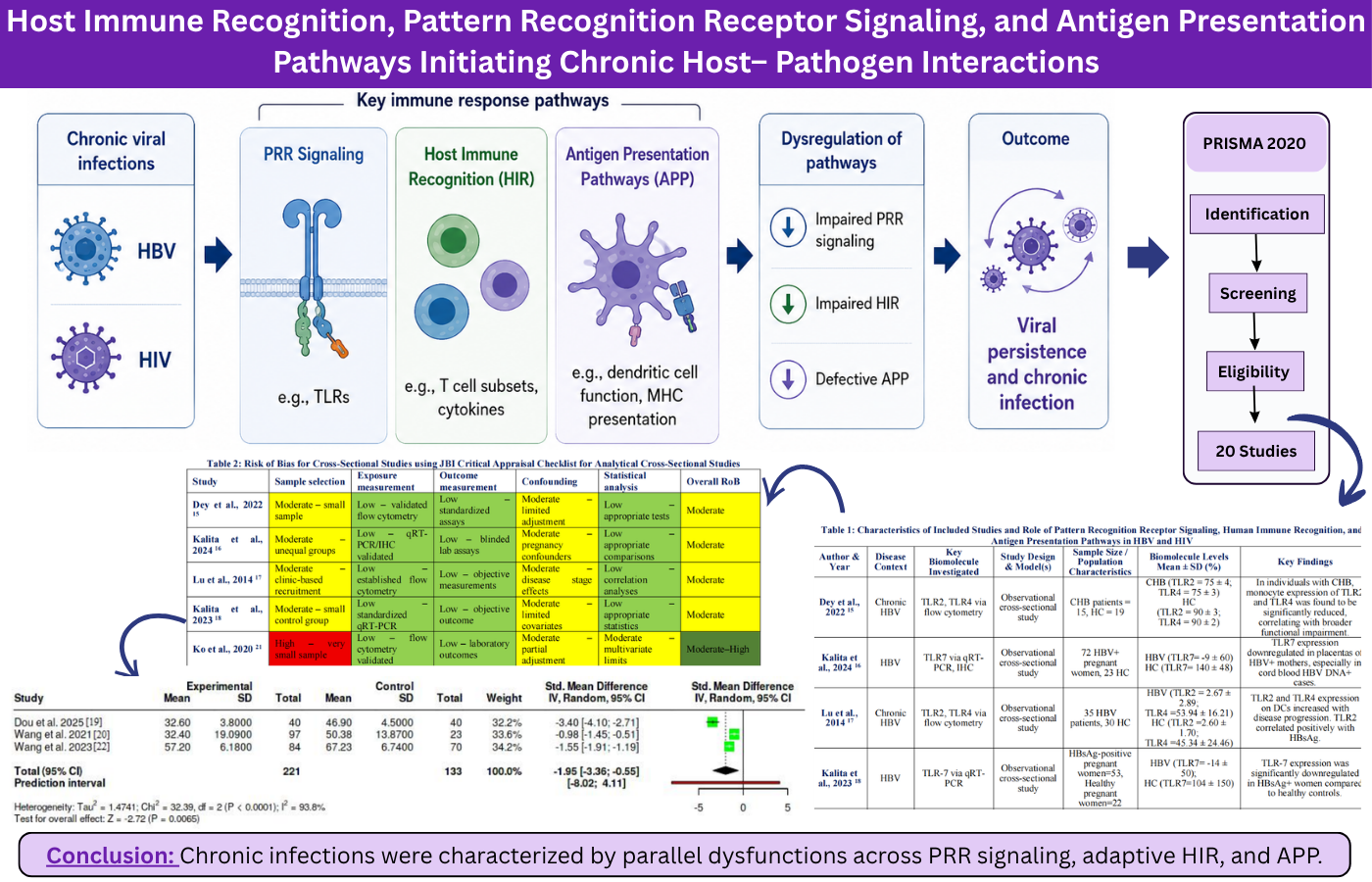
Background: The spread of chronic viral diseases like Hepatitis B (HBV) and Human Immunodeficiency Virus (HIV) became a significant health issue in the world. Pattern recognition receptor (PRR) signaling, antigen presentation pathways (APP), and host immune recognition (HIR) were the key pathways of host immune response that were often dysregulated to allow viral persistence. This study aimed at synthesizing available literature on the dysregulation of PRR signaling, HIR and APP pathways in the development and persistence of chronic HBV and HIV infections. Methods: This study was performed according to PRISMA 2020 guidelines. Research was conducted in PubMed, Scopus, Web of Science, and Google Scholar from 2014 to 2024. Those studies included that involved PRR (e.g. TLRs), HIR (e.g. T cell subsets), and APP (e.g. dendritic cell function) interactions in the chronic HBV and HIV. Non-English articles, reviews, and studies without quantitative data were excluded. Statistical analyses were performed using MetaAnalysisOnline tool. The risk of bias was assessed using appropriate tools, and the certainty of evidence was evaluated using the GRADE framework. Results: The analysis of twelve studies revealed downregulation of TLR7 (SMD: -1.92, 95% CI: -3.19 to -0.66) and reduction of CD3⁺ T cells (SMD: -1.95, 95% CI: -3.36 to -0.55) in patient cohorts versus controls, whereasTLR2, TLR4, CD4⁺, CD8⁺ T, and dendritic cell markers showed no statistically association. Overall risk of bias was evaluated to be moderate, whereas the certainty of evidence was low. Conclusion: Chronic infections were characterized by parallel dysfunctions across PRR signaling, adaptive HIR, and APP.
References
1. Bekker L-G, Beyrer C, Mgodi N, Lewin SR, Delany-Moretlwe S, Taiwo B, et al. HIV infection. Nat Rev Dis Primers. 2023;9(1):42. https://doi.org/10.1038/s41572-023-00452-3
2. Bull RA, Leung P, Gaudieri S, Deshpande P, Cameron B, Walker M, et al. Transmitted/founder viruses rapidly escape from CD8+ T cell responses in acute hepatitis C virus infection. J Virol. 2015;89(10):5478-90. https://doi.org/10.1128/JVI.03717-14
3. Mahmood F, Xu R, Awan MUN, Song Y, Han Q, Xia X, et al. HBV vaccines: advances and development. Vaccines. 2023;11(12):1862. https://doi.org/10.3390/vaccines11121862
4. Klok S, van Dulm E, Boyd A, Generaal E, Eskander S, Joore IK, et al. Hepatitis B Virus (HBV), Hepatitis C Virus (HCV) and Human Immunodeficiency Virus (HIV) infections among undocumented migrants and uninsured legal residents in the Netherlands: A cross-sectional study, 2018–2019. PLoS One. 2021;16(10):e0258932. https://doi.org/10.1371/journal.pone.0258932
5. Sharma M, Wagh P, Shinde T, Trimbake D, Tripathy AS. Exploring the Role of Pattern Recognition Receptors as Immunostimulatory Molecules. Immun Inflamm Dis. 2025;13(5):e70150. https://doi.org/10.1002/iid3.70150
6. Luo X, Qiu Y, Fitzsimonds ZR, Wang Q, Chen Q, Lei YL. Immune escape of head and neck cancer mediated by the impaired MHC-I antigen presentation pathway. Oncogene. 2024;43(6):388-94. https://doi.org/10.1038/s41388-023-02912-2
7. Yang K, Halima A, Chan TA. Antigen presentation in cancer—mechanisms and clinical implications for immunotherapy. Nat Rev Clin Oncol. 2023;20(9):604-23. https://doi.org/10.1038/s41571-023-00789-4
8. Jin M, Fang J, Wang J-j, Shao X, Xu S-w, Liu P-q, et al. Regulation of toll-like receptor (TLR) signaling pathways in atherosclerosis: from mechanisms to targeted therapeutics. Acta Pharmacol Sin. 2023;44(12):2358-75. https://doi.org/10.1038/s41401-023-01123-5
9. Xiang S, Li S, Xu J. Unravelling T cell exhaustion through co‐inhibitory receptors and its transformative role in cancer immunotherapy. Clin Transl Med. 2025;15(5):e70345. https://doi.org/10.1002/ctm2.70345
10. Plebanek MP, Xue Y, Nguyen Y-V, DeVito NC, Wang X, Holtzhausen A, et al. A lactate-SREBP2 signaling axis drives tolerogenic dendritic cell maturation and promotes cancer progression. Sci Immunol. 2024;9(95):eadi4191. https://doi.org/ 10.1126/sciimmunol.adi4191
11. Parums DV. Review articles, systematic reviews, meta-analysis, and the updated preferred reporting items for systematic reviews and meta-analyses (PRISMA) 2020 guidelines. Med Sci Monit. 2021;27:e934475-1. https://doi.org/10.12659/MSM.934475
12. Carra MC, Romandini P, Romandini M. Risk of Bias Evaluation of Cross‐Sectional Studies: Adaptation of the Newcastle‐Ottawa Scale. J Periodontal Res. 2025. https://doi.org/10.1111/jre.13405
13. Barker TH, Stone JC, Sears K, Klugar M, Leonardi-Bee J, Tufanaru C, et al. Revising the JBI quantitative critical appraisal tools to improve their applicability: an overview of methods and the development process. JBI Evid Synth. 2023 Mar;21(3):478–493. https://doi.org/10.11124/JBIES-22-00125
14. Fekete JT, Győrffy B. MetaAnalysisOnline. com: web-based tool for the rapid meta-analysis of clinical and epidemiological studies. J Med Internet Res. 2025;27:e64016. https://preprints.jmir.org/preprint/64016
15. Dey D, Pal S, Chakraborty BC, Bhadra S, Ghosh R, Banerjee S, et al. Multifaceted Defects in Monocytes in Different Phases of Chronic HBV Infection: Persistence After Antiviral Therapy. Microbiol Spectr. 2022. https://doi.org/10.1128/spectrum.01939-22
16. Kalita S, Kalita MJ, Talukdar AJ, Das PP, Dutta K, Hazarika G, et al. Altered TLR7 Expression-Mediated Immune Modulation Is Supportive of Persistent Replication and Intrauterine Transmission of HBV. Viral Immunol. 2024;37(3):149-58. https://doi.org/10.1089/vim.2023.0117
17. Lu X, Xu Q, Bu X, Ma X, Zhang F, Deng Q, et al. Relationship between expression of toll-like receptors 2/4 in dendritic cells and chronic hepatitis B virus infection. Int J Clin Exp Pathol. 2014;7(9):6048. https://doi.org/10.1012/PMC4203221
18. Kalita S, Kalita MJ, Hazarika G, Das PP, Dutta K, Rudola T, et al. Altered expression of endosomal Toll‐like receptors and HBeAg seropositivity may act synergistically towards the vertical transmission of HBV. Am J Reprod Immunol. 2023;90(2):e13747. https://doi.org/10.1111/aji.13747
19. Dou Y, Zhang L, Wang H. Differences and clinical significance of liver-kidney function parameters, inflammatory markers and peripheral blood T lymphocyte subsets in patients with HBV-related acute-on-chronic liver failure. BMC Gastroenterol. 2025;25(1):663. https://doi.org/10.1186/s12876-025-04112-6
20. Wang F, Sun W, Xiao Q, Liang C, Jiang S, Lian Y, et al. Peripheral T lymphocytes predict the severity and prognosis in patients with HBV-related acute-on-chronic liver failure. Medicine. 2021;100(5):e24075. http://dx.doi.org/10.1097/MD.0000000000024075
21. Ko W-S, Yang Y-P, Shen F-P, Wu M-C, Shih C-J, Lu M-C, et al. The study of correlation between serum vitamin D3 concentrations and HBV DNA levels and immune response in chronic hepatitis patients. Nutrients. 2020;12(4):1114. https://doi.org/10.3390/nu12041114
22. Wang L, Qiao Q, Hou L. Changes in the IL-18, IL-22, and T lymphocyte subset levels in patients with hepatitis B-related liver cirrhosis and their predictive values for hepatorenal syndrome. Am J Transl Res. 2023;15(6):3976. https://doi.org/10.1012/37434826
23. Cardinaud S, Urrutia A, Rouers A, Coulon PG, Kervevan J, Richetta C, et al. Triggering of TLR‐3,‐4, NOD2, and DC‐SIGN reduces viral replication and increases T‐cell activation capacity of HIV‐infected human dendritic cells. Eur J Immunol. 2017;47(5):818-29. https://doi.org/10.1002/eji.201646603
24. Gutiérrez-Martínez E, Garrabé SB, Mateos N, Erkizia I, Nieto-Garai JA, Lorizate M, et al. Actin-regulated Siglec-1 nanoclustering influences HIV-1 capture and virus-containing compartment formation in dendritic cells. Elife. 2023;1(2):e78836. https://doi.org/10.7554/eLife.78836
25. Bertram KM, Botting RA, Baharlou H, Rhodes JW, Rana H, Graham JD, et al. Identification of HIV transmitting CD11c+ human epidermal dendritic cells. Nat Commun. 2019;10(1):2759. https://doi.org/10.1038/s41467-019-10697-w
26. Rhodes JW, Botting RA, Bertram KM, Vine EE, Rana H, Baharlou H, et al. Human anogenital monocyte-derived dendritic cells and langerin+ cDC2 are major HIV target cells. Nat Commun. 2021;12(1):2147. https://doi.org/10.1038/s41467-021-22375-x
27. Kayesh MEH, Kohara M, Tsukiyama-Kohara K. Toll-like receptor response to human immunodeficiency virus type 1 or co-infection with hepatitis B or C virus: an overview. Int J Mol Sci. 2023;24(11):9624. https://doi.org/10.3390/ijms24119624
28. Yang G, Wan P, Zhang Y, Tan Q, Qudus MS, Yue Z, et al. Innate immunity, inflammation, and intervention in HBV infection. Viruses. 2022;14(10):2275. https://doi.org/10.3390/v14102275
29. Winkler F, Hipp AV, Ramirez C, Martin B, Villa M, Neuwirt E, et al. Enolase represents a metabolic checkpoint controlling the differential exhaustion programmes of hepatitis virus-specific CD8+ T cells. Gut. 2023;72(10):1971-84. https://doi.org/10.1136/gutjnl-2022-328734
30. Chaudhary O, Trotta D, Wang K, Wang X, Chu X, Bradley C, et al. Patients with HIV-associated cancers have evidence of increased T cell dysfunction and exhaustion prior to cancer diagnosis. J Immunother Cancer. 2022;10(4):e004564. https://doi.org/10.1136/jitc-2022-004564
31. Deng GuangYing DG, Ge Jun GJ, Liu Chao LC, Pang JinKe PJ, Huang ZuXiong HZ, Peng Jie PJ, et al. Impaired expression and function of TLR8 in chronic HBV infection and its association with treatment responses during peg-IFN-α-2a antiviral therapy. Clin Res Hepatol Gastroenterol. 2017. http://dx.doi.org/10.1016/j.clinre.2016.12.006
32. Bošnjak B, Do KTH, Förster R, Hammerschmidt SI. Imaging dendritic cell functions. Immunol Rev. 2022;306(1):137-63. https://doi.org/10.1111/imr.13050
33. Poondla N, Sheykhhasan M, Ahmadyousefi Y, Akbari M, Seyedebrahimi R, Farsani ME, et al. Dendritic cells-winning the fight against HIV. Curr Stem Cell Res Ther. 2023;18(2):174-85. https://doi.org/10.2174/1574888X17666220401102718
34. Ma H, Yan Q-Z, Ma J-R, Li D-F, Yang J-L. Overview of the immunological mechanisms in hepatitis B virus reactivation: Implications for disease progression and management strategies. World J Gastroenterol. 2024;30(10):1295. https://doi.org/10.3748/wjg.v30.i10.1295
35. Eslami M, Arjmand N, Mahmoudian F, Babaeizad A, Tahmasebi H, Fattahi F, et al. Deciphering host–virus interactions and advancing therapeutics for chronic viral infection. Viruses. 2025;17(3):390. https://doi.org/10.3390/v17030390
36. Costa JP, de Carvalho A, Paiva A, Borges O. Insights into immune exhaustion in chronic hepatitis B: A review of checkpoint receptor expression. Pharmaceuticals. 2024;17(7):964.
https://doi.org/10.3390/ph17070964
37. Marks KM, Kang M, Umbleja T, Avihingsanon A, Sugandhavesa P, Cox AL, et al. Immunogenicity and safety of hepatitis B virus (HBV) vaccine with a toll-like receptor 9 agonist adjuvant in HBV vaccine-naïve people with human immunodeficiency virus. Clin Infect Dis. 2023;77(3):414-8. https://doi.org/10.1093/cid/ciad201
38. Elbrolosy AM, Elabd NS, ElGedawy GA, Abozeid M, Abdelkreem M, Montaser B, et al. Toll-like receptor 2 polymorphism and IL-6 profile in relation to disease progression in chronic HBV infection: a case control study in Egyptian patients. Clin Exp Med. 2023;23(1):117-29. https://doi.org/10.1007/s10238-022-00792-6
39. Gay CL, DeBenedette MA, Tcherepanova IY, Gamble A, Lewis WE, Cope AB, et al. Immunogenicity of AGS-004 dendritic cell therapy in patients treated during acute HIV infection. AIDS Res Hum Retroviruses. 2018;34(1):111-22. https://doi.org/10.1089/aid.2017.0071
40. Hoogeveen RC, Dijkstra S, Bartsch LM, Drescher HK, Aneja J, Robidoux MP, Cheney JA, Timm J, Gehring A, de Sousa PS, Ximenez L. Hepatitis B virus-specific CD4 T cell responses differentiate functional cure from chronic surface antigen+ infection. J Hepat. 2022;77(5):1276-86. https://doi.org/10.1016/j.jhep.2022.05.041
Published
Issue
Section
License
Copyright (c) 2026 Ejaz Ahmed, Faiza Azhar, Muhammad Akhter (Author)

This work is licensed under a Creative Commons Attribution-NonCommercial 4.0 International License.
Journal of Biomolecules, Pathogenesis and Therapeutics (JBPT) follows the Attribution Creative Commons-Non commercial (CC BY-NC 4.0) license which allows the users to copy and redistribute the material in any medium or format, remix, transform and build upon the material. The users must give credit to the source and indicate, provide a link to the license, and indicate if changes were made. However, the CC BY-NC 4.0 license restricts the use of material for commercial purposes (Further details are available at website. The Editorial Board of the JBPT endeavors to ensure the accuracy, integrity, and quality of all published content. However, the responsibility of opinions, interpretations, and conclusions expressed in the published articles rests entirely with the authors and do not necessarily reflect the views of the Editorial Board, publisher, or affiliated institutions.