Ultraweak Photon Emission in the Brain: Mechanisms and Prospects for Non-invasive Neural Monitoring
DOI:
https://doi.org/10.68041/jbpt.v1i1/02Keywords:
Brain, Ultraweak Photon Emission, Biophotons, Neural Metabolism, Oxidative Stress, NeuroimagingAbstract
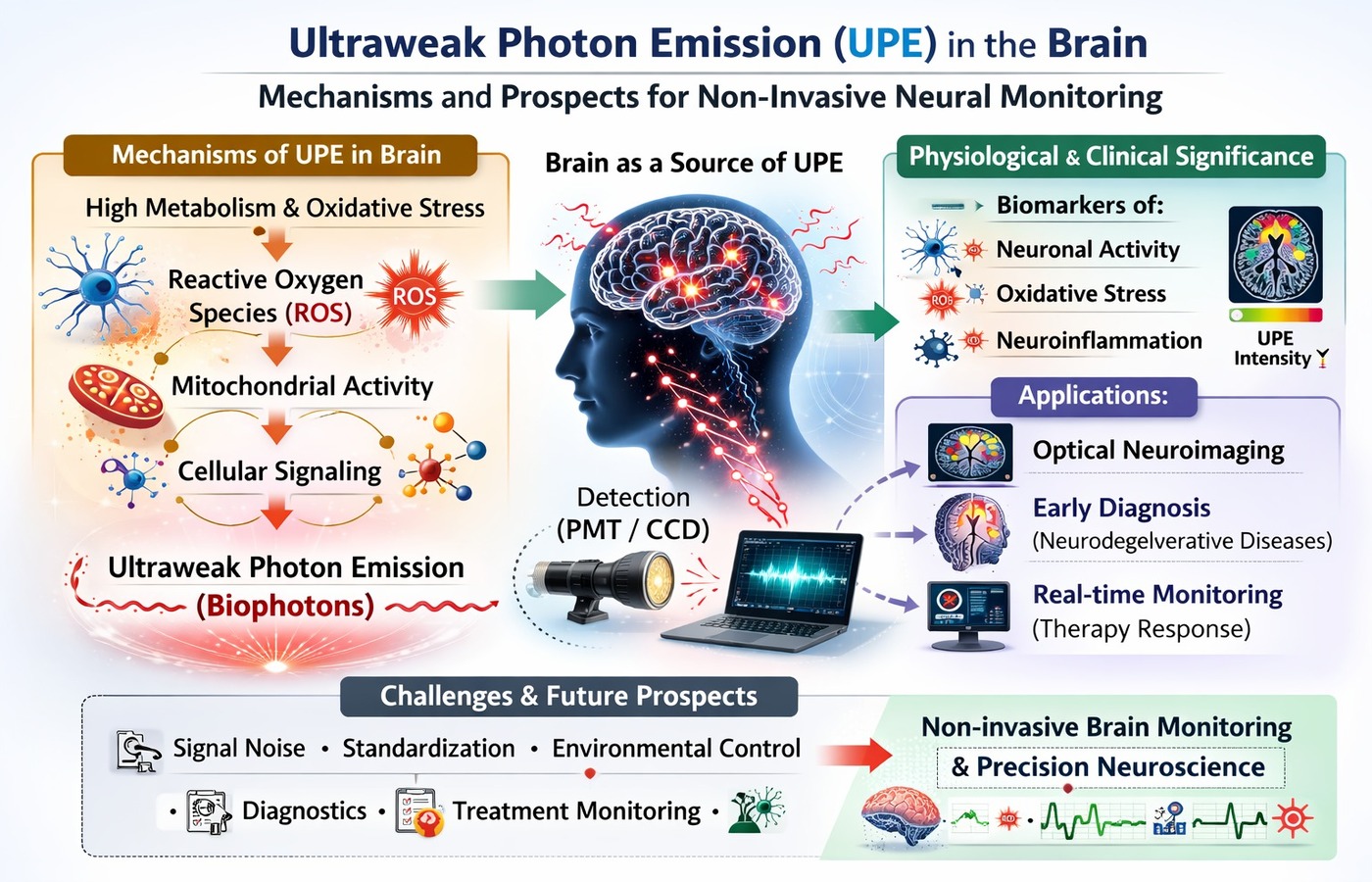
Ultraweak photon emission (UPE) or biophoton emission is a spontaneous emission of low intensity photons by living cells as a byproduct of metabolic and oxidative activities. According to recent research, the brain being a high metabolism and oxidative environment is a significant source of UPE. Though the amount of these emissions is nowhere near the threshold that the human eye can sense, the emissions can be sensed with a sensitive photomultiplier tube or charge-coupled device, which offers a potential non-invasive look at the functioning of the neuron and systemic oxidative stress. In this view, the mechanistic basis of the brain UPE with a particular focus on its connection with the reactive oxygen species production, mitochondrial activity, and cellular signaling pathways is explored. We will talk about the possible relationship between UPE intensity and changes in neuronal metabolic states, neuroinflammatory conditions, and oxidative burden and present a possible biomarker of neurological activity and disease. Moreover, the article addresses the theoretical consequences of UPE in brain monitoring, such as the opportunities of optical-based neuroimaging, the early diagnosis of neurodegenerative diseases, and real-time evaluation of the treatment mode. The problems of measuring such as signal-noise constraints, standardization of detection procedures and environmental interference are also identified to guide future studies. Given that such synthesis of current evidence and conceptual frameworks, this perspective will be used to offer a foundation to integrate brain UPE into experimental and clinical neuroscience. Further development of the given field could eventually allow new methods of diagnostics and monitoring, as well as allow us to learn more about the physiology and pathophysiology of the brain under the influence of non-invasive optical signals.
References
1. Mould RR, Mackenzie AM, Kalampouka I, Nunn AV, Thomas EL, Bell JD, et al. Ultra weak photon emission—a brief review. Front Physiol. 2024 Feb 14;15:1348915. https://doi.org/10.3389/fphys.2024.1348915
2. Sefati N, Esmaeilpour T, Salari V, Zarifkar A, Dehghani F, Ghaffari MK, et al. Monitoring Alzheimer’s disease via ultraweak photon emission. iScience. 2024 Jan 19;27(1). https://doi.org/10.1016/j.isci.2023.108744
3. Esmaeilpour T, Lotfealian A, Anvari M, Namavar M, Karbalaei N, Shahedi A, et al. Effect of methamphetamine on ultraweak photon emission and level of reactive oxygen species in male rat brain. Neurosci Lett. 2023 Mar 28;801:137136. https://doi.org/10.1016/j.neulet.2023.137136
4. Casey H, DiBerardino I, Bonzanni M, Rouleau N, Murugan NJ. Exploring ultraweak photon emissions as optical markers of brain activity. iScience. 2025 Mar 21;28(3):112019. https://doi.org/10.1016/j.isci.2025.112019
5. Vinokurov AY, Stelmashuk OA, Ukolova PA, Zherebtsov EA, Abramov AY. Brain region specificity in reactive oxygen species production and maintenance of redox balance. Free Radic Biol Med. 2021 Oct 1;174:195–201. https://doi.org/10.1016/j.freeradbiomed.2021.08.014
6. Song D, Chen X, Zhou N, Yuan Y, Geng S, Zhang C, et al. Low-intensity pulsed ultrasound triggers beneficial neuromodulation in dementia mice with chronic cerebral hypoperfusion via activation of hippocampal Fndc5/irisin signaling. J Transl Med. 2023 Feb 23;21(1):139. https://doi.org/10.1186/s12967-022-03824-7
7. Wysocka I, Dębowski M. Advantages and limitations of measurement methods for assessing odour nuisance in air—a comparative review. Appl Sci. 2025 May 18;15(10):5622. https://doi.org/10.3390/app15105622
8. Zolotukhin DB, Horkowitz AH, Keidar M. Long-range non-invasive electromagnetic treatment of U87 MG glioblastoma (in vitro) by plasma discharge tube with a concave reflective electrode. IEEE Trans Radiat Plasma Med Sci. 2025 May 7. https://doi.org/10.1109/TRPMS.2025.3567663
9. Du J, Deng T, Cao B, Wang Z, Yang M, Han J. The application and trend of ultra-weak photon emission in biology and medicine. Front Chem. 2023 Feb 17;11:1140128. https://doi.org/10.3389/fchem.2023.1140128
10. Moazed KT. The quantum biology of consciousness and visual perception. In: Quantum Biology of the Eye: Understanding the Essentials. Cham: Springer International Publishing; 2023. p. 119–160. https://doi.org/10.1007/978-3-031-32060-6_7
11. Hees JT, Harbauer AB. Metabolic regulation of mitochondrial protein biogenesis from a neuronal perspective. Biomolecules. 2022 Oct 29;12(11):1595. https://doi.org/10.3390/biom12111595
12. Manoharan RR, Prasad A, Pospíšil P, Kzhyshkowska J. ROS signaling in innate immunity via oxidative protein modifications. Front Immunol. 2024 Mar 7;15:1359600. https://doi.org/10.3389/fimmu.2024.1359600
13. Dev AV, Basavarajappa MG, Deshpande SS, Mukherjee P, Ajayakumar A, Muthu C, et al. Thermally induced reversible fluorochromism by self-trapped excitonic emission in a two-dimensional hybrid copper(I)-halide single crystal. Chem Mater. 2024 Jun 6;36(12):5912–5921. https://doi.org/10.1021/acs.chemmater.4c00045
14. Naumova EV, Vladimirov YA, Tuchin VV, Namiot VA, Volodyaev IV. Methods of studying ultraweak photon emission from biological objects: III. Physical methods. Biophysics. 2022 Feb;67(1):27–58. https://doi.org/10.1134/S0006350922010109
15. Sun W, Chen X, Mei Y, Li X, Yang Y, An L. Co-exposure of melamine and cyanuric acid as a risk factor for oxidative stress and energy metabolism: adverse effects on hippocampal neuronal and synaptic function induced by excessive ROS production. Ecotoxicol Environ Saf. 2022 Dec 1;247:114230. https://doi.org/10.1016/j.ecoenv.2022.114230
16. Liebert A, Capon W, Pang V, Vila D, Bicknell B, McLachlan C, et al. Photophysical mechanisms of photobiomodulation therapy as precision medicine. Biomedicines. 2023 Jan 17;11(2):237. https://doi.org/10.3390/biomedicines11020237
17. Selivanov VA, Zagubnaya OA, Nartsissov YR, Cascante M. Unveiling a key role of oxaloacetate–glutamate interaction in regulation of respiration and ROS generation in nonsynaptic brain mitochondria using a kinetic model. PLoS One. 2021 Aug 3;16(8):e0255164. https://doi.org/10.1371/journal.pone.0255164
18. Nampoothiri S, Nogueiras R, Schwaninger M, Prevot V. Glial cells as integrators of peripheral and central signals in the regulation of energy homeostasis. Nat Metab. 2022 Jul;4(7):813–825. https://doi.org/10.1038/s42255-022-00610-z
19. Salari V, Valian H, Bassereh H, Bókkon I, Barkhordari A. Ultraweak photon emission in the brain. J Integr Neurosci. 2015 Sep 1;14(3):419–429. https://doi.org/10.1142/S0219635215300012
20. Mulica P, Grünewald A, Pereira SL. Astrocyte–neuron metabolic crosstalk in neurodegeneration: a mitochondrial perspective. Front Endocrinol (Lausanne). 2021 May 7;12:668517. https://doi.org/10.3389/fendo.2021.668517
21. Endale HT, Tesfaye W, Mengstie TA. ROS-induced lipid peroxidation and their role in ferroptosis. Front Cell Dev Biol. 2023 Aug 1;11:1226044. https://doi.org/10.3389/fcell.2023.1226044
22. Maharjan PS, Bhattarai HK. Singlet oxygen, photodynamic therapy, and mechanisms of cancer cell death. J Oncol. 2022;2022:7211485. https://doi.org/10.1155/2022/7211485
23. Zapata F, Pastor-Ruiz V, Ortega-Ojeda F, Montalvo G, Ruiz-Zolle AV, Garcia-Ruiz C. Human ultra-weak photon emission as a non-invasive spectroscopic tool for diagnosis of internal states—a review. J Photochem Photobiol B. 2021 Mar 1;216:112141. https://doi.org/10.1016/j.jphotobiol.2021.112141
24. Bolt T, Nomi JS, Bzdok D, Salas JA, Chang C, Thomas Yeo BT, et al. A parsimonious description of global functional brain organization in three spatiotemporal patterns. Nat Neurosci. 2022 Aug;25(8):1093–1103. https://doi.org/10.1038/s41593-022-01118-1
25. Linne ML. Computational modeling of neuron–glia signaling interactions to unravel cellular and neural circuit functioning. Curr Opin Neurobiol. 2024 Apr 1;85:102838. https://doi.org/10.1016/j.conb.2023.102838
26. Open AI. ChatGPT (GPT-4o) [Computer Software]. 2026 [cited 2026 Dec 18]. Available from: https://chatgpt.com
Downloads
Published
Issue
Section
License
Copyright (c) 2025 Samreen Memon, Seemya kaya, Hafiz Muhammad Haseeb Khaliq (Author)

This work is licensed under a Creative Commons Attribution-NonCommercial 4.0 International License.
Journal of Biomolecules, Pathogenesis and Therapeutics (JBPT) follows the Attribution Creative Commons-Non commercial (CC BY-NC 4.0) license which allows the users to copy and redistribute the material in any medium or format, remix, transform and build upon the material. The users must give credit to the source and indicate, provide a link to the license, and indicate if changes were made. However, the CC BY-NC 4.0 license restricts the use of material for commercial purposes (Further details are available at website. The Editorial Board of the JBPT endeavors to ensure the accuracy, integrity, and quality of all published content. However, the responsibility of opinions, interpretations, and conclusions expressed in the published articles rests entirely with the authors and do not necessarily reflect the views of the Editorial Board, publisher, or affiliated institutions.