Patterns of Supportive Medication Use Among Oncology Patients: A Cross-Sectional Study
DOI:
https://doi.org/10.68041/jbpt.v2i3/05Keywords:
Antiemetics, Drug Interactions, drug utilization, Neoplasms, Polypharmacy, Treatment OutcomeAbstract
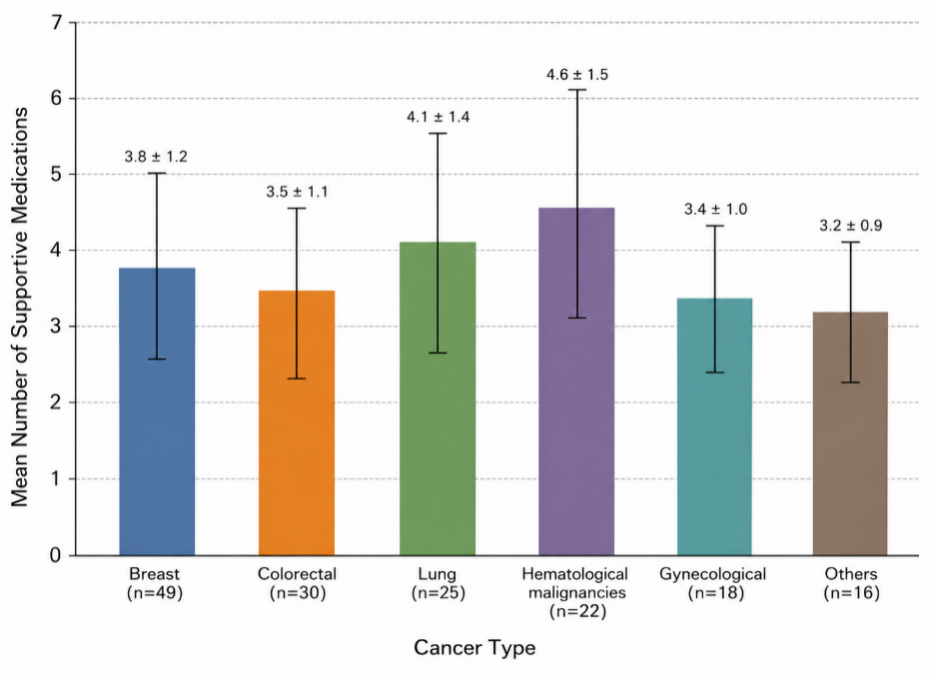
Background: In oncology, supportive medicines play an important role in preventing or managing treatment toxicity and in maintaining tolerance to systemic cancer treatment. This study aimed to describe the supportive medication use, indications, medication-related problems, and clinical outcomes of oncology patients receiving chemotherapy. Methods: This study involved 160 adults with solid or hematological malignancies treated with systemic chemotherapy. Cancer type, chemotherapy regimen, supportive medications, therapeutic indications, polypharmacy, medication-related problems, adverse drug reactions, and treatment outcomes were included. Data frequencies, percentages, means, standard deviations, and medians were summarized in the results in SPSS version 26.0. Results: The age of the study population was 55.3 ± 12.8 years, with 90(56.3%) being female. In total, 151(94.4%) of patients had supportive drugs. The most commonly used drugs were antiemetics (90.6%), proton pump inhibitors 116(72.5%), corticosteroids 104(65.0%), and analgesics 97(60.6%). The mean supportive-medication burden was greatest for patients with hematological malignancies (4.6 ± 1.5). A total of 47(29.4%) patients had five or more supportive medicines, or "polypharmacy. 33(20.6%) had potential drug interactions, and 118(73.8%) had good symptom control, and 127(79.4%) finished chemotherapy as planned. Conclusions: Medications that supported patients' treatment and symptom management were widespread and effective. Medication reconciliation, screening for medication interactions, and pharmacist-led review of medication regimens can help prevent polypharmacy and medication-related problems, enhancing the safety and effectiveness of supportive care.
References
1. Scotté F, Taylor A, Davies A. Supportive care: the “keystone” of modern oncology practice. Cancers (Basel). 2023;15(15):3860. https://doi.org/10.3390/cancers15153860 DOI: https://doi.org/10.3390/cancers15153860
2. Kaye AD, Turpin DB, Shah S, Abbott B, Hollander AV, Burroughs CR, et al. The pharmacological and clinical roles of antiemetics: a narrative review. Cureus. 2025;17(1):e77370. https://doi.org/10.7759/cureus.77370 DOI: https://doi.org/10.7759/cureus.77370
3. Basch E, Prestrud AA, Hesketh PJ, Kris MG, Feyer PC, Somerfield MR, et al. Antiemetics: American Society of Clinical Oncology clinical practice guideline update. J Clin Oncol. 2011;29(31):4189-4198. https://doi.org/10.1200/JCO.2010.34.4614 DOI: https://doi.org/10.1200/JCO.2010.34.4614
4. Gu YL, Xie JM, Ren J, Cao H, Wei JR, Chen C, et al. Dexamethasone-sparing regimen is an effective and safe alternative in overall antiemetic protection: a systematic review and meta-analysis. Medicine (Baltimore). 2019;98(39):e17364. https://doi.org/10.1097/MD.0000000000017364 DOI: https://doi.org/10.1097/MD.0000000000017364
5. Scarborough B, Smith CB. Optimal pain management for patients with cancer in the modern era. CA Cancer J Clin. 2018;68(3):182-196. https://doi.org/10.3322/caac.21453 DOI: https://doi.org/10.3322/caac.21453
6. Given BA, Given CW, Sikorskii A, Vachon E, Banik A. Medication burden of treatment using oral cancer medications. Asia Pac J Oncol Nurs. 2017;4(4):275-282. https://doi.org/10.4103/apjon.apjon_7_17 DOI: https://doi.org/10.4103/apjon.apjon_7_17
7. Tawengi MM, Baraka J, Al Shibly R, Danjuma MI. Prevalence and determinants of polypharmacy among cancer patients: a systematic review and meta-analysis. Syst Rev. 2026;15(1):176. https://doi.org/10.1186/s13643-026-03068-2
8. Mohamed MR, Juba K, Awad H, Flannery M, Culakova E, Wells M, et al. Effect of polypharmacy and potentially inappropriate medications on physical functional decline among older adults with advanced cancer receiving systemic treatment. Support Care Cancer. 2024;32(10):674. https://doi.org/10.1007/s00520-024-08877-6
9. Katende-Kyenda LN. Patient-drug-related factors associated with nonadherence to chronic treatment in patients attending a primary care setting in South Africa. Hospitals. 2026;3(2):8. https://doi.org/10.3390/hospitals3020008 DOI: https://doi.org/10.3390/hospitals3020008
10. Sawaid IO, Samson AO. Proton pump inhibitors and cancer risk: a comprehensive review of epidemiological and mechanistic evidence. J Clin Med. 2024;13(7):1970. https://doi.org/10.3390/jcm13071970 DOI: https://doi.org/10.3390/jcm13071970
11. Xiang HW, Shen YY, Wang JX, Zhao Y, Yi BW, Zhao N. Impact of pharmacist-led interventions on oncology drug therapy outcomes: a systematic review and meta-analysis. Int J Pharm Pract. 2026;34(2):117-129. https://doi.org/10.1093/ijpp/riaf098 DOI: https://doi.org/10.1093/ijpp/riaf098
12. Sullivan KM, Dean A, Soe MM. OpenEpi: a web-based epidemiologic and statistical calculator for public health. Public Health Rep. 2009;124(3):471–474. https://doi.org/10.1177/003335490912400320 DOI: https://doi.org/10.1177/003335490912400320
13. Goodyear MDE, Krleza-Jeric K, Lemmens T. The Declaration of Helsinki. BMJ. 2007;335(7621):624–625. https://doi.org/10.1136/bmj.39339.610000.BE DOI: https://doi.org/10.1136/bmj.39339.610000.BE
14. Herrstedt J, Celio L, Hesketh PJ, Zhang L, Navari RM, Chan A, et al. 2023 updated MASCC/ESMO consensus recommendations: prevention of nausea and vomiting following high-emetic-risk antineoplastic agents. Support Care Cancer. 2024;32(1):47. https://doi.org/10.1007/s00520-023-08221-4 DOI: https://doi.org/10.1007/s00520-023-08221-4
15. Renaux Torres MC, Robinson PD, Sung L, Dupuis LL; International Pediatric Oncology Supportive Care Guideline Network. Outcomes of chemotherapy-induced nausea and vomiting guideline adherence in pediatric and adult patients: a systematic review. Support Care Cancer. 2024;32(7):455. https://doi.org/10.1007/s00520-024-08623-y DOI: https://doi.org/10.1007/s00520-024-08623-y
16. Navari RM, Nelson WW, Shoaib S, Singh R, Zhang W, Bailey WL. Real-world treatment outcomes, healthcare resource use, and costs associated with antiemetics among cancer patients on cisplatin-based chemotherapy. Adv Ther. 2023;40(7):3217-3226. https://doi.org/10.1007/s12325-023-02537-7 DOI: https://doi.org/10.1007/s12325-023-02537-7
17. Shin Y, Shin S, Ryu H, Lee J, Lee EE. Impact of oncology pharmacy services on the management of chemotherapy-induced nausea and vomiting: a systematic review and meta-analysis. Am J Health Syst Pharm. 2025;82(3):e131-e147. https://doi.org/10.1093/ajhp/zxae237 DOI: https://doi.org/10.1093/ajhp/zxae237
18. Raoul JL, Moreau-Bachelard C, Gilabert M, Edeline J, Frénel JS. Drug-drug interactions with proton pump inhibitors in cancer patients: an underrecognized cause of treatment failure. ESMO Open. 2023;8(1):100880. https://doi.org/10.1016/j.esmoop.2023.100880 DOI: https://doi.org/10.1016/j.esmoop.2023.100880
19. Chow R, Celio L, Im J, Caini S, Eng L, Prsic E, et al. Multi-day versus single-day dexamethasone for the prophylaxis of chemotherapy-induced nausea and vomiting: systematic review and meta-analysis. Support Care Cancer. 2024;32(11):736. https://doi.org/10.1007/s00520-024-08934-0 DOI: https://doi.org/10.1007/s00520-024-08934-0
20. Paice JA, Bohlke K, Barton D, Craig DS, El-Jawahri A, Hershman DL, et al. Use of opioids for adults with pain from cancer or cancer treatment: ASCO guideline. J Clin Oncol. 2023;41(4):914-930. https://doi.org/10.1200/JCO.22.02198 DOI: https://doi.org/10.1200/JCO.22.02198
21. Baig H, Somlo B, Eisen M, Stryker S, Bensink M, Morrow PK. Appropriateness of granulocyte colony-stimulating factor use in patients receiving chemotherapy by febrile neutropenia risk level. J Oncol Pharm Pract. 2019;25(7):1576-1585. https://doi.org/10.1177/1078155218799859 DOI: https://doi.org/10.1177/1078155218799859
22. Tawengi MM, Baraka J, Al Shibly R, Danjuma MI. Prevalence and determinants of polypharmacy among cancer patients: a systematic review and meta-analysis. Syst Rev. 2026;15(1):176. https://doi.org/10.1186/s13643-026-03068-2 DOI: https://doi.org/10.1186/s13643-026-03068-2
23. Mohamed MR, Juba K, Awad H, Flannery M, Culakova E, Wells M, et al. Effect of polypharmacy and potentially inappropriate medications on physical functional decline among older adults with advanced cancer receiving systemic treatment. Support Care Cancer. 2024;32(10):674. https://doi.org/10.1007/s00520-024-08877-6 DOI: https://doi.org/10.1007/s00520-024-08877-6
24. Venugopal J, Shalini S, Rajasekaran A, Karnan D. Drug-related problems in cancer patients: a systematic review. J Oncol Pharm Pract. 2024;30(3):562-571. https://doi.org/10.1177/10781552241229662 DOI: https://doi.org/10.1177/10781552241229662
25. Fentie AM, Huluka SA, Gebremariam GT, Gebretekle GB, Abebe E, Fenta TG. Impact of pharmacist-led interventions on medication-related problems among patients treated for cancer: a systematic review and meta-analysis of randomized controlled trials. Res Social Adm Pharm. 2024;20(5):487-497. https://doi.org/10.1016/j.sapharm.2024.02.006 DOI: https://doi.org/10.1016/j.sapharm.2024.02.006
Published
Issue
Section
License
Copyright (c) 2026 Khadija Aslam, Raeesa Ali, Ramisha Rehmat

This work is licensed under a Creative Commons Attribution-NonCommercial 4.0 International License.
Journal of Biomolecules, Pathogenesis and Therapeutics (JBPT) follows the Attribution Creative Commons-Non commercial (CC BY-NC 4.0) license which allows the users to copy and redistribute the material in any medium or format, remix, transform and build upon the material. The users must give credit to the source and indicate, provide a link to the license, and indicate if changes were made. However, the CC BY-NC 4.0 license restricts the use of material for commercial purposes (Further details are available at website. The Editorial Board of the JBPT endeavors to ensure the accuracy, integrity, and quality of all published content. However, the responsibility of opinions, interpretations, and conclusions expressed in the published articles rests entirely with the authors and do not necessarily reflect the views of the Editorial Board, publisher, or affiliated institutions.