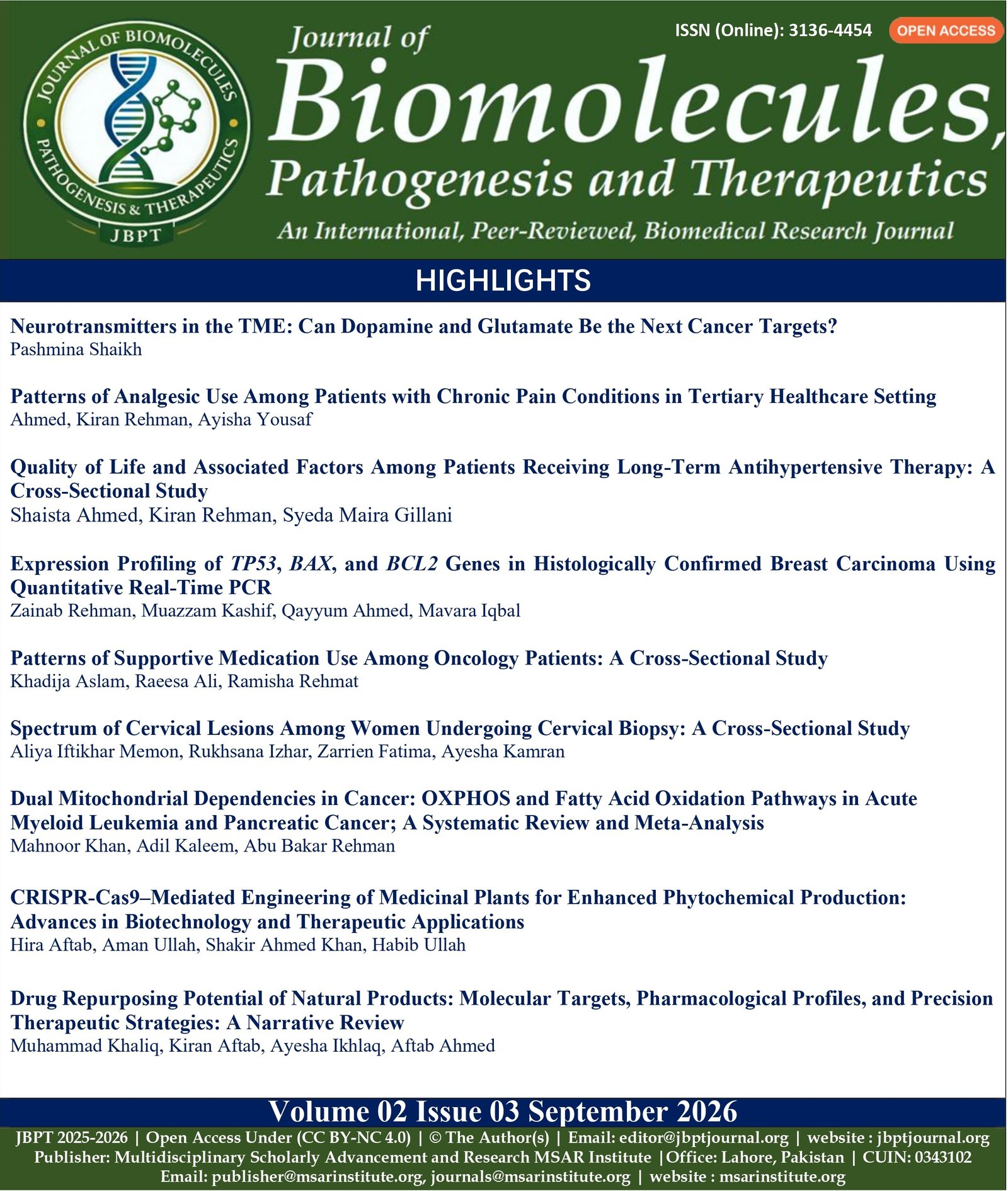
Neurotransmitters in the TME: Can Dopamine and Glutamate Be the Next Cancer Targets?
DOI:
https://doi.org/10.68041/jbpt.v2i3/01Keywords:
Immunomodulation, Neurotransmitter Agents, Receptors, Dopamine, Receptors, Glutamate, Tumor MicroenvironmentAbstract
Immune and stromal factors are not the only factors that create the tumor microenvironment (TME) because neuromodulatory signals can also change tumor biology. Classical neurotransmitters of the central nervous system, dopamine and glutamate, are becoming known to have an active role in tumor progression, immune modulation, angiogenesis, and metabolic reprogramming of the TME. Dopamine receptors enable dopaminergic to regulate tumor cell proliferation, vascular permeability, and recruitment/activation of immune cells, and glutamatergic to regulate cancer-cell bioenergetics, migration, and excitatory paracrine interactions with stromal cells. Preclinical evidence indicates that receptor heterogeneity, setting-dependent effects, and possible neurotoxicity make it difficult to translate findings from preclinical studies that propose that manipulation of such pathways can sensitize tumors to chemotherapy and immunotherapy. The objective is to summarize existing mechanistic understanding of the roles of dopamine and glutamate in the TME, assess the therapeutic interventions to target the receptors or modulate the metabolism, and outline the main challenges that the biomarker choice, spatial heterogeneity, and safety need to be overcome to develop neuromodulatory oncology. Neurotransmitter network targeting is an exciting, but challenging, area that would add value to the currently available TME-directed therapies and increase the precision of the oncology group.
References
1. Restaino AC, Vermeer PD. Neural regulations of the tumor microenvironment. FASEB Bioadv. 2021;491): 29–42. https://doi.org/10.1096/fba.2021-00066 DOI: https://doi.org/10.1096/fba.2021-00066
2. Xiao L, Li X, Fang C, Yu J, Chen T. Neurotransmitters: promising immune modulators in the tumor microenvironment. Front Immunol. 2023;14:1118637. https://doi.org/10.3389/fimmu.2023.1118637 DOI: https://doi.org/10.3389/fimmu.2023.1118637
3. Buck SA, Quincy Erickson-Oberg M, Logan RW, Freyberg Z. Relevance of interactions between dopamine and glutamate neurotransmission in schizophrenia. Mol Psychiatry. 2022;27(9): 3583–9. https://doi.org/10.1038/s41380-022-01649-w DOI: https://doi.org/10.1038/s41380-022-01649-w
4. Sobczuk P, Łomiak M, Cudnoch-Jędrzejewska A. Dopamine D1 receptor in cancer. Cancers. 2020;12(11):3232. https://doi.org/10.3390/cancers12113232 DOI: https://doi.org/10.3390/cancers12113232
5. Yi H, Talmon G, Wang J. Glutamate in cancers: from metabolism to signaling. J Biomed Res. 2020;34(1):260–70. https://doi.org/10.7555/JBR.34.20190037 DOI: https://doi.org/10.7555/JBR.34.20190037
6. García-Gaytán AC, Hernández-Abrego A, Díaz-Muñoz M, Méndez I. Glutamatergic system components as potential biomarkers and therapeutic targets in cancer in non-neural organs. Front Endocrinol. 2022;13:1029210. https://doi.org/10.3389/fendo.2022.1029210 DOI: https://doi.org/10.3389/fendo.2022.1029210
7. Shalabi S, Belayachi A, Larrivée B. Involvement of neuronal factors in tumor angiogenesis and the shaping of the cancer microenvironment. Front Immunol. 2024;15:1284629. https://doi.org/10.3389/fimmu.2024.1284629 DOI: https://doi.org/10.3389/fimmu.2024.1284629
8. Cheng JN, Yuan YX, Zhu B, Jia Q. Myeloid-derived suppressor cells: a multifaceted accomplice in tumor progression. Front Cell Dev Biol. 2021;9:740827. https://doi.org/10.3389/fcell.2021.740827 DOI: https://doi.org/10.3389/fcell.2021.740827
9. Kumar MA, Baba SK, Khan IR, Khan MS, Husain FM, Ahmad S, et al. Glutamine metabolism: molecular regulation, biological functions, and diseases. MedComm. 2025;6(7): e70120. https://doi.org/10.1002/mco2.70120 DOI: https://doi.org/10.1002/mco2.70120
10. Wang Z, Xu C, Wang Q, Wang Y. Repurposing of nervous system drugs for cancer treatment: recent advances, challenges, and future perspectives. Discov Oncol. 2025;16(1):396. https://doi.org/10.1007/s12672-025-02067-4 DOI: https://doi.org/10.1007/s12672-025-02067-4
11. Magdaleno Roman JY, Chapa González C. Glutamate and excitotoxicity in central nervous system disorders: ionotropic glutamate receptors as a target for neuroprotection. Neuroprotection. 2024;2(02):137–50. https://doi.org/10.1002/nep3.46 DOI: https://doi.org/10.1002/nep3.46
12. Zhou Y, Liu Z, Yu A, Zhao G, Chen B. Immune checkpoint inhibitor combined with antiangiogenic agent synergistically improving the treatment efficacy for solid tumors. Immunotargets Ther. 2024;13:813–29. https://doi.org/10.2147/ITT.S494670 DOI: https://doi.org/10.2147/ITT.S494670
13. Goenka A, Khan F, Verma B, Sinha P, Dmello CC, Jogalekar MP, et al. Tumor microenvironment signaling and therapeutics in cancer progression. Cancer Commun. 2023;43(5): 525–61. https://doi.org/10.1002/cac2.12416 DOI: https://doi.org/10.1002/cac2.12416
14. Bray LJ, Hutmacher DW, Bock N. Addressing patient specificity in the engineering of tumor models. Front Bioeng Biotechnol. 2019;7:217. https://doi.org/10.3389/fbioe.2019.00217 DOI: https://doi.org/10.3389/fbioe.2019.00217
15. Thiel V, Sur D, Picoli CC, McErlain T, Couto K, Simon DJ, et al. Next-gen tools in cancer neuroscience. Cell Rep. 2025;44(9): 116258. https://doi.org/10.1016/j.celrep.2025.116258 DOI: https://doi.org/10.1016/j.celrep.2025.116258
16. Flanary VL, Fisher JL, Wilk EJ, Howton TC, Lasseigne BN. Computational advancements in cancer combination therapy prediction. JCO Precis Oncol. 2023;7:e2300261. https://doi.org/10.1200/PO.23.00261 DOI: https://doi.org/10.1200/PO.23.00261
Published
Issue
Section
License
Copyright (c) 2026 Pashmina Shaikh

This work is licensed under a Creative Commons Attribution-NonCommercial 4.0 International License.
Journal of Biomolecules, Pathogenesis and Therapeutics (JBPT) follows the Attribution Creative Commons-Non commercial (CC BY-NC 4.0) license which allows the users to copy and redistribute the material in any medium or format, remix, transform and build upon the material. The users must give credit to the source and indicate, provide a link to the license, and indicate if changes were made. However, the CC BY-NC 4.0 license restricts the use of material for commercial purposes (Further details are available at website. The Editorial Board of the JBPT endeavors to ensure the accuracy, integrity, and quality of all published content. However, the responsibility of opinions, interpretations, and conclusions expressed in the published articles rests entirely with the authors and do not necessarily reflect the views of the Editorial Board, publisher, or affiliated institutions.