Quality of Life and Associated Factors Among Patients Receiving Long-Term Antihypertensive Therapy: A Cross-Sectional Study
DOI:
https://doi.org/10.68041/jbpt.v2i3/03Keywords:
Antihypertensive Agents, Blood Pressure; Hypertension, Lifestyle, Medication Adherence, Quality of LifeAbstract
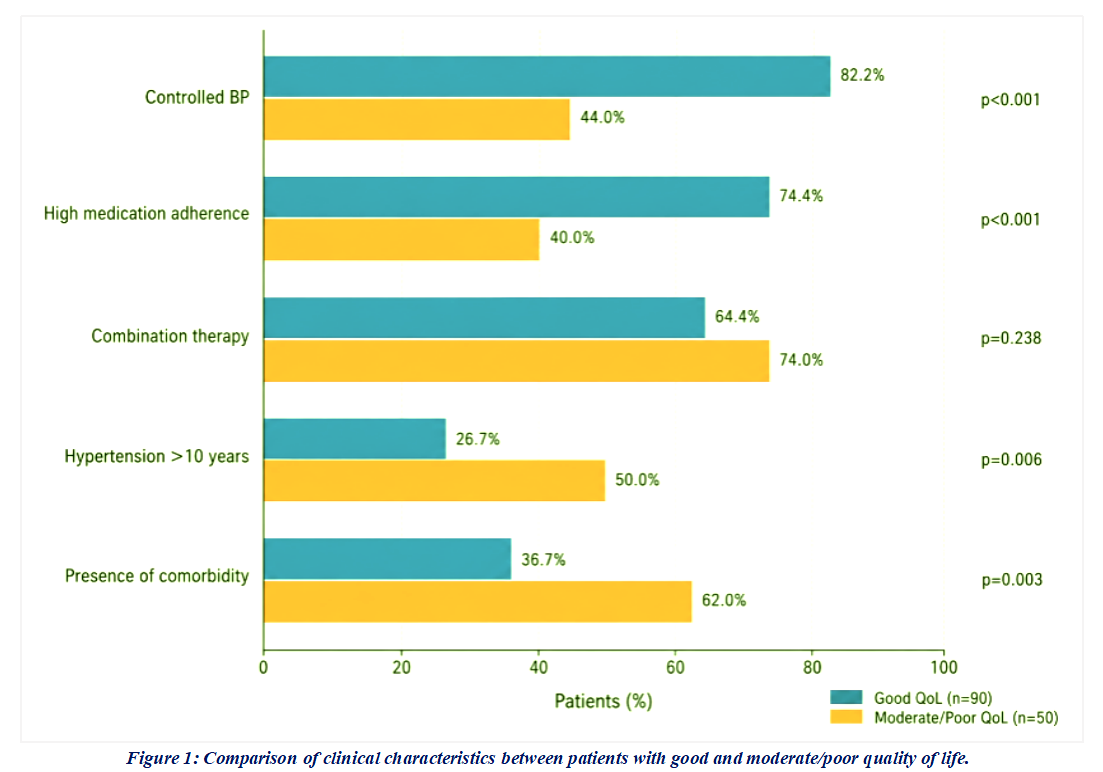
Background: Hypertension is a condition that requires treatment for life and can impact patients' physical, psychological, and social health. The purpose of this study was to evaluate the health-related quality of life and related factors in patients under long-term antihypertensive treatment. Methods: This descriptive cross-sectional study (n=140) included adult patients undergoing antihypertensive treatment for at least one year via consecutive sampling technique. A structured questionnaire and medical-record review were used to collect data regarding demographic and clinical features, treatment regimen, adherence to treatment, blood-pressure control, quality of life, and treatment-related problems. The WHOQOL-BREF was used to measure health-related quality of life. Data were analysed with descriptive statistics and Chi square / Fisher exact test (p<0.05) using SPSS version 26.0. Results: The mean age was 58.6 ± 11.2 years, and 77(55.0%) were female. 95(67.9%) used combination therapy, and 96(68.6%) achieved controlled blood pressure. Overall, 90(64.3%) participants had a good quality of life. Patients with good quality of life were more likely to have controlled blood pressure and higher medication adherence rates than those with moderate/poor quality of life (74 (82.2%) vs. 22 (44.0%), p<0.001; 67 (74.4%) vs. 20 (40.0%), p<0.001, respectively). Poor quality of life was associated with hypertension (which persisted more than 10 years) and comorbidity. The most frequent problem was difficulty with lifestyle modification 48 (34.3%). Conclusion: The quality of life was good in most patients, but physical functioning and vitality continued to be problematic.References
1. Mohammad A, Yadav I, Lashari UG, Sabra S, Sabra A, Sabra M, et al. Hypertension and risk of stroke: a systematic review and meta-analysis. Cureus. 2025;17(12):e99863. https://doi.org/10.7759/cureus.99863 DOI: https://doi.org/10.7759/cureus.99863
2. Anaswara DP, Thomas SC, Olickal JJ, Sarma PS, Thankappan KR. Hypertension control rate, associated factors, facilitators, and barriers in Kerala, India: a mixed-methods study. Cureus. 2025;17(8):e91073. https://doi.org/10.7759/cureus.91073 DOI: https://doi.org/10.7759/cureus.91073
3. Sheppard JP, Stevens S, Stevens R, Martin U, Mant J, Hobbs FDR, et al. Benefits and harms of antihypertensive treatment in low-risk patients with mild hypertension. JAMA Intern Med. 2018;178(12):1626-1634. https://doi.org/10.1001/jamainternmed.2018.4684 DOI: https://doi.org/10.1001/jamainternmed.2018.4684
4. Kaplan RM, Hays RD. Health-related quality of life measurement in public health. Annu Rev Public Health. 2022;43(1):355-373. https://doi.org/10.1146/annurev-publhealth-052120-012811 DOI: https://doi.org/10.1146/annurev-publhealth-052120-012811
5. Rocha NS, Power MJ, Bushnell DM, Fleck MP. Cross-cultural evaluation of the WHOQOL-BREF domains in primary care depressed patients using Rasch analysis. Med Decis Making. 2012;32(1):41-55. https://doi.org/10.1177/0272989X11415112 DOI: https://doi.org/10.1177/0272989X11415112
6. Amlak BT, Getie A, Messelu MA, Ayenew T, GebreEyesus FA, Emire MS, et al. Health-related quality of life among adult hypertensive patients globally: a systematic review and meta-analysis. BMJ Public Health. 2025;3(2):e001662. https://doi.org/10.1136/bmjph-2024-001662 DOI: https://doi.org/10.1136/bmjph-2024-001662
7. Kandasamy G, Almanasef M, Orayj K, Alshahrani AM, Alahmari SM. Assessing the impact of hypertension on health-related quality of life: insights from sociodemographic, economic, and clinical features using SF-36. Healthcare (Basel). 2025;13(7):838. https://doi.org/10.3390/healthcare13070838 DOI: https://doi.org/10.3390/healthcare13070838
8. Penmatsa KR, Teki P, Gupta A. Hypertension in the hospitalized patient: an update. Nefrologia (Engl Ed). 2021;41(6):605-611. https://doi.org/10.1016/j.nefroe.2021.11.015 DOI: https://doi.org/10.1016/j.nefro.2020.12.020
9. Choudhry NK, Kronish IM, Vongpatanasin W, Ferdinand KC, Pavlik VN, Egan BM, et al. Medication adherence and blood pressure control: a scientific statement from the American Heart Association. Hypertension. 2022;79(1):e1-e14. https://doi.org/10.1161/HYP.0000000000000203 DOI: https://doi.org/10.1161/HYP.0000000000000203
10. Lee CJ, Park WJ, Suh JW, Choi EK, Jeon DW, Lim SW, et al. Relationship between health-related quality of life and blood pressure control in patients with uncontrolled hypertension. J Clin Hypertens (Greenwich). 2020;22(8):1415-1424. https://doi.org/10.1111/jch.13941
11. Akeroyd JM, Chan WJ, Kamal AK, Palaniappan L, Virani SS. Adherence to cardiovascular medications in the South Asian population: a systematic review of current evidence and future directions. World J Cardiol. 2015;7(12):938-947. https://doi.org/10.4330/wjc.v7.i12.938 DOI: https://doi.org/10.4330/wjc.v7.i12.938
12. Vlad AL, Popazu CR, Lescai AM, Prisacaru DI, Voinescu DC, Baltă AAS. The impact of comorbidities on health-related quality of life among patients with rheumatoid arthritis. Healthcare (Basel). 2026;14(2):256. https://doi.org/10.3390/healthcare14020256 DOI: https://doi.org/10.3390/healthcare14020256
13. Banda S, Kohler IV, Kohler HP, Chichlowska SC. Health-related quality of life and its predictors among hypertensive adults 45 years and older in rural Malawi: a population-based study. Malawi Med J. 2024;36(2):97-106. https://doi.org/10.4314/mmj.v36i2.6 DOI: https://doi.org/10.4314/mmj.v36i2.6
14. Sullivan KM, Dean A, Soe MM. OpenEpi: a web-based epidemiologic and statistical calculator for public health. Public Health Rep. 2009;124(3):471–474. https://doi.org/10.1177/003335490912400320 DOI: https://doi.org/10.1177/003335490912400320
15. Skevington SM, Lotfy M, O'Connell KA. The World Health Organization's WHOQOL-BREF quality of life assessment: psychometric properties and results of the international field trial. A report from the WHOQOL group. Qual Life Res. 2004;13(2):299-310. https://doi.org/10.1023/B:QURE.0000018486.91360.00 DOI: https://doi.org/10.1023/B:QURE.0000018486.91360.00
16. Goodyear MDE, Krleza-Jeric K, Lemmens T. The Declaration of Helsinki. BMJ. 2007;335(7621):624–625. https://doi.org/10.1136/bmj.39339.610000.BE DOI: https://doi.org/10.1136/bmj.39339.610000.BE
17. Kasaudhan S, Chaudhary V, Saraswathy KN, et al. Impact of hypertension, diabetes, and obesity on quality of life in rural Punjab, India. Discover Public Health. 2024;21(1):242. https://doi.org/10.1186/s12982-024-00359-8 DOI: https://doi.org/10.1186/s12982-024-00359-8
18. Solhi M, Hosseini M, et al. The effect of self-care, self-efficacy, and health literacy on health-related quality of life in patients with hypertension: a cross-sectional study. BMC Public Health. 2025;25(1). https://doi.org/10.1186/s12889-025-23914-7 DOI: https://doi.org/10.1186/s12889-025-23914-7
19. Lee CJ, Park WJ, Suh JW, Choi EK, Jeon DW, Lim SW, et al. Relationship between health-related quality of life and blood pressure control in patients with uncontrolled hypertension. J Clin Hypertens (Greenwich). 2020;22(8):1415-1424. https://doi.org/10.1111/jch.13941 DOI: https://doi.org/10.1111/jch.13941
20. Chantzaras A, Yfantopoulos J. Association between medication adherence and health-related quality of life of patients with hypertension and dyslipidemia. Hormones (Athens). 2023;22(4):665–676. https://doi.org/10.1007/s42000-023-00471-5 DOI: https://doi.org/10.1007/s42000-023-00471-5
21. Lama S, Dahal P, Neupane S, Pandey B, Baral D, Alam K, et al. Medication adherence and health-related quality of life among hypertensive patients in Nepal: a cross-sectional study. Public Health Chall. 2026;5(2):e70289. https://doi.org/10.1002/puh2.70289 DOI: https://doi.org/10.1002/puh2.70289
22. Kim KY. Association between health-related quality of life and nonadherence to antihypertensive medication. Nurs Open. 2023;10(6):3570–3578. https://doi.org/10.1002/nop2.1599 DOI: https://doi.org/10.1002/nop2.1599
23. Mannan A, Akter KM, Akter F, Chy NUHA, Alam N, Pinky SD, et al. Association between comorbidity and health-related quality of life in a hypertensive population: a hospital-based study in Bangladesh. BMC Public Health. 2022;22(1):181. https://doi.org/10.1186/s12889-022-12562-w DOI: https://doi.org/10.1186/s12889-022-12562-w
24. Rahman MM, Sorkar MNU, Nakamura R, Islam MM, Alam MA, Azmat SK, et al. Socio-demographic disparities in health-related quality of life in hypertensive patients in Bangladesh: a comprehensive survey analysis. Qual Life Res. 2025;34(5):1457–1471. https://doi.org/10.1007/s11136-025-03912-3 DOI: https://doi.org/10.1007/s11136-025-03912-3
25. Insani WN, Wei L, Abdulah R, Alfian SD, Ramadhani NA, Andhika R, et al. Exploring the association of adverse drug reactions with medication adherence and quality of life among hypertensive patients: a cross-sectional study. Int J Clin Pharm. 2025;47(2):354–364. https://doi.org/10.1007/s11096-024-01832-9 DOI: https://doi.org/10.1007/s11096-024-01832-9
26. Aslam N, Shoaib MH, Bushra R, Asif S, Shafique Y. Evaluating the socio-demographic, economic and clinical factors affecting health-related quality of life of hypertensive patients using the EQ-5D-5L scoring algorithm. PLoS One. 2022;17(6):e0270587. https://doi.org/10.1371/journal.pone.0270587 DOI: https://doi.org/10.1371/journal.pone.0270587
27. Patel S, Huang M, Miliara S. Understanding treatment adherence in chronic diseases: challenges, consequences, and strategies for improvement. J Clin Med. 2025;14(17):6034. https://doi.org/10.3390/jcm14176034 DOI: https://doi.org/10.3390/jcm14176034
28. Kolcu M, Ergun A. Effect of a nurse-led hypertension management program on quality of life, medication adherence, and hypertension management in older adults: a randomized controlled trial. Geriatr Gerontol Int. 2020;20(12):1182-1189. https://doi.org/10.1111/ggi.14068 DOI: https://doi.org/10.1111/ggi.14068
29. Baruki SBS, de Lima Montebello MI, Pazzianotto-Forti EM. Physical training in outdoor fitness gym improves blood pressure, physical fitness, and quality of life of hypertensive patients: a randomized controlled trial. J Sports Med Phys Fitness. 2022;62(7):997-1005. https://doi.org/10.23736/S0022-4707.21.10942-9 DOI: https://doi.org/10.23736/S0022-4707.21.10942-9
Published
Issue
Section
License
Copyright (c) 2026 Shaista Ahmed, Kiran Rehman, Syeda Maira Gillani

This work is licensed under a Creative Commons Attribution-NonCommercial 4.0 International License.
Journal of Biomolecules, Pathogenesis and Therapeutics (JBPT) follows the Attribution Creative Commons-Non commercial (CC BY-NC 4.0) license which allows the users to copy and redistribute the material in any medium or format, remix, transform and build upon the material. The users must give credit to the source and indicate, provide a link to the license, and indicate if changes were made. However, the CC BY-NC 4.0 license restricts the use of material for commercial purposes (Further details are available at website. The Editorial Board of the JBPT endeavors to ensure the accuracy, integrity, and quality of all published content. However, the responsibility of opinions, interpretations, and conclusions expressed in the published articles rests entirely with the authors and do not necessarily reflect the views of the Editorial Board, publisher, or affiliated institutions.