Expression Profiling of TP53, BAX, and BCL2 Genes in Histologically Confirmed Breast Carcinoma Using Quantitative Real-Time PCR
DOI:
https://doi.org/10.68041/jbpt.v2i3/04Keywords:
Apoptosis, bcl-2-Associated X Protein, Breast Neoplasms, Genes, bcl-2, Genes, p53, Real-Time Polymerase Chain ReactionAbstract
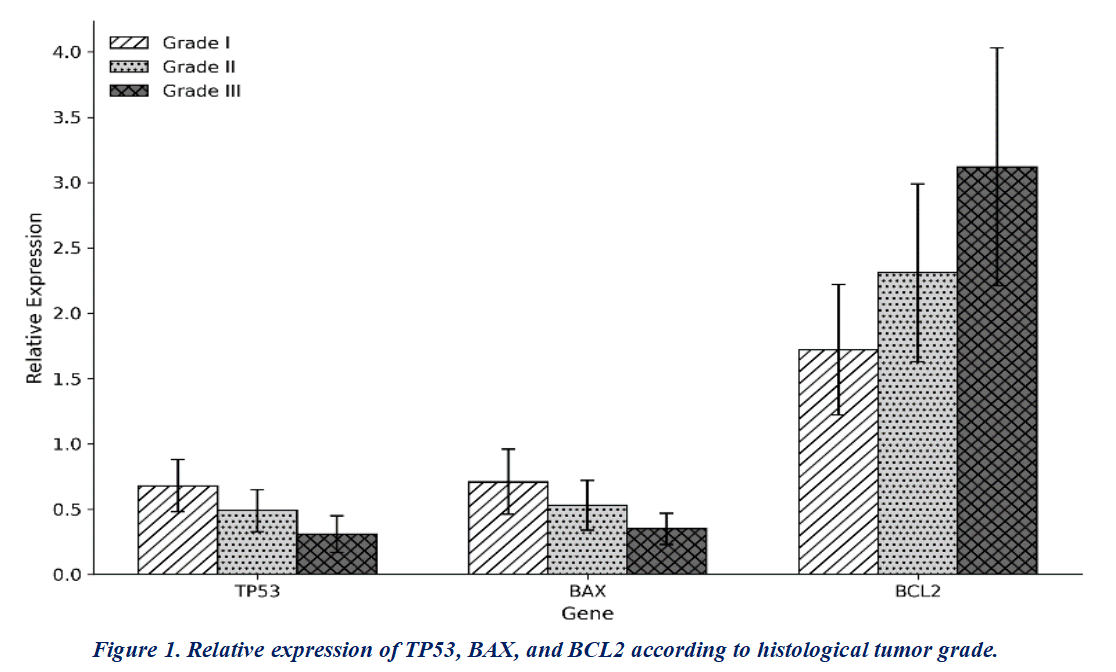
Background: Disruption of genes that play a role in the regulation of apoptosis, both DNA-damage responses and mitochondrial cell death, can influence breast carcinoma progression. The objective of this study was to compare the expression of TP53, BAX, and BCL2 between histologically confirmed breast carcinoma and non-malignant tissues and to check the clinicopathological associations. Methods: A case-control analysis was performed, comprising 90 tissue samples, with breast carcinoma (60) and non-malignant (30). Total RNA was extracted and converted to complementary DNA (cDNA). The mRNA expression of TP53, BAX, and BCL2 was quantified by quantitative real-time PCR, normalized to GAPDH, and calculated using the 2^-ΔΔCt method. Growth patterns were assessed based on tumour grade, tumour size, and lymph-node involvement. Results: Carcinoma tissues showed lower TP53 (0.46 ± 0.18) and BAX (0.52 ± 0.21) and higher BCL2 (2.38 ± 0.74) expression than controls. TP53 and BAX decreased, whereas BCL2 increased, from Grade I to III tumors. The BAX/BCL2 ratio declined from 1.02 ± 0.18 in controls to 0.11 ± 0.05 in Grade III tumors. Gene expression was also associated with tumor size and lymph node involvement. Conclusion: Breast carcinoma showed downregulation of TP53 and BAX and upregulation of BCL2, with a progressive decline in the BAX/BCL2 ratio across tumor grades. These findings indicated altered apoptotic regulation associated with clinicopathological features.
References
1. Sung H, Filho AM, Laversanne M, Ferlay J, Siegel RL, Soerjomataram I, et al. Global cancer statistics 2024: GLOBOCAN estimates of incidence and mortality worldwide for 34 cancers in 186 countries. CA Cancer J Clin. 2026;76(4). https://doi.org/10.3322/caac.70090 DOI: https://doi.org/10.3322/caac.70090
2. Unuofin JO, Adefisan-Adeoye AO, Paimo OK, Maphetu N, Lebelo SL. Breast cancer: epidemiology, molecular classification, diagnostics and evolving treatment paradigms. Molecules. 2026;31(14):2551. https://doi.org/10.3390/molecules31142551 DOI: https://doi.org/10.3390/molecules31142551
3. Lukow DA, Sausville EL, Suri P, Chunduri NK, Wieland A, Leu J, et al. Chromosomal instability accelerates the evolution of resistance to anti-cancer therapies. Dev Cell. 2021;56(17):2427-2439.e4. https://doi.org/10.1016/j.devcel.2021.07.009 DOI: https://doi.org/10.1016/j.devcel.2021.07.009
4. Jankowska J, Szeleszczuk Ł, Pisklak DM. Flavonoids as modulators of the p53–Bcl-2 axis in cancer: molecular mechanisms and therapeutic implications. Pharmaceutics. 2026;18(6):738. https://doi.org/10.3390/pharmaceutics18060738 DOI: https://doi.org/10.3390/pharmaceutics18060738
5. Abuetabh Y, Wu HH, Chai C, et al. DNA damage response revisited: the p53 family and its regulators provide endless cancer therapy opportunities. Exp Mol Med. 2022;54(10):1658-1669. https://doi.org/10.1038/s12276-022-00863-4 DOI: https://doi.org/10.1038/s12276-022-00863-4
6. Hwang SH, Baek SH, Lee MJ, et al. Clinical relevance of TP53 mutation and its characteristics in breast cancer with long-term follow-up date. Cancers (Basel). 2024;16(23):3899. https://doi.org/10.3390/cancers16233899
7. Liu Z, Ding Y, Ye N, Wild C, Chen H, Zhou J. Direct activation of BAX protein for cancer therapy. Med Res Rev. 2016;36(2):313-341. https://doi.org/10.1002/med.21379 DOI: https://doi.org/10.1002/med.21379
8. Vucicevic K, Jakovljevic V, Colovic N, et al. Association of BAX expression and BCL2/BAX ratio with clinical and molecular prognostic markers in chronic lymphocytic leukemia. J Med Biochem. 2016;35(2):150-157. https://doi.org/10.1515/jomb-2015-0017 DOI: https://doi.org/10.1515/jomb-2015-0017
9. Stafyla VK, Christodoulou S, Tsiakanikas P, et al. Upregulation of a circular BAX transcript in breast cancer is associated with unfavorable prognosis. Int J Mol Sci. 2026;27(10):4160. https://doi.org/10.3390/ijms27104160 DOI: https://doi.org/10.3390/ijms27104160
10. Ultimescu F, Hudita A, Popa DE, et al. Impact of molecular profiling on therapy management in breast cancer. J Clin Med. 2024;13(17):4995. https://doi.org/10.3390/jcm13174995 DOI: https://doi.org/10.3390/jcm13174995
11. Sullivan KM, Dean A, Soe MM. OpenEpi: a web-based epidemiologic and statistical calculator for public health. Public Health Rep. 2009;124(3):471–474. https://doi.org/10.1177/003335490912400320 DOI: https://doi.org/10.1177/003335490912400320
12. Vogler M, Braun Y, Smith VM, Westhoff MA, Pereira RS, Pieper NM, et al. The BCL2 family: from apoptosis mechanisms to new advances in targeted therapy. Signal Transduct Target Ther. 2025;10(1):91. https://doi.org/10.1038/s41392-025-02176-0 DOI: https://doi.org/10.1038/s41392-025-02176-0
13. Hwang SH, Baek SH, Lee MJ, Kook Y, Bae SJ, Ahn SG, et al. Clinical relevance of TP53 mutation and its characteristics in breast cancer with long-term follow-up date. Cancers (Basel). 2024;16(23):3899. https://doi.org/10.3390/cancers16233899 DOI: https://doi.org/10.3390/cancers16233899
14. Anderson SA, Bartow BB, Harada S, Siegal GP, Wei S, Dal Zotto VL, et al. p53 protein expression patterns associated with TP53 mutations in breast carcinoma. Breast Cancer Res Treat. 2024;207(1):213-222. https://doi.org/10.1007/s10549-024-07357-z DOI: https://doi.org/10.1007/s10549-024-07357-z
15. Dajti G, Serra M, Cisternino G, Ceccarelli C, Pellegrini A, Melina M, et al. Prognostic role of p53 immunohistochemical status in invasive breast cancer: a retrospective review of 1387 cases with luminal-like/HER2-negative breast tumors. Oncologist. 2024;29(5):384-391. https://doi.org/10.1093/oncolo/oyad309 DOI: https://doi.org/10.1093/oncolo/oyad309
16. Marvalim C, Datta A, Lee SC. Role of p53 in breast cancer progression: an insight into p53-targeted therapy. Theranostics. 2023;13(4):1421-1442. https://doi.org/10.7150/thno.81847 DOI: https://doi.org/10.7150/thno.81847
17. Qayoom H, Haq BU, Sofi S, Jan N, Jan A, Mir MA. Targeting mutant p53: a key player in breast cancer pathogenesis and beyond. Cell Commun Signal. 2024;22(1):484. https://doi.org/10.1186/s12964-024-01863-9 DOI: https://doi.org/10.1186/s12964-024-01863-9
18. Reinhardt LS, Groen K, Xavier A, Avery-Kiejda KA. p53 dysregulation in breast cancer: insights on mutations in the TP53 network and p53 isoform expression. Int J Mol Sci. 2023;24(12):10078. https://doi.org/10.3390/ijms241210078 DOI: https://doi.org/10.3390/ijms241210078
19. Czabotar PE, Garcia-Saez AJ. Mechanisms of BCL-2 family proteins in mitochondrial apoptosis. Nat Rev Mol Cell Biol. 2023;24(10):732-748. https://doi.org/10.1038/s41580-023-00629-4 DOI: https://doi.org/10.1038/s41580-023-00629-4
20. Gómez-Crisóstomo NP, López-Marure R, Zapata E, Zazueta C, Martínez-Abundis E. BAX induces cytochrome c release by multiple mechanisms in mitochondria from MCF7 cells. J Bioenerg Biomembr. 2013;45(5):441-448. https://doi.org/10.1007/s10863-013-9508-x DOI: https://doi.org/10.1007/s10863-013-9508-x
21. Solanki R, Rajput PK, Jodha B, Yadav UCS, Patel S. Enhancing apoptosis-mediated anticancer activity of evodiamine through protein-based nanoparticles in breast cancer cells. Sci Rep. 2024;14(1):2595. https://doi.org/10.1038/s41598-024-51970-3 DOI: https://doi.org/10.1038/s41598-024-51970-3
22. Sofi S, Mehraj U, Jan N, Almilaibary A, Ahmad I, Ahmad F, et al. Clinicopathological significance and expression pattern of BCL2 in breast cancer: a comprehensive in silico and in vitro study. Saudi J Biol Sci. 2024;31(2):103916. https://doi.org/10.1016/j.sjbs.2023.103916 DOI: https://doi.org/10.1016/j.sjbs.2023.103916
23. Hassan WA, El-Assmy M, ElBanna AK, Harbieh I, Noufal N, Lotfy H, et al. Associations between BCL-2 expression and different histopathological prognostic factors in different molecular subtypes of invasive breast carcinoma of no special type. Histol Histopathol. 2025;40(6):825-834. https://doi.org/10.14670/HH-18-831
24. Vieira JO, Pesquero JB, Nazário ACP. TP53 gene polymorphism at codon 72 as a response predictor for neoadjuvant chemotherapy. Breast Care (Basel). 2024;19(2):96-105. https://doi.org/10.1159/000536115 DOI: https://doi.org/10.1159/000536115
25. Ito K, Honma N, Ogata H, Yamada A, Miyashita M, Arai T, et al. Clinicopathological importance of Bcl-2 and p53 in postmenopausal triple-negative breast carcinoma and association with age. Pathol Int. 2024;74(10):574-582. https://doi.org/10.1111/pin.13429 DOI: https://doi.org/10.1111/pin.13429
26. Rahman HA, Zaim SNN, Suhaimei US, Jamain AA. Prognostic factors associated with breast cancer-specific survival from 1995 to 2022: a systematic review and meta-analysis of 1,386,663 cases from 30 countries. Diseases. 2024;12(6):111. https://doi.org/10.3390/diseases12060111 DOI: https://doi.org/10.3390/diseases12060111
Published
Issue
Section
License
Copyright (c) 2026 Zainab Rehman, Muazzam Kashif, Qayyum Ahmed, Mavara Iqbal

This work is licensed under a Creative Commons Attribution-NonCommercial 4.0 International License.
Journal of Biomolecules, Pathogenesis and Therapeutics (JBPT) follows the Attribution Creative Commons-Non commercial (CC BY-NC 4.0) license which allows the users to copy and redistribute the material in any medium or format, remix, transform and build upon the material. The users must give credit to the source and indicate, provide a link to the license, and indicate if changes were made. However, the CC BY-NC 4.0 license restricts the use of material for commercial purposes (Further details are available at website. The Editorial Board of the JBPT endeavors to ensure the accuracy, integrity, and quality of all published content. However, the responsibility of opinions, interpretations, and conclusions expressed in the published articles rests entirely with the authors and do not necessarily reflect the views of the Editorial Board, publisher, or affiliated institutions.