Knowledge, patterns, and therapeutic factors associated with self-medication practices among adult patients attending outpatient healthcare facilities
DOI:
https://doi.org/10.68041/jbpt.v2i2/07Keywords:
Self-medication, drug utilization, therapeutic factors, medication safety, rational drug use, adult patients, healthcare behaviorAbstract
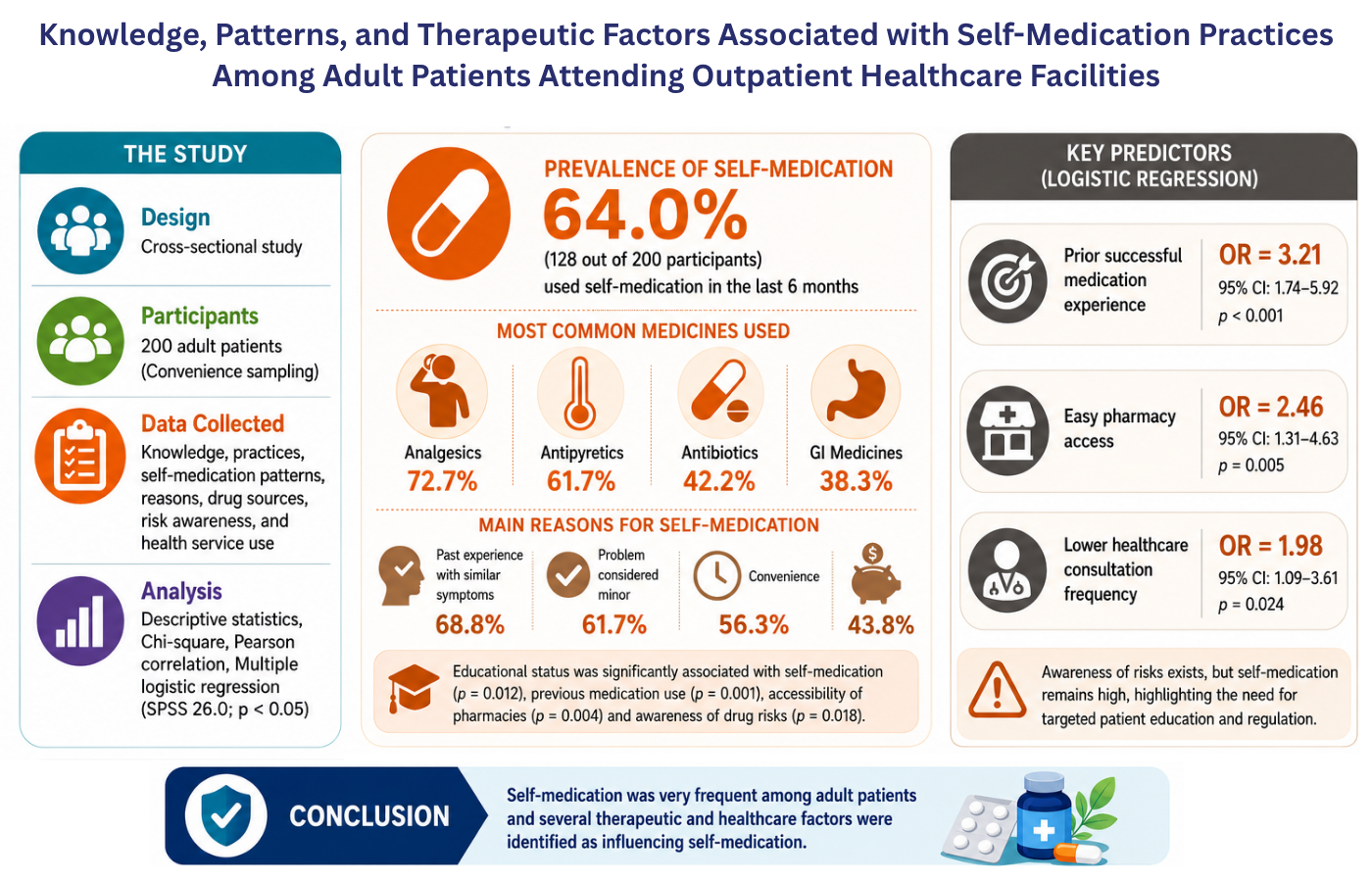
Background: Self-medication occurs throughout the world and defined as the use of medicines without medical advice. The aim was to regulate the extent of self-medication and the therapeutic factors associated with the use of medication among adult patients. Methods: A cross sectional study (n=200) used convenience sampling method was utilized for participant selection. The data were gathered from a pre-designed questionnaire that included the following sections: Socio-demographic data, self-medication frequency, self-medication drugs used, self-medication aims, bases of drug information, understanding the potential risks of self-medication, and utilization of health services (SPSS 26.0 software. p value <0.05). Results: Of the 200 participants, 128 (64.0%) said that they used self-medication over the last six months. The most commonly used medicines were analgesics (72.7%), antipyretics (61.7%), antibiotics (42.2%) and gastrointestinal medicines (38.3%). Past experience with similar symptoms (68.8%), thinking the problem was minor (61.7%), convenience (56.3%) and cost-saving (43.8%) were frequent reasons. Educational status was considerably linked with self-medication (p = 0.012), previous medication use (p = 0.001), accessibility of pharmacies (p = 0.004) and awareness about the risks of drugs (p = 0.018). Logistic regression analysis identified prior successful medication experience (OR = 3.21, 95% CI: 1.74–5.92, p < 0.001), easy pharmacy access (OR = 2.46, 95% CI: 1.31–4.63, p = 0.005), and lower healthcare consultation frequency (OR = 1.98, 95% CI: 1.09–3.61, p = 0.024). Conclusions: Self-medication was very frequent among adult patients and several therapeutic and healthcare factors were identified as influencing self-medication.
References
1. Aljinović-Vučić V. Self-Medication as a Global Health Concern: Overview of Practices and Associated Factors-A Narrative Review. Healthcare (Basel). 2025 Jul 31;13(15):1872. https://doi.org/10.3390/healthcare13151872 DOI: https://doi.org/10.3390/healthcare13151872
2. Ikwara AE, Atwijukiire H. Self-medication and medication storage practices among Lira University students in Lira city, Northern Uganda. Front Public Health. 2023 Nov 3;11:1259279. https://doi.org/10.3389/fpubh.2023.1259279 DOI: https://doi.org/10.3389/fpubh.2023.1259279
3. Akande-Sholabi W, Akinyemi OO. Self-medication with over-the-counter drugs among consumers: a cross-sectional survey in a Southwestern State in Nigeria. BMJ Open. 2023 May 18;13(5):e072059. https://doi.org/10.1136/bmjopen-2023-072059 DOI: https://doi.org/10.1136/bmjopen-2023-072059
4. Fekadu G, Dugassa D, Negera GZ, Woyessa TB, Turi E, Tolossa T, et al. Self-Medication Practices and Associated Factors Among Health-Care Professionals in Selected Hospitals of Western Ethiopia. Patient Prefer Adherence. 2020 Feb 20;14:353-361. https://doi.org/10.2147/PPA.S244163 DOI: https://doi.org/10.2147/PPA.S244163
5. Al Hemaidi S, Alharthi A, AlFehaid M, Almalki H, Hamzi YA, Alnemari A, et al. Knowledge, Attitude, and Practice Regarding Over-the-Counter Prescription of Topical Eye Medications Among the General Population of Saudi Arabia. Cureus. 2025 Mar 16;17(3):e80665. https://doi.org/10.7759/cureus.80665 DOI: https://doi.org/10.7759/cureus.80665
6. Kim M, Suh D, Barone JA, Jung SY, Wu W, Suh DC. Health Literacy Level and Comprehension of Prescription and Nonprescription Drug Information. Int J Environ Res Public Health. 2022 May 30;19(11):6665. https://doi.org/10.3390/ijerph19116665 DOI: https://doi.org/10.3390/ijerph19116665
7. Masumoto S, Yamakawa T, Sakamoto N, Maeno T. Association between health literacy and medication comprehension; attitudes toward reporting adverse events in adults using over-the-counter medicines. J Pharm Policy Pract. 2023 Jul 17;16(1):90. https://doi.org/10.1186/s40545-023-00596-3 DOI: https://doi.org/10.1186/s40545-023-00596-3
8. Gashaw T, Yadeta TA, Weldegebreal F, Demissie L, Jambo A, Assefa N. The global prevalence of antibiotic self-medication among the adult population: systematic review and meta-analysis. Syst Rev. 2025 Feb 26;14(1):49. https://doi.org/10.1186/s13643-025-02783-6 DOI: https://doi.org/10.1186/s13643-025-02783-6
9. Al-Omrani H, Marwah MK, Al-Whaib R, Mekkawy M, Shokr H. Patterns of Drug Utilization and Self-Medication Practices: A Cross Sectional Study. Pharmacy (Basel). 2023 Nov 22;11(6):183. https://doi.org/10.3390/pharmacy11060183 DOI: https://doi.org/10.3390/pharmacy11060183
10. Cotobal-Calvo EM, Mata-Pérez C, Bocchino A, Gilart E, Gutiérrez-Baena B, Palazón-Fernández JL. Self-Medication Practice and Associated Factors Among Health Professionals in Spain. Nurs Rep. 2025 Feb 4;15(2):53. https://doi.org/10.3390/nursrep15020053 DOI: https://doi.org/10.3390/nursrep15020053
11. Demsie DG, Addisu ZD, Tefera BB, Gebrie D, Tsegay EW, Yehualaw A, et al. Knowledge, and attitude as determinants of healthcare professionals' self-medication practice to antibacterials in Tertiary Care hospitals, North West Ethiopia. Sci Rep. 2025 Feb 12;15(1):5241. https://doi.org/10.1038/s41598-025-88979-1 DOI: https://doi.org/10.1038/s41598-025-88979-1
12. Rathod P, Sharma S, Ukey U, Sonpimpale B, Ughade S, Narlawar U, et al. Prevalence, Pattern, and Reasons for Self-Medication: A Community-Based Cross-Sectional Study From Central India. Cureus. 2023 Jan 18;15(1):e33917. https://doi.org/10.7759/cureus.33917 DOI: https://doi.org/10.7759/cureus.33917
13. Aljalamdeh R, Barakat M, Mosleh R, H Abdel-Qader D. Knowledge, attitude, and practices of self-medication with antibiotics among senior undergraduate pharmacy students: A cross-sectional study in Jordan. SAGE Open Med. 2025 Dec 19;13:20503121251404848. https://doi.org/10.1177/20503121251404848
14. Aljalamdeh R, Barakat M, Mosleh R, H Abdel-Qader D. Knowledge, attitude, and practices of self-medication with antibiotics among senior undergraduate pharmacy students: A cross-sectional study in Jordan. SAGE Open Med. 2025 Dec 19;13:20503121251404848. https://doi.org/10.1177/20503121251404848 DOI: https://doi.org/10.1177/20503121251404848
15. Nakato G, Adongo PR, Iramiot JS, Epuitai J. Practices and drivers of self-medication with antibiotics among undergraduate medical students in Eastern Uganda: A cross-sectional study. PLoS One. 2023 Dec 21;18(12):e0293685. https://doi.org/10.1371/journal.pone.0293685 DOI: https://doi.org/10.1371/journal.pone.0293685
16. Oumer A, Ale A, Hamza A, Dagne I. Extent and Correlates of Self-Medication Practice among Community-Dwelling Adults in Eastern Ethiopia. Biomed Res Int. 2023 Nov 30;2023:4726010. https://doi.org/10.1155/2023/4726010 DOI: https://doi.org/10.1155/2023/4726010
17. Juneja K, Chauhan A, Shree T, Roy P, Bardhan M, Ahmad A, et al. Self-medication prevalence and associated factors among adult population in Northern India: A community-based cross-sectional study. SAGE Open Med. 2024 Mar 25;12:20503121241240507. https://doi.org/10.1177/20503121241240507 DOI: https://doi.org/10.1177/20503121241240507
18. Chindhalore CA, Dakhale GN, Giradkar AB. Comparison of self-medication practices with analgesics among undergraduate medical and paramedical students of a tertiary care teaching institute in Central India - A questionnaire-based study. J Educ Health Promot. 2020 Nov 26;9:309. https://doi.org/10.4103/jehp.jehp_378_20 DOI: https://doi.org/10.4103/jehp.jehp_378_20
19. Kassa T, Gedif T, Andualem T, Aferu T. Antibiotics self-medication practices among health care professionals in selected public hospitals of Addis Ababa, Ethiopia. Heliyon. 2022 Jan 23;8(1):e08825. https://doi.org/10.1016/j.heliyon.2022.e08825 DOI: https://doi.org/10.1016/j.heliyon.2022.e08825
20. Cabral C, Zhang T, Oliver I, Little P, Yardley L, Lambert H. Influences on use of antibiotics without prescription by the public in low- and middle-income countries: a systematic review and synthesis of qualitative evidence. JAC Antimicrob Resist. 2024 Oct 25;6(5):dlae165. https://doi.org/10.1093/jacamr/dlae165 DOI: https://doi.org/10.1093/jacamr/dlae165
21. Gupta S, Chakraborty A. Pattern and practice of self medication among adults in an urban community of West Bengal. J Family Med Prim Care. 2022 May;11(5):1858-1862. https://doi.org/10.4103/jfmpc.jfmpc_1823_20 DOI: https://doi.org/10.4103/jfmpc.jfmpc_1823_20
22. Belachew SA, Hall L, Erku DA, Selvey LA. No prescription? No problem: drivers of non-prescribed sale of antibiotics among community drug retail outlets in low and middle income countries: a systematic review of qualitative studies. BMC Public Health. 2021 Jun 3;21(1):1056. https://doi.org/10.1186/s12889-021-11163-3 DOI: https://doi.org/10.1186/s12889-021-11163-3
23. Khadka S, Shrestha O, Koirala G, Acharya U, Adhikari G. Health seeking behavior and self-medication practice among undergraduate medical students of a teaching hospital: A cross-sectional study. Ann Med Surg (Lond). 2022 May 13;78:103776. https://doi.org/10.1016/j.amsu.2022.103776 DOI: https://doi.org/10.1016/j.amsu.2022.103776
24. Rees S, Williams A. Promoting and supporting self-management for adults living in the community with physical chronic illness: A systematic review of the effectiveness and meaningfulness of the patient-practitioner encounter. JBI Libr Syst Rev. 2009;7(13):492-582. https://doi.org/10.11124/01938924-200907130-00001 DOI: https://doi.org/10.11124/jbisrir-2009-194
25. Raja A, Bin Amin S, Azeem B, Raja S, Aftab Y, Rafi M, et al. Self-diagnosis and self-medication based on internet search among Non-Medical University students of Karachi. Ann Med Surg (Lond). 2024 Oct 1;86(11):6507-6513. https://doi.org/10.1097/MS9.0000000000002605 DOI: https://doi.org/10.1097/MS9.0000000000002605
Published
Issue
Section
License
Copyright (c) 2026 Esha Khalid, Ahmed Ikram (Author)

This work is licensed under a Creative Commons Attribution-NonCommercial 4.0 International License.
Journal of Biomolecules, Pathogenesis and Therapeutics (JBPT) follows the Attribution Creative Commons-Non commercial (CC BY-NC 4.0) license which allows the users to copy and redistribute the material in any medium or format, remix, transform and build upon the material. The users must give credit to the source and indicate, provide a link to the license, and indicate if changes were made. However, the CC BY-NC 4.0 license restricts the use of material for commercial purposes (Further details are available at website. The Editorial Board of the JBPT endeavors to ensure the accuracy, integrity, and quality of all published content. However, the responsibility of opinions, interpretations, and conclusions expressed in the published articles rests entirely with the authors and do not necessarily reflect the views of the Editorial Board, publisher, or affiliated institutions.