NARRATIVE REVIEW
Drug Repurposing Potential of Natural Products: Molecular Targets, Pharmacological Profiles, and Precision Therapeutic Strategies: A Narrative Review
Muhammad Khaliq1* | Kiran Aftab1 | Ayesha Ikhlaq1 | Aftab Ahmed1
1Department of Pathology, University of Health sciences, Pakistan
*Correspondence: Muhammad Khaliq ([email protected])
Acknowledgement: None;
Competing Interests: The author declared no competing interests;
Grant Support and Funding Source: No external funding;
Study Ethical Approval: Not Applicable;
Consent for Participation and Publication: Not Applicable;
Availability of Data and Materials: The data are available from the corresponding author upon reasonable request;
Use of Artificial Intelligence: The authors declared that artificial intelligence and AI-assisted tools were not used in the preparation or editing of this manuscript and during all editorial processings;
Authors’ Contribution: MK, KA: Conceptualization, scope design, literature search strategy formulation, study selection, drafting the manuscript, critical review, approval of the final version to be published. AI, AA: Data synthesis, molecular and pharmacological literature assessment, critical appraisal of the included literature, data interpretation, acting as the third reviewer for resolving screening disagreements, drafting the manuscript, critical review, approval of the final version to be published. All authors agreed to all aspects of the results and provided final approval as per ICMJE criteria.
Received: 23 May, 2026; Revised: 01 September, 2026; Accepted: 13 September, 2026; Published: 20 September, 2026
ABSTRACT
Repurposing compounds is an important way to look at new uses for approved drugs. Natural products have a wide range of structural and pharmacologic diversity and have the potential to be applied in repurposing, especially for complex and chronic diseases. This is a narrative review of molecular targets, pharmacological properties and therapeutic strategies for repurposed natural compounds. Natural products are predicted to modulate pathways that include PI3K/Akt, NF-κB, and AMPK, all of which play a role in cancer, neurodegenerative and metabolic diseases, according to computational and systems level studies. The predicted mechanisms have been studied preclinically and pharmacological effects have been observed in experimental models; structure-activity relationship studies and semi-synthetic modifications have been examined to gain more favorable bioavailability and target-related properties. Nevertheless, low solubility and high metabolism of phytochemicals, and their variable compositions, are significant limitations. While multi-omics and AI methods could help identify targets and aid precision medicine, predictions need experimental and clinical validation. The clinical evidence is limited and heterogeneous, and larger trials are needed to confirm efficacy and safety, and reported to have therapeutic effect for curcumin, resveratrol, and berberine. Standardization and regulatory variations are also barriers to translation. In summary, combining computational prediction, preclinical evidence, and strong clinical data is crucial for natural product drug discovery.
Keywords: Biological Availability; Drug Repositioning; Phytochemicals; Precision Medicine; Structure-Activity Relationship
Introduction
Drug repurposing is the discovery of new therapeutic uses for available pharmacological agents in a specific biological and molecular context 1,2. Unlike traditional drug discovery, which requires de novo synthesis and subsequent validation, repurposing leverages known pharmacokinetic, toxicological, and safety profiles, minimizing uncertainty during development 3. Repurposed agents are often polypharmacological, engaging with many signaling pathways 4 that are involved in the pathogenesis of cancer, inflammatory disorders, and metabolic diseases, including PI3K/Akt, NF-κB, and MAPK 2.
Natural products represent a chemically heterogeneous and biologically active group of compounds that have traditionally played a major role in approved therapeutic agents, specifically in the fields of oncology, infectious diseases, and metabolic disorders 5. Recent pharmacological studies have shown that plant-produced secondary metabolites, such as alkaloids, flavonoids, terpenoids, and polyphenols, have structurally complex scaffolds that allow them to engage with a variety of molecular targets 6. This multi-target binding ability is aided by the recent studies in network pharmacology which show that natural compounds can be able to mediate interconnected signaling pathways including NF-κB, PI3K/Akt/mTOR and MAPK cascades 7,8, which play a crucial role in inflammation, tumor progression, and cellular stress responses. The development of high-throughput screening and metabolomics has enabled the discovery of bioactive phytochemicals with specific molecular targets, such as enzymes, receptors, and transcription factors 9.
Ethnopharmacological evidence confirmed that drug repurposing is promising, since traditional medicinal systems are proven to have compounds that are experimentally verified to have pharmacological activity 10. Curcumin, resveratrol, and berberine have been shown to have regulatory effects on oxidative stress, mitochondrial activity, and inflammatory mediators in preclinical and clinical trials 11,12. Nevertheless, low aqueous solubility, rapid metabolism, and changes in the phytochemical composition caused by environmental and extraction variables limit the pharmacological translation of natural products 13. The latest advances in formulation approaches such as nanoencapsulation and phytosome-based delivery systems have demonstrated higher bioavailability and target specificity of natural products 14. Thus, natural products are a mechanistically validated and ever-growing pool of drug repurposing, especially in the realm of multi-factorial and chronic diseases.
Methodology
This narrative review is organized in an informative literature synthesis approach to provide transparency and reproducibility. The major biomedical databases, such as PubMed, Scopus, and Web of Science, were used to identify relevant studies in the pharmacological and biomedical fields. Validated keyword combinations, including drug repurposing, natural products, phytochemicals, precision medicine, and molecular targets, were included as the search strings, and further refined with Boolean operators. The primary search string was: ("drug repurposing" OR "drug repositioning") AND ("natural products" OR phytochemicals) AND ("molecular targets" OR mechanisms OR "precision medicine"). Peer-reviewed original research papers, systematic reviews and meta-analyses were included to make sure that the most recent scientific evidence would be integrated. Research without experimental validation, those that were not published in English, and those that were not peer-reviewed were eliminated to maintain scientific rigor. The extraction of data was based on molecular mechanisms, pharmacological profiles, and clinical relevance of natural compounds. Critical appraisal was also carried out through reviewing of the study design, sample size, reproducibility, and methodology quality, which was in line with the use of narrative review standards. Where reviewer disagreement occurred during study selection or data interpretation, discrepancies were discussed and resolved through consensus; unresolved disagreements were adjudicated by a third reviewer.
Molecular Mechanisms and Systems-Level Approaches in Drug Repurposing: The molecular basis of drug repurposing lies in identifying novel drug–target interactions beyond the original therapeutic indication. Proteomics-based binding assays and transcriptomic profiling are examples of high-throughput screening technologies that have helped identify new molecular targets for repurposed compounds 15; for example, transcriptomic signature-based analyses have prioritized statins such as simvastatin and atorvastatin for COVID-19 16, whereas thermal proteome profiling has revealed celecoxib-targeted proteins for neurodegenerative disorders 17 such as Alzheimer’s disease and supported its repurposing potential. To illustrate the multi-pathway and network-level mechanisms underlying the therapeutic effects of repurposed natural compounds, Figure 1 summarized their interactions with key signaling cascades involved in complex diseases.
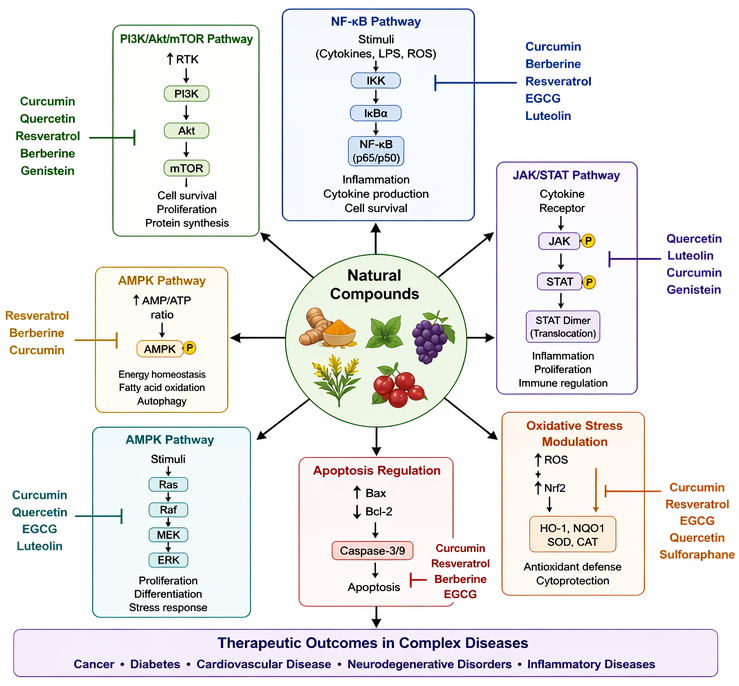
Figure 1: Multi-target mechanisms and network pharmacology of repurposed natural compounds in complex diseases: Natural compounds (e.g., curcumin, resveratrol, berberine, quercetin, EGCG, genistein) modulate interconnected signalling pathways including PI3K/Akt/mTOR, NF-κB, JAK/STAT, AMPK, and MAPK, regulating inflammation, apoptosis, proliferation, metabolism, and oxidative stress. Through pathway crosstalk and Nrf2-mediated antioxidant responses, these compounds exert network-level, pleiotropic effects relevant to cancer, metabolic, cardiovascular, and neurodegenerative diseases 8,11, 19,22,53.
Recent research applying network pharmacology strategies revealed that drug-target interactions can be charted over biological networks, enabling the identification of key proteins and pivot regulatory nodes in the progression of diseases 7,18. Natural compounds have been demonstrated to mediate central signaling pathways that include PI3K/Akt, JAK/STAT, NF-κB, and AMPK, which control cellular functions like proliferation, apoptosis, inflammation, and energy metabolism 8,19. Curcumin has been reported to inhibit NF-κB signaling and reduce inflammatory mediator expression 20,21, while also suppressing PI3K/Akt activity in cancer cells and activating AMPK in inflammatory and injury models. Similarly, berberine attenuates NF-κB activation in cellular and animal systems, supporting its role in controlling inflammatory and apoptotic responses 22. Resveratrol has been shown to activate AMPK in neurons and brain tissue, but its effects are not uniform across tissues or exposure conditions, underscoring the importance of context in interpreting pathway modulation 23.
Structure-Activity Relationships (SAR) and Chemical Optimization of Natural Compounds: The Structure-Activity Relationships (SAR) is an essential part of the current drug repurposing practices, which offers mechanistic understanding of how certain chemical attributes of natural compounds affect their biological action and target 24. Various experimental studies have demonstrated that curcumin exerts its antioxidant activity through its phenolic hydroxyl groups and conjugated diketone structure, which enable binding and inhibition of NF-κB signaling proteins 25. In another study, epigallocatechin-3-gallate (EGCG) from green tea demonstrated strong binding affinity to multiple protein targets, and may disrupt Oropouche virus infection through multi-target mechanisms 26.
The use of high-resolution structural biology methods, such as X-ray crystallography and cryo-electron microscopy, has enabled the specific mapping of ligand–target interactions to enable rational manipulation of natural compounds to increase their therapeutic effect 27-29. X-ray crystallography provided high-resolution, static structural details of ligand–target complexes, making it ideal for precise binding-site analysis, whereas cryo-EM allows visualization of large and dynamic macromolecular complexes in near-native states, offering advantages in studying membrane proteins and flexible systems 28. For instance, rapamycin, a natural macrolide repurposed as an immunosuppressant and anticancer agent, was structurally characterized using X-ray crystallography, revealing its binding to FKBP12–mTOR complexes, which guided the development of improved analogs 30. Similarly, ivermectin, originally derived from Streptomyces avermitilis, has been studied using cryo-EM to understand its interaction with glutamate-gated chloride channels, explaining its antiparasitic efficacy and enabling exploration of broader therapeutic roles 31. In addition, paclitaxel (Taxol), a plant-derived anticancer drug, was characterized through X-ray crystallography, elucidating its binding to β-tubulin and stabilization of microtubules, forming the basis for its clinical activity 32.
Structural alteration, however, is limited by the necessity to maintain the basic bioactive scaffold that is responsible for the pharmacological effect. Thus, SAR-guided optimization can be considered an important connection between natural compound identification and a high-quality drug repurposing to create more powerful, selective, and bioavailable therapeutic compounds.
Repurposed Natural Compounds Pharmacokinetics and Pharmacodynamics: Pharmacodynamics (PD) and pharmacokinetics (PK) play a vital role in the therapeutic efficacy and safety of repurposed natural compounds, regulating their absorption, distribution, metabolism, excretion, and biological actions at target sites 33. Recent pharmacological research indicated that natural compounds have poor aqueous solubility, intestinal permeability, and extensive first-pass metabolism through cytochrome P450 enzymes, which led to low oral bioavailability 34. Curcumin and resveratrol were quickly converted to glucuronide and sulfate conjugates, respectively 12, and this greatly decreases the bioactive concentrations of the two compounds in the body. The development of novel drug delivery systems such as lipid-based nanoparticles, solid lipid carriers, and nanoemulsions increased the absorption capacity and extended systemic circulation of these substances 35. These systems improved solubility of poorly water-soluble phytochemicals, protect them from chemical and enzymatic degradation, and increase intestinal absorption and bioavailability. Curcumin-loaded lipid nanoparticles have shown significantly higher plasma concentration and prolonged circulation time compared to free curcumin 36.
Pharmacodynamically, natural products tend to have pleiotropic effects, by acting on several signaling pathways akin to each other, such as inflammatory mediators, oxidative stress responses, and apoptosis regulators 33. For example, curcumin has been reported to inhibit DNA methyltransferases (DNMTs) and histone deacetylases (HDACs), leading to altered DNA methylation and increased histone acetylation, thus controlling gene expression in disease-relevant pathways 38,39. Similarly, sulforaphane functions primarily as an HDAC inhibitor, promoting histone acetylation and enhancing anticancer gene expression 53. Thus, pharmacokinetic profile optimization and mechanistic pharmacodynamic insight is critical to the successful clinical translation of repurposed natural products 40.
Computational Repurposing of Drugs: The latest developments in machine learning and artificial intelligence have made great progress in predicting compound-target binding, pharmacological activity, and toxicity profiles from large-scale biological data 41,42. Computational methods, such as quantitative structure-activity relationship (QSAR) modeling and machine learning-based prediction systems, are also becoming popular to measure important pharmacophores and optimize lead compounds 43. QSAR studies on curcumin analogs have demonstrated that the presence and position of methoxy and hydroxyl groups significantly influence anti-inflammatory and anticancer activity, guiding the design of more potent derivatives 44. Similarly, QSAR modeling of flavonoids has shown that structural features such as hydroxylation patterns and planarity strongly correlate with antioxidant and enzyme inhibitory activity 45. These semi-synthetic alterations target pharmacokinetic characteristics (such as solubility, metabolic stability, and membrane permeability) to optimize natural products for their pharmacokinetic behavior 48. Derivatization of compounds like curcumin and resveratrol has been demonstrated to lead to increased bioavailability and decreased rapid metabolic degradation via methylation, glycosylation, and nanoparticle conjugation 49.
Additionally, molecular docking and molecular dynamics simulations are extensively employed to predict binding affinity and stability of compound-target interactions, and the use of artificial intelligence is extensively employed to enhance prediction quality 50. Nonetheless, target identification is limited by issues like off-target effects, binding specificity variability, and pathway activation depending on context 51. Hence, the molecular architecture of drug repurposing is based on the combination of experimental verification with computational prediction to generate mechanistically accurate and therapeutically relevant results. The integrated pipeline from computational prediction to clinical translation of natural compounds provided a systems-level overview of the drug repurposing process, as shown in Figure 2.
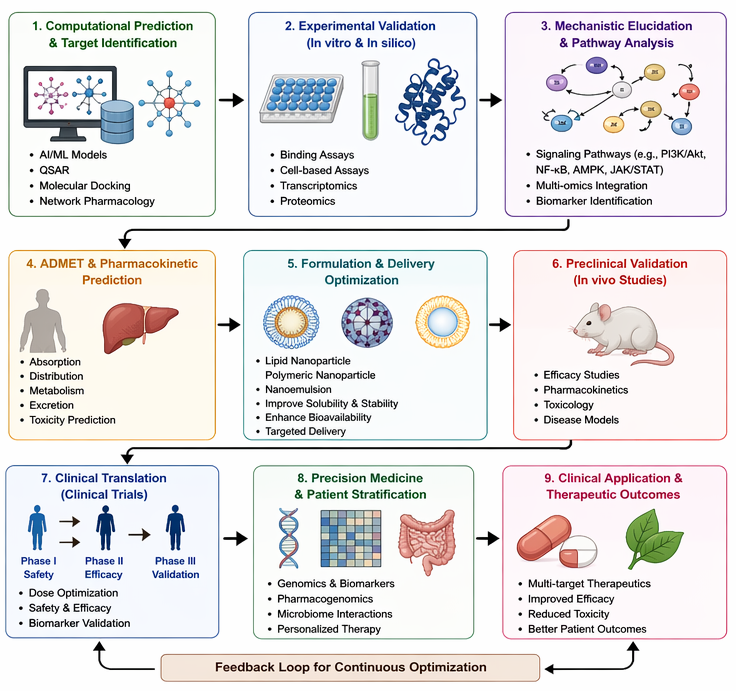
Figure 2: Integrated framework of drug repurposing of natural compounds: from computational prediction to clinical translation. A stepwise framework for natural product repurposing, encompassing AI/QSAR-based target prediction, experimental validation, mechanistic pathway analysis, ADMET/PK profiling, and formulation optimization, followed by preclinical studies and clinical trials. Integration of multi-omics and precision medicine enables patient stratification, with iterative feedback improving therapeutic efficacy and safety 1,2,26,39,48.
A recent study demonstrated that machine learning-guided virtual screening achieved up to a fivefold increase in hit rates compared to conventional high-throughput screening, while also reducing false positives by 20-30% 52. Network pharmacology combines genomics, proteomics, and metabolomics data to build interaction networks that can reveal major regulatory nodes and pathways in disease progression.
Natural Products Multi-Pathway Targeting in Complex Diseases: It is also becoming evident that natural products have the capacity to tune a variety of molecular pathways at once, which can be especially useful in the treatment of complex and multifactorial diseases 19. Natural compounds regulate these pathways by targeting key signaling molecules involved in phosphorylation and transcriptional activation. Curcumin inhibits NF-κB by blocking IKK activity and suppresses PI3K/Akt/mTOR signaling, while activating AMPK 21. Quercetin inhibits PI3K/Akt and JAK/STAT (STAT3 phosphorylation), reducing cell survival and inflammation 22. Berberine activates AMPK (via increased AMP/ATP ratio) and suppresses NF-κB and PI3K/Akt/mTOR, thereby regulating inflammation, apoptosis, and metabolic homeostasis 53.
Natural products have been reported to decrease oxidative stress, prevent protein aggregation, and control neuroinflammatory responses, all of which are core factors in conditions like Alzheimer and Parkinson disease in neurodegenerative disease 54. Nonetheless, there is a difficulty in predicting dose-response relationships and possible off-target effects due to the complexity of multi-pathway interactions 55. Thus, natural compounds show integrated network effects that are necessary to understand to maximize their use in drug repurposing strategies to complex diseases.
Precision Medicine Approaches in Natural Product Repurposing: Drug repurposing with precision medicine methods centers on developing therapeutic interventions that are customized to specific genetic, molecular, and phenotypic characteristics to enhance treatment efficacy and minimize adverse effects. Emerging technologies in genomics and molecular diagnostics identified that disease-specific biomarkers may help in the selection of natural compounds that have specific pharmacological effects 56. Whole-genome and transcriptome analysis have shown that there are patient-specific differences in gene expression and activation of signaling pathways, which determine responsiveness to therapy, and are revealed by high-throughput sequencing technologies 57. It is demonstrated that natural products can regulate critical molecular targets in a context-specific way, suggesting their potential in precision-based therapeutic approaches.
The pharmacogenomic research suggested that genetic polymorphisms in drug-metabolizing enzymes, transporters, and receptors can have a considerable influence on the pharmacokinetics and pharmacodynamics of natural compounds. Indicatively, the activity of cytochrome P450 enzyme has been linked to variability in metabolism and bioavailability of phytochemicals 58. Moreover, new evidence suggests the involvement of gut microbiota in altering the bioactivity of natural products by means of biotransformation processes, thus affecting the outcome of individual treatment. Multi-omics integration, such as genomics, proteomics, and metabolomics, has made it possible to create predictive models of personalized choice of therapy 59. Nonetheless, the application of precision medicine to natural product repurposing is limited due to the lack of clinical validation, inconsistency in compound standardization and the multi-target interaction. Thus, to advance the personalized therapeutic use of natural compounds, it is necessary to integrate biomarker-based strategies with mechanistic insights.
Clinical Evidence and Translational Research of Repurposed Natural Products: Over the past few years clinical and translational studies on repurposed natural products have increased dramatically with the growing interest in multi-target therapeutics in chronic and complex disease therapy 60. Recent clinical trials suggest that various natural products, such as curcumin, resveratrol, and berberine, have now been developed beyond the preclinical validation to human trials, with demonstrated effects on inflammation, metabolic homeostasis, and tumor development. Randomized controlled trials have documented that curcumin supplementation (500–1000 mg/day) was able to lower biomarkers of inflammation including C-reactive protein and interleukin-6 in patients with inflammatory and metabolic disorders 61,62. Similarly, clinical studies on resveratrol (150–500 mg/day) have shown improved endothelial function and increased insulin sensitivity, along with reduced oxidative stress markers in patients with type 2 diabetes 63. A consolidated overview of the mechanistic, pharmacokinetic, and translational characteristics of key repurposed natural compounds was provided in Table I.
Table I: A Summary of Mechanistic and Translational Profile of Repurposed Natural Compounds in Drug Discovery
| Natural Compound |
Primary Molecular Targets |
Key Signaling Pathways |
Experimentally Validated Mechanisms |
Pharmacokinetic Limitations |
Repurposing Relevance |
Level of Evidence |
| Curcumin 11,12,20,21,39,60,61,62 |
NF-κB, STAT3, COX-2, DNMTs, HDACs |
PI3K/Akt, NF-κB, MAPK, AMPK |
Inhibits IKK → NF-κB suppression; epigenetic modulation (DNMT/HDAC); antioxidant activity |
Poor solubility; rapid metabolism |
Cancer, inflammation, metabolic disorders |
Clinical trials |
| Resveratrol 23,47,63 |
SIRT1, AMPK, NF-κB |
AMPK, mTOR |
Activates AMPK/SIRT1; improves mitochondrial function; anti-inflammatory |
Rapid metabolism; low bioavailability |
Diabetes, cardiovascular diseases |
Clinical trials |
| Berberine 22,59 |
AMPK, NF-κB |
AMPK, PI3K/Akt |
AMPK activation via AMP/ATP; NF-κB suppression |
Moderate absorption; microbiota metabolism |
Type 2 diabetes, dyslipidemia |
Clinical + preclinical |
| Quercetin 33,53 |
PI3K, MAPK, NF-κB |
PI3K/Akt, MAPK |
Inhibits kinase signaling; reduces oxidative stress and cytokines |
Poor solubility; low stability |
Cancer, inflammation |
Preclinical + limited clinical |
| EGCG 26,33 |
EGFR, VEGF |
MAPK, PI3K/Akt |
Inhibits receptor tyrosine kinases; anti-angiogenic |
Moderate bioavailability; instability |
Cancer prevention, antiviral |
Preclinical + emerging clinical |
| Genistein 5,6 |
Tyrosine kinases, ER receptors |
PI3K/Akt |
Tyrosine kinase inhibition; hormonal pathway modulation |
Moderate absorption; endocrine effects |
Hormone-dependent cancers |
Clinical + epidemiological |
| Artemisinin 5 |
ROS-related targets |
MAPK, oxidative stress |
ROS generation → cytotoxicity |
Good bioavailability; resistance concerns |
Malaria, cancer repurposing |
Approved + trials |
| Paclitaxel 32 |
β-tubulin |
Cell cycle pathways |
Microtubule stabilization → mitotic arrest (32) |
IV administration; toxicity |
Cancer |
FDA-approved |
| Sulforaphane 33,38 |
HDACs, Nrf2 |
Nrf2/ARE |
HDAC inhibition; Nrf2 activation → antioxidant gene expression |
Rapid metabolism; variable PK |
Cancer prevention |
Clinical + preclinical |
| Luteolin 8 |
JAK/STAT, NF-κB |
JAK/STAT |
Inhibits STAT3 signaling; anti-inflammatory |
Low solubility; limited PK data |
Cancer, inflammation |
Preclinical |
| AMPK= AMP-activated protein kinase; ARE= Antioxidant response element; COX-2= Cyclooxygenase-2; DNMTs= DNA methyltransferases; EGCG= Epigallocatechin-3-gallate; ER= Estrogen receptor; HDACs= Histone deacetylases; IKK= IκB kinase; JAK= Janus kinase; MAPK= Mitogen-activated protein kinase; mTOR= Mammalian target of rapamycin; NF-κB= Nuclear factor kappa B; Nrf2= Nuclear factor erythroid 2–related factor 2; PI3K= Phosphoinositide 3-kinase; PK= Pharmacokinetics; ROS= Reactive oxygen species; SIRT1= Sirtuin 1; STAT3= Signal transducer and activator of transcription 3 |
Natural products are also being considered in the field of oncology as an adjunct to conventional therapies to improve the efficacy of conventional therapies and minimize treatment-related toxicity 64. Nonetheless, clinical translation has been limited by variability in standardization of compounds, heterogeneity in study design, and lack of large-scale multicenter studies. Another issue that leads to regulatory obstacles is the variation in the classification of natural products as dietary supplements or pharmaceuticals among jurisdictions 65. Thus, a strong clinical validation of repurposed natural products should be established with standard protocols and large-scale trials to determine the therapeutic credibility.
Future Opportunities: Precision Therapeutics with Natural Products: Integration of artificial intelligence, multi-omics data, and precision medicine frameworks are likely to lead future developments in drug repurposing of natural products. Recent findings show that AI-based predictive models are capable of increasing the discovery of new drug-target interactions and can select compounds more accurately. Single-cell sequencing and spatial transcriptomics are emerging technologies that are helping to gain a deeper insight into the heterogeneity of different diseases, allowing more targeted therapeutic targeting of natural compounds 66. Secondly, nanotechnology-based delivery carriers, such as liposomal and polymeric carriers, have demonstrated enhanced bioavailability, targeted delivery, and decreased systemic toxicity in preclinical and early clinical trials 67.
Integrative treatments using natural substances and traditional medications are also becoming a subject of study to improve their effectiveness and counter drug resistance, especially in cancer and metabolic diseases 68. Moreover, innovations in synthetic biology, and metabolic engineering are facilitating the scaleable production and structural optimization of bioactive natural products 69. Nonetheless, standardized formulations, large-scale clinical trials, and harmonized regulatory frameworks are prerequisites to successful clinical integration. Thus, the intersection of computational innovation, molecular precision, and translational research is likely to make natural products an essential part of future therapeutic approaches.
Conclusion
The opportunities to manipulate biosynthetic pathways of pharmaceutically important phytochemicals in medicinal plants have been increased by the advent of CRISPR-Cas9 and other genome-editing technologies. Gene disruption, activation of genes using the CRISPR approach, engineering of transcription factors, and multiplex editing have shown promise in modifying metabolic pathways and phytochemical production in selected experimental systems. But there are significant issues to address such as inefficient transformation and regeneration, pathway complexity, metabolic trade-offs, scalability, and regulatory differences. Improved phytochemical production has been reported in some, but not all cases and many are still in the experimental or proof-of-concept stage. Further development of genome editing technology, genomic resources, and tissue culture, metabolic modelling and regulatory frameworks could enable the translation to real-world applications. In summary, CRISPR engineering is a viable strategy for enhancing the production of therapeutic phytochemicals, but needs to be validated and scaled up further.
References
- Atanasov AG, Zotchev SB, Dirsch VM, Supuran CT. Natural products in drug discovery: advances and opportunities. Nat Rev Drug Discov. 2021;20(3):200–216. https://doi.org/10.1038/s41573-020-00114-z
- Olivoto T, Nardino M, Carvalho IR, Follmann DN, Szareski VJ, Ferrari M, et al. Plant secondary metabolites and its dynamical systems of induction in response to environmental factors: A review. Afr J Agric Res. 2017;12(2):71-84. https://doi.org/10.5897/AJAR2016.11677
- Bonfill M, Mangas S, Moyano E, Cusidó RM, Palazón J. Production of centellosides and phytosterols in cell suspension cultures of Centella asiatica. Plant Cell Tiss Organ Cult. 2011;104(1):61–67. https://doi.org/10.1007/s11240-010-9804-7
- Srinivasan P, Smolke CD. Biosynthesis of medicinal tropane alkaloids in yeast. Nature. 2020;585(7826):614–619. https://doi.org/10.1038/s41586-020-2650-9
- Pramanik D, Shelake RM, Kim MJ, Kim JY. CRISPR-mediated engineering across the central dogma in plant biology for basic research and crop improvement. Mol Plant. 2021;14(1):127–150. https://doi.org/10.1016/j.molp.2020.11.002
- Anzalone AV, Koblan LW, Liu DR. Genome editing with CRISPR–Cas nucleases, base editors, transposases and prime editors. Nat Biotechnol. 2020;38(7):824-44. https://doi.org/10.1038/s41587-020-0561-9
- Doudna JA, Charpentier E. The new frontier of genome engineering with CRISPR-Cas9. Science. 2014;346(6213):1258096. https://doi.org/10.1126/science.1258096
- Hu JH, Miller SM, Geurts MH, Tang W, Chen L, Sun N, et al. Evolved Cas9 variants with broad PAM compatibility and high DNA specificity. Nature. 2018;556(7699):57–63. https://doi.org/10.1038/nature26155
- Casini A, Olivieri M, Petris G, Montagna C, Reginato G, Maule G, et al. A highly specific SpCas9 variant is identified by in vivo screening in yeast. Nat Biotechnol. 2018;36(3):265–271. https://doi.org/10.1038/nbt.4066
- Shimatani Z, Kashojiya S, Takayama M, Terada R, Arazoe T, Ishii H, et al. Targeted base editing in rice and tomato using a CRISPR-Cas9 cytidine deaminase fusion. Nat Biotechnol. 2017;35(5):441–443. https://doi.org/10.1038/nbt.3833
- Lin Q, Zong Y, Xue C, Wang S, Jin S, Zhu Z, et al. Prime genome editing in rice and wheat. Nat Biotechnol. 2020;38(5):582–585. https://doi.org/10.1038/s41587-020-0455-x
- Lowder LG, Zhang D, Baltes NJ, Paul JW 3rd, Tang X, Zheng X, et al. A CRISPR/Cas9 toolbox for multiplexed plant genome editing and transcriptional regulation. Plant Physiol. 2015;169(2):971–985. https://doi.org/10.1104/pp.15.00636
- Ahmad A, Munawar N, Khan Z, Qusmani AT, Khan SH, Jamil A, et al. An outlook on global regulatory landscape for genome-edited crops. Int J Mol Sci. 2021;22(21):11753. https://doi.org/10.3390/ijms222111753
- Altpeter F, Springer NM, Bartley LE, Blechl AE, Brutnell TP, Citovsky V, et al. Advancing crop transformation in the era of genome editing. Plant Cell. 2016;28(7):1510–1520. https://doi.org/10.1105/tpc.16.00196
- Maione F, Cicala C, Musciacco G, De Feo V, Amat AG, Ialenti A, et al. A review of natural products as leads to potential therapeutic agents. Nat Prod Commun. 2013;8(4):1934578X1300800434. https://doi.org/10.1177/1934578X130080043
- Zhang Y, Liang Z, Zong Y, Wang Y, Liu J, Chen K, et al. Efficient and transgene-free genome editing in wheat through transient expression of CRISPR/Cas9 DNA or RNA. Nat commun. 2016;7(1):12617. https://doi.org/10.1038/ncomms12617
- Liang Z, Chen K, Li T, Zhang Y, Wang Y, Zhao Q, et al. Efficient DNA-free genome editing of bread wheat using CRISPR/Cas9 ribonucleoprotein complexes. Nat Commun. 2016;7(1):12617. https://doi.org/10.1038/ncomms14261
- Hesami M, Baiton A, Alizadeh M, Pepe M, Torkamaneh D, Jones AMP. Advances and perspectives in tissue culture and genetic engineering of cannabis. Int J Mol Sci. 2021;22(11):5671. https://doi.org/10.3390/ijms22115671
- Demirer GS, Zhang H, Matos JL, Goh NS, Cunningham FJ, Sung Y, et al. High aspect ratio nanomaterials enable delivery of functional genetic material without DNA integration in mature plants. Nat Nanotechnol. 2019;14(5):456–464. https://doi.org/10.1038/s41565-019-0382-5
- Lv Z, Jiang R, Chen J, Chen W. Nanoparticle‐mediated gene transformation strategies for plant genetic engineering. Plant J. 2020;104(4):880-91. https://doi.org/10.1111/tpj.14973
- Töpfer N, Fuchs LM, Aharoni A. The PhytoClust tool for metabolic gene clusters discovery in plant genomes. Nucleic Acids Res. 2017;45(12):7049–7063. https://doi.org/10.1093/nar/gkx404
- Vranová E, Coman D, Gruissem W. Network analysis of the MVA and MEP pathways for isoprenoid synthesis. Annu Rev Plant Biol. 2013;64:665–700. https://doi.org/10.1146/annurev-arplant-050312-120116
- Sharma A, Shahzad B, Rehman A, Bhardwaj R, Landi M, Zheng B. Response of phenylpropanoid pathway and the role of polyphenols in plants under abiotic stress. Molecules. 2019;24(13):2452. https://doi.org/10.3390/molecules24132452
- Wang Z, Yun Q, Hu J, Wei Z, Feng D, Li N, et al. Spatiotemporal dynamics of benzylisoquinoline alkaloid gene expression and co-expression networks during Papaver Somniferum developmental stages. Scientific Reports. 2025;15(1):27406. https://doi.org/10.1038/s41598-025-11942-7
- Rai A, Saito K, Yamazaki M. Integrated omics analysis of specialized metabolism in medicinal plants. Plant J. 2017;90(4):764–787. https://doi.org/10.1111/tpj.13485
- Miettinen K, Dong L, Navrot N, Schneider T, Burlat V, Pollier J, et al. The seco-iridoid pathway from Catharanthus roseus. Nat Commun. 2014;5(1):3606. https://doi.org/10.1038/ncomms4606
- González-Hernández RA, Valdez-Cruz NA, Macías-Rubalcava ML, Trujillo-Roldán MA. Overview of fungal terpene synthases and their regulation. World J Microbiol Biotechnol. 2023;39(7):194. https://doi.org/10.1007/s11274-023-03635-y
- Schenke D, Cai D. Applications of CRISPR/Cas to improve crop disease resistance: beyond inactivation of susceptibility factors. iScience. 2020;23(9):101478. https://doi.org/10.1016/j.isci.2020.101478
- Aghaali Z, Naghavi MR. Developing benzylisoquinoline alkaloid-enriched opium poppy via CRISPR-directed genome editing: A review. BMC Plant Biol. 2024;24(1):700. https://doi.org/10.1186/s12870-024-05412-x
- Dang TT, Chen X, Facchini PJ. Acetylation serves as a protective group in noscapine biosynthesis in opium poppy. Nat Chem Biol. 2015;11(2):104–106. https://doi.org/10.1038/nchembio.1717
- Li C, Colinas M, Wood JC, Vaillancourt B, Hamilton JP, Jones SL, et al. Cell‐type‐aware regulatory landscapes governing monoterpene indole alkaloid biosynthesis in the medicinal plant Catharanthus roseus. New Phytol. 2025;245(1):347-62. https://doi.org/10.1111/nph.20208
- Caputi L, Franke J, Farrow SC, Chung K, Payne RM, Nguyen TD, et al. Missing enzymes in the biosynthesis of the anticancer drug vinblastine in Madagascar periwinkle. Science. 2018;360(6394):1235-9. https://doi.org/10.1126/science.aat4100
- Tholl D. Terpene synthases and the regulation, diversity and biological roles of terpene metabolism. Curr Opin Plant Biol. 2006;9(3):297–304. https://doi.org/10.1016/j.pbi.2006.03.014
- Van der Fits L, Memelink J. ORCA3, a jasmonate-responsive transcriptional regulator of plant primary and secondary metabolism. Science. 2000;289(5477):295-7. https://doi.org/10.1126/science.289.5477.295
- Zeinali M, Sabzehzari M, Ménard D. A Systematic Review of Alternative Artemisinin Production Strategies. Int J Mol Sci. 2025;26(24):12095. https://doi.org/10.3390/ijms262412095
- Wang H, Han J, Kanagarajan S, Lundgren A, Brodelius PE. Trichome-specific expression of the amorpha-4, 11-diene 12-hydroxylase (cyp71av1) gene, encoding a key enzyme of artemisinin biosynthesis in Artemisia annua, as reported by a promoter-GUS fusion. Plant Mol Biol. 2013;81(1):119-38. https://doi.org/10.1007/s11103-012-9986-y
- Vergara D, Huscher EL, Keepers KG, Cizek CG, Torres A, Gaudino R, et al. Gene copy number is associated with phytochemistry in Cannabis sativa. AoB Plants. 2019;11(1):plz074. https://doi.org/10.1093/aobpla/plz074
- Matchett-Oates L, Braich S, Spangenberg GC, Rochfort S, Cogan NO. In silico analysis enabling informed design for genome editing in medicinal cannabis; gene families and variant characterisation. PLoS One. 2021;16(9):e0257413. https://doi.org/10.1371/journal.pone.0257413
- Kochan E, Sienkiewicz M, Szmajda-Krygier D, Balcerczak E, Szymańska G. Carvacrol as a stimulant of the expression of key genes of the Ginsenoside Biosynthesis Pathway and its effect on the Production of Ginseng Saponins in Panax Quinquefolium Hairy Root cultures. Int J Mol Sci. 2024;25(2):909. https://doi.org/10.3390/ijms25020909
- Choi HS, Koo HB, Jeon SW, Han JY, Kim JS, Jun KM, et al. Modification of ginsenoside saponin composition via the CRISPR/Cas9-mediated knockout of protopanaxadiol 6-hydroxylase gene in Panax ginseng. J Ginseng Res. 2022;46(4):505-14. https://doi.org/10.1016/j.jgr.2021.06.004
- Kirakosyan A, Sirvent TM, Gibson DM, Kaufman PB. The production of hypericins and hyperforin by in vitro cultures of St. John's wort (Hypericum perforatum). Biotechnol Appl Biochem. 2004;39(1):71-81. https://doi.org/10.1042/BA20030144
- Chen J, Liang C, He X, Huang J, Huang W, Huang A, et al. Advances in the Function Roles of Hydroxycinnamoyl-CoA Shikimate/Quinate Hydroxycinnamoyl Transferases: A Key Enzyme Linking Phenylpropanoid Metabolism to Plant Terrestrial Adaptation. Plants. 2026;15(8):1162. https://doi.org/10.3390/plants15081162
- Wang C, Wu C, Wang Y, Xie C, Shi M, Nile S, et al.Transcription factor OpWRKY3 is involved in the development and biosynthesis of camptothecin and its precursors in Ophiorrhiza pumila hairy roots. Int J Mol Sci. 2019;20(16):3996. https://doi.org/10.3390/ijms20163996
- Rabeh K, Hnini M, Oubohssaine M. A comprehensive review of transcription factor-mediated regulation of secondary metabolites in plants under environmental stress. Stress Biol. 2025;5(1):15. https://doi.org/10.1007/s44154-024-00201-w
- Sun J, Christie A, Peebles M. Engineering overexpression of ORCA3 and strictosidine glucosidase in Catharanthus roseus hairy roots increases alkaloid production. Protoplasma. 2016;253(5):1255. https://doi.org/10.1007/s00709-015-0881-7
- Schluttenhofer C, Yuan L. Regulation of specialized metabolism by WRKY transcription factors. Plant physiol. 2015;167(2):295-306. https://doi.org/10.1104/pp.114.251769
- Xu F, Ning Y, Zhang W, Liao Y, Li L, Cheng H, et al. An R2R3-MYB transcription factor as a negative regulator of the flavonoid biosynthesis pathway in Ginkgo biloba. Funct Integr Genomics. 2014;14(1):177-89. https://doi.org/10.1007/s10142-013-0352-1
- Lowder LG, Zhang D, Baltes NJ, Paul III JW, Tang X, Zheng X, et al. A CRISPR/Cas9 toolbox for multiplexed plant genome editing and transcriptional regulation. Plant physiol. 2015;169(2):971-85. https://doi.org/10.1104/pp.15.00636
- Slaman E, Kottenhagen L, de Martines W, Angenent GC, de Maagd RA. Comparison of Cas12a and Cas9-mediated mutagenesis in tomato cells. Sci Rep. 2024;14(1):4508. https://doi.org/10.1038/s41598-024-55088-4
- Xu Z, Wang G, Wang Q, Li X, Zhang G, Qurban A, et al. A near-complete genome assembly of Catharanthus roseus and insights into its vinblastine biosynthesis and high susceptibility to the Huanglongbing pathogen. Plant Commun. 2023;4(6). https://doi.org/10.1016/j.xplc.2023.100661
- Shin H, Choi WL, Lim JY, Huh JH. Epigenome editing: targeted manipulation of epigenetic modifications in plants. Genes Genom. 2022;44(3):307-15. https://doi.org/10.1007/s13258-021-01199-5
- Kindermans JM, Pilloy J, Olliaro P, Gomes M. Ensuring sustained ACT production and reliable artemisinin supply. Malar J. 2007;6(1):125. https://doi.org/10.1186/1475-2875-6-125
- Paddon CJ, Keasling JD. Semi-synthetic artemisinin: a model for the use of synthetic biology in pharmaceutical development. Nat Rev Microbi. 2014;12(5):355-67. https://doi.org/10.1038/nrmicro3240
- Yin JY, Lai M, Yu XY, Su DD, Xiong XY, Li YL. Comprehensive strategies for paclitaxel production: insights from plant cell culture, endophytic microorganisms, and synthetic biology. Hortic Res. 2025;12(3):uhae346. https://doi.org/10.1093/hr/uhae346
- Devinsky O, Cross JH, Laux L, Marsh E, Miller I, Nabbout R, et al. Trial of cannabidiol for drug-resistant seizures in the Dravet syndrome. N Engl J Med. 2017;376(21):2011-20. https://doi.org/10.1056/NEJMoa1611618
- Tjallinks G, Mattevi A, Fraaije MW. Biosynthetic strategies of berberine bridge enzyme-like flavoprotein oxidases toward structural diversification in natural product biosynthesis. Biochemistry. 2024;63(17):2089-110. https://doi.org/10.1021/acs.biochem.4c00320
- Matchett-Oates L, Braich S, Spangenberg GC, Rochfort S, Cogan NO. In silico analysis enabling informed design for genome editing in medicinal cannabis; gene families and variant characterisation. PLoS One. 2021;16(9):e0257413. https://doi.org/10.1371/journal.pone.0257413
- Borah A, Singh S, Chattopadhyay R, Kaur J, Bari VK. Integration of CRISPR/Cas9 with multi-omics technologies to engineer secondary metabolite productions in medicinal plant: Challenges and Prospects. Funct Integr Genomics. 2024 Dec;24(6):207. https://doi.org/10.1007/s10142-024-01486-w
- Guo M, Chen H, Dong S, Zhang Z, Luo H. CRISPR-Cas gene editing technology and its application prospect in medicinal plants. Chin Med. 2022;17(1):33. https://doi.org/10.1186/s13020-022-00584-w
- Ishii T, Araki M. Consumer acceptance of food crops developed by genome editing. Plant Cell Rep. 2017;36(1):1–5. https://doi.org/10.1007/s00299-016-1974-2