Kainat Zafar1* | Irshad Sana Ullah2
1School of Biochemistry and Biotechnology, University of the Punjab, Lahore | 2Department of Allied Health Sciences, University of Lahore Pakistan
*Correspondence: Kainat Zafar ([email protected])
Received: 20 April, 2026; Revised: 30 May, 2026; Accepted: 02 June, 2026; Published: 10 June, 2026
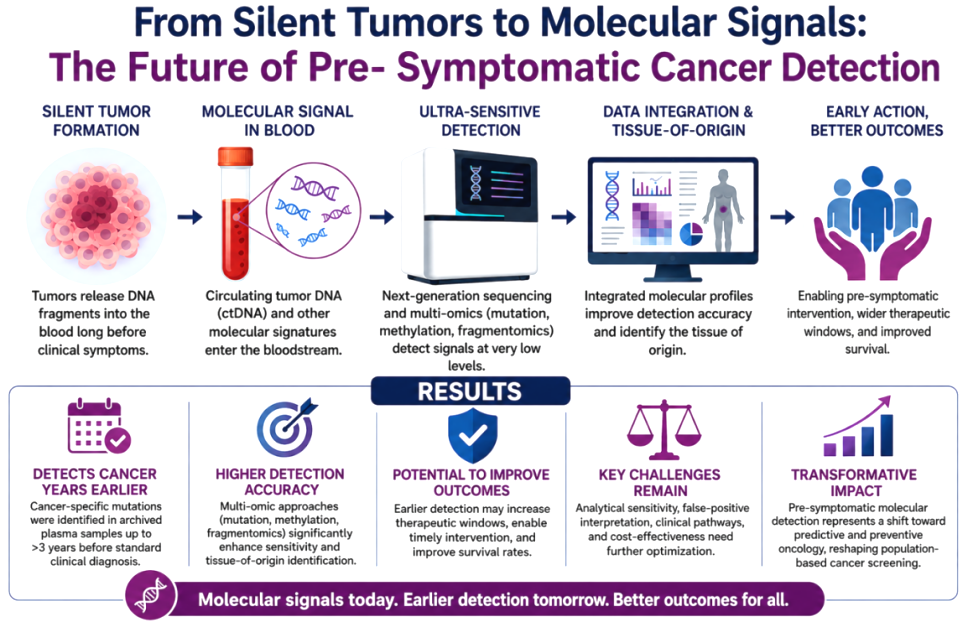
The latest developments in molecular oncology are revolutionizing the world of cancer diagnosis as they create an opportunity to detect tumor-related signals way before they have clinical effects. The circulating tumor DNA (ctDNA), which is released into the blood by cancer cells, can be now detected at very low levels by ultra-sensitive technologies based on next generation sequencing. Recent retrospective studies on archived plasma samples have also shown the existence of cancer-specific mutations over three years before standard diagnosis, and this highlights the high sensitivity of current genomic technologies. Multi-cancer early detection schemes incorporating mutation profiling, epigenetic methylation signature, and fragmentomic studies also improve the detection accuracy and tissue-of-origin identification. Despite of their great potential, there are still issues of analytical sensitivity, false-positive interpretation, clinical management pathways, and cost-effectiveness. The research highlights that pre-symptomatic molecular detection represents transformative shift towards predictive and preventive oncology with potential to increase therapeutic windows, enhance survival rates, and alter the conceptualization of population-based cancer screening.
Keywords: Cancer Screening, DNA Methylation, High-Throughput Nucleotide Sequencing, Molecular Markers, Risk Assessment, Personalized Medicines.
One of the most common causes of death in the world is cancer and survival rates depend greatly on the stage at which the cancer is diagnosed. The traditional diagnostic techniques, such as imaging, tissue biopsies, and screening based on the symptoms usually detect cancer when the tumors have already expanded 1. They are often silent early-stage malignancies that cannot be detected via conventional methods and do not give a chance to perform a curative intervention. These shortcomings have motivated the investigation of pre-symptomatic molecular detection strategies that can detect cancer in a state where intervention becomes more effective, survival is greater and the toxicity of treatment can be minimized 2. One of the first changes at the molecular level of carcinogenesis is epigenetic changes, especially aberrant DNA methylation. Global hypomethylation contributes to genomic instability, and hypermethylation of CpG islands of tumor suppressor gene promoters is responsible of gene silencing 3. Such changes in the methylation are preceding the clinical manifestation and are very cancer-type selective 4.
Notably, methylation tumor DNA biomarkers offer consistent and delicate markers that predict early cancer occurrence and tissue-of-origin 5. Circulating tumor DNA (ctDNA) has become one of the most popular emerging methods as a minimally invasive biomarker to detect cancer at an early stage 6. The ctDNA is composed of small fragments of DNA released by the tumor cells into the blood either by apoptosis, necrosis, or as a result of active secretion. Such fragments have tumor-specific genetic and epigenetic changes such as point mutations, changes in copy numbers, and patterns of DNA methylation, unlike normal cell-free DNA. Early cancer detection can be achieved using liquid biopsy, which is a type of noninvasive method that can be repeated over time to detect disease progression due to the presence of ctDNA in plasma 7. It has been demonstrated that ctDNA can be observed years prior to clinical diagnosis. Retrospective studies of archived plasma samples showed that tumor-specific mutations detected during diagnosis had already been apparent in plasma samples taken as many as three years earlier, but at a lower allele fraction. Such results highlight the remarkable sensitivity of the modern genomic technologies to detect silent molecular signals of cancer 8.
Multi-cancer early detection (MCED) tests are based on ctDNA profiling with epigenetic methylation signatures and fragmentomic analysis to improve detection sensitivity and prediction accuracy of the tissue-of-origin 9. Fragmentomics, the study of ctDNA fragment size and end motifs, has become another area of information that enhances the difference between tumor-derived DNA and normal cell-free DNA. Machine-learning algorithms combine mutation, methylation and fragmentomic data to produce predictive models that can identify various cancers using one blood sample. These combined methods have been clinically validated to be very specific in reducing false positives and possessing sensitivity to detect various types of tumors in their early stages when asymptomatic 10.
Although it has the potential, pre-symptomatic ctDNA detection has both analytical and clinical difficulties. False negatives may be caused by the low level of ctDNA in the early-stage tumors. False-positive signals may be generated due to biological noise, e.g. clonal hematopoiesis, and thus interpretation becomes difficult 11. Detection does not localize the tumor and one has to use follow-up imaging or tissue biopsy to confirm the presence of the tumor. Moreover, there are no standardized clinical pathways of positive ctDNA outcomes, and it has not yet been determined how early detection affects survival due to prospective studies. Ethical factors such as overdiagnosis and patient anxiety, cost-effectiveness and fair access to the technologies are major challenges. The use of ctDNA with other biomarkers, including circulating tumor RNA and proteins, and stringent bioinformatics and quality controls can enhance the accuracy of the assays and clinical reliability 12.
Before symptoms, there are enormous clinical consequences of molecular detection. Early cancer diagnosis enables procedures to be performed when the tumors are small, localized and when they can respond to curative therapy thereby enhancing survival and decreasing the intensive procedures of treatment. High-risk MCED screening at the population level would help increase cancer screening beyond high-risk populations, which would democratize access and may decrease inequalities in cancer outcomes 13. It is also possible to implement longitudinal ctDNA monitoring to identify the presence of minimal residual disease and recurrence that is used to alter treatment in accordance with individual patients. Multi-omic liquid biopsy data predictive models integrated with multi-omic data aid in individualizing risks stratified cancer management. Altogether, pre-symptomatic ctDNA detection is a paradigm shift in the domain of predictive and preventive oncology that changes the definition of population-based screening and clinical treatment 14,15.
To sum up, the possibility to identify silent tumors with the help of ctDNA, methylation patterns, and fragmentomic signatures provides an unprecedented chance to act prior to the onset of clinical signs of cancer. Although technical issues, clinical validation, and cost-effectiveness issues persist, the incorporation of multi-omic molecular detection into clinical practice can widen therapeutic indices, enhance survival, and transform oncology towards treatment, rather than proactive prevention. The future of genomic technologies promises to fundamentally change the paradigm of cancer screening and treatment as pre-symptomatic molecular detection is established to make precision oncology a population-wide reality.
In conclusion, pre-symptomatic cancer detection through ctDNA, DNA methylation patterns, and fragmentomic signatures represents a major advancement in preventive oncology. These molecular tools offer the potential to identify silent tumors before clinical symptoms appear, allowing earlier intervention and improved survival outcomes. Although challenges related to sensitivity, false positives, clinical validation, cost, and ethical concerns remain, the integration of multi-omic liquid biopsy approaches may transform cancer screening from reactive diagnosis to proactive, precision-based prevention.
Acknowledgement
None
Conflict of Interest
None
Grant Support & Funding Source
None
Use of Artificial Intelligence
The Graphical summary has been created by using OpenAI ChatGPT (GPT-4o) solely for the purpose of better illustration and scientific understandings. The corresponding author declared that no other artificial intelligence or AI-assisted tools were used anywhere in this manuscript.
Authors’ Contribution
KZ and ISU contributed equally as per ICMJE. Both authors gave final approval of manuscript to be published.

Journal of Biomolecules, Pathogenesis and Therapeutics, J Biomol Pathog Ther. 2026;2(2), p69-71 (jbptjournal.org) © 2026 Authors. This work is published by Multidisciplinary Scholarly Advancement and Research MSAR Institute. The full terms of Journal Publishing policy is available at https://jbptjournal.org/index.php/jbpt/-publishing-license and incorporate the Creative Commons Attribution – Non Commercial (CC BY, NC 4.0) License https://creativecommons.org/licenses/by-nc/4.0/. By accessing the work you hereby accept the Terms. Non-commercial uses of the work are permitted without any further permission, provided the work is properly attributed. Publisher’s Note: MSAR Institute remains neutral with regard to jurisdictional claims in published maps and institutional affiliations, and assumes no liability for the scientific accuracy or clinical efficacy of the content herein, as they rest entirely with the authors.